- Saturday, 6 June 2026

Using AI For The Sake Of Humanity

We bade farewell to 2025, the final year of the first quarter of the 21st century, with a blend of hope and despair. Irrespective of the global politics, which is indeed an everyday sensation, if there is anything figured out most, the impacts of climate change and information technology come at the top.
The scope and speed of information knew no bounds to usher in humanity to digital euphoria, while the recent years have witnessed the spurt of artificial intelligence (AI) and the subsequent dog-eat-dog atmosphere has seen increasing urgency of ethics, responsibility and containment of AI overtures. Similarly, the biodiversity loss, air pollution and climate change have been dubbed three major planetary crises when it comes to the environment, humanity and ecosystem.
Connectivity at scale
The first quarter recorded unprecedented global connectivity. The internet, largely limited to academic research in a few developed countries before 2000, is now available to over 6 billion (over 70 per cent) people on the planet. It is said that hardly 7 per cent of the world's population had internet access in 2000. Now, life without the internet is unthinkable. The development and expansion of IT further led to the production and availability of digital data, internet bandwidth and extension of related infrastructures, accelerated digitisation and digitalisation campaigns, and importantly, the continued research and increasing investment. It prepared a solid base to spur the AI expansion this quarter. The applications run over the internet, including ChatGPT and DeepSeek, have taken development to a new stage.
The importance of the internet and its expansion was felt as a pressing need during the global pandemic of COVID-19. The pandemic, despite massacring humanity, reinforced the urgency of digital expansion to keep people in touch and transactions alive. The crisis played a role in augmenting investments in multifarious dimensions of the digital realm, including education, entertainment and conferences. A report projected the pace of the digital economy to be three times faster than the global economy, reaching some US $24 trillion in 2025. It accounts for 21 per cent of global GDP. It is a clear indication of how digital activities are stimulating the digital economy. With digital disruption already seizing global attention, AI has evidently been a force multiplier.
The tech platforms have emerged so powerful that their services have tethered billions to the screens, thereby creating a virtual life and business. Traditional values are fast losing relevance or in need of redefinition or adjustment for survival. Organisational behaviours have been revamped to ease the production and service to reach global consumers and audiences. On the other hand, the passive users of the digital/virtual contents are facing increasing vulnerabilities like cybercrimes, while the tech giants are strengthening surveillance capitalism, which, according to Harvard Professor Shoshana Zuboff, is a 'winner-takes-all' arena. Users' data are quantified by the tech platforms for the latter's regime-building.
The cost of modern technology on the environment is equally worrying. To feed data centres of AI ventures, huge amounts of energy are required. It further dents air quality with an alarming amount of emissions of carbon dioxide. Likewise, the information disorder characterised by deepfakes, mis/disinformation has paralysed the entire ecosystem of information. In the hands of rogue elements, the AI is certainly amplifying the chaos.
The widespread use of plastic has been a detrimental threat to the environment. The ecosystem is getting ruined by plastics everywhere. By 2050, scientists have warned that the ocean will have more plastics than the water animals. Although there is no denying that these 25 years were of exponential growth in IT, the incremental growth and development in science and technology pre-2000 cannot be belittled at all. The debates it plowed set an entrenched foundation for the present achievements in science and technology that bettered humanity at humungous scale.
The who- and what-ness of human was unlocked by a formidable 17th-century philosopher, René Descartes, with his seminal view: "I think, therefore I am". The discovery of truth or the scientific inventions has its roots in this statement, centering the 'thought' or the process and attitude to doubt that finally relates to existence and identify human. The philosophical foundation of thoughts was further given a boost through practice, unlocking human potential in science and technology frontiers.
What next?
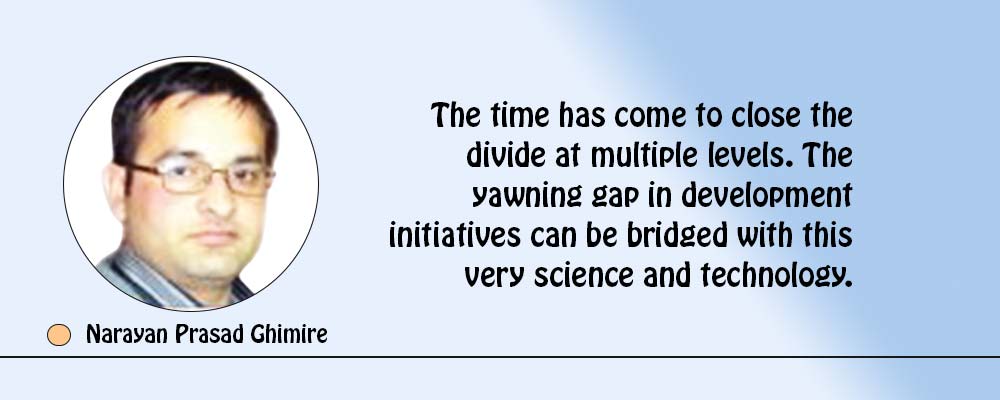
The time has come to close the divide at multiple levels. The yawning gap in development initiatives can be bridged with this very science and technology. AI needs to be utilised for the sake of humanity, elevating the livelihood of those most backward ones. Another crisis, climate change and its impacts, needs to be minimised through the wise use of AI. Development in one country and continent should not cost the other. For equality and the reduction of downsides of modern tech for better humanity, efforts are also going on at the regional and global levels.
Hundreds of events are held every year on climate change and artificial intelligence (AI), gathering governments, private sectors, climate scientists, technologists, and observers, among others, from across the globe. Although expected results are often elusive, the concern raised in the global events counts much to know how some countries are suffering the impacts of climate change and tech divides and some others are disproportionately developing best practices. With these two defining agendas of our time, the thought of what life will be like in the next 25 years or rest of the century dogs every conscious person. Let's hope the future will usher in betterment with the containment of the downsides of AI and climate change. It is testing time ahead for the world.
(Ghimire is an executive editor at the National News Agency (RSS)
-original-thumb.jpg)



-square-thumb.jpg)







-original-thumb.jpg)