- Tuesday, 2 June 2026

JICA Volunteers Strengthening Communities

The Japan International Cooperation Agency's (JICA) volunteer programme is playing a significant role in Nepal, with dedicated Japanese volunteers actively engaged at the grassroots level. Their efforts aim to support local development, enhance community resilience, and foster a lasting friendship between Nepal and Japan.
JICA volunteers are contributing in various sectors, bringing diverse skills and fresh perspectives to address local needs and promote sustainable development.
At the same time, they transfer their skills to the local communities and individuals and promote cultural exchange between the two countries. JICA volunteers thus act as powerful representatives for cross-cultural dialogue and collaboration.
Since 1970, more than 1,471 JICA volunteers—including both Japan Overseas Cooperation Volunteers (JOCV) and Senior Volunteers—have served across Nepal in the fields of agriculture, health advisory services, traffic safety, education, forestry, sanitation, sports, and community planning.
Currently, about 26 volunteers are working in local communities in Bagmati, Koshi, and Gandaki Provinces. Of these, four volunteers — including one in fisheries, two in education and one in fruit cultivation — are serving in Gandaki Province.
Advancing aquaculture research
JICA Senior Volunteer Yoichi Ohashi has been engaged in zooplankton research at the Fishery Research Station in Begnas, Pokhara, for the past year and a half, contributing significantly to aquaculture research in Nepal.
Ohashi arrived in Nepal in April 2024 and will continue his assignment until April 2026. With more than 30 years of experience in aquaculture, his expertise is being used to strengthen research on fish nutrition, fry growth, and overall fish productivity at the station.
According to Ohashi, zooplankton research plays a crucial role in enhancing the survival rate and growth of fish fry, which in turn directly impacts fish production.
His research focuses on identifying suitable plankton species and improving natural feed availability for inland aquaculture systems. However, the transfer of research-based knowledge to younger generations remains a challenge in Nepal.
He taught three young researchers during the period. “Even though the number of young researchers engaged in his research is small, I expect that each of them will share it with nine others, and those nine will further share it with 27 youths,” he said.
Currently, he is focusing on zooplankton research in four fish species — common carp, grass carp, rohu and naini. He said that although the experiment is being conducted on a small scale, it could be expanded on a larger scale.
His research shows that zooplankton is more effective than micro-feed in promoting the growth and survival of fish, particularly common carp and grass carp. According to the study, fish fed with zooplankton recorded higher growth rates than those given micro-feed. The survival rate was also significantly better when zooplankton was used as the primary feed.
He emphasised that the use of zooplankton can enhance fish health, reduce mortality and improve overall aquaculture productivity. Technical Officer at the Fishery Research Station, Begnas, Guna Bahadur Gurung, said that the senior JICA volunteer wanted to involve more youth in the research to transfer knowledge on fry production and increase fish output. However, very few young people showed interest.
“Only three youths were found to be interested in knowledge-sharing,” Gurung said.
The infrastructure of the Fishery Research Station was built by JICA with grant assistance in 1991. The station focuses on improving aquaculture, inland water management, and resource conservation while providing technical support to farmers and fishing communities in western Nepal.
It also produces fingerlings for distribution to the fish farmers. These fish seeds produced at Begnas Seed Production Centre have revitalised aquaculture in the Pokhara region's lakes, ponds and paddies, providing income and employment opportunities directly to more than 100,000 households.
Around 400,000 fry of various species—including common carp, grass carp, rohu and naini—are produced annually at the research station. The fry are sold to farmers at prices ranging from Rs. 1 to Rs. 2 per fry.
Digital learning, extra activities in schools
Currently, two Japan Overseas Cooperation Volunteers are supporting educational activities at Shree Ramrekha Basic School in Baglung and Shree Sahara Bal Basic School in Pokhara Metropolitan City, Kaski, focusing on youth activities and digital learning.
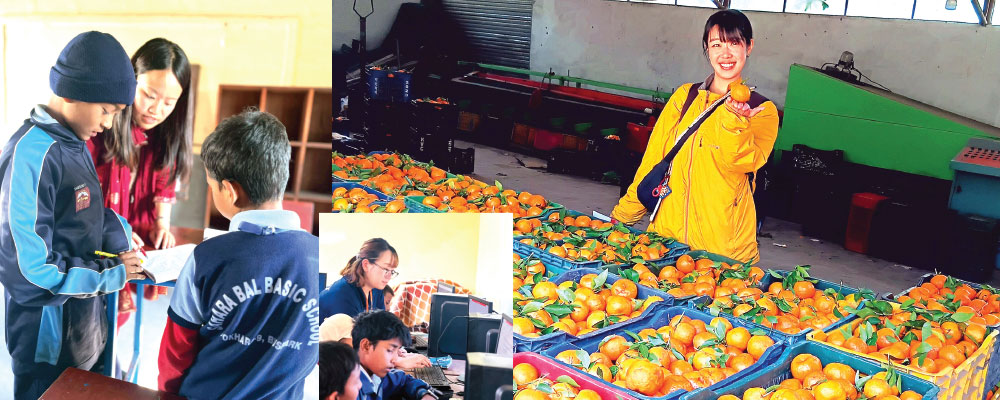
Honoka Tanimoto has been working at Shree Ramrekha Basic School in Baglung, which serves around 130 students from early childhood education to grade 8. The school has 12 teachers and mainly serves students from economically disadvantaged families.
As part of her assignment, Tanimoto conducts practical computer education classes for grades 4 to 8, teaching basic typing skills and applications such as Microsoft Word and Paint.
She also provides learning support during vacant periods at school by organising drawing and other creative activities. However, the school faces several challenges, including a limited number of functional computers, hardware damage, virus-related issues and a shortage of teaching staff. These constraints have affected the expansion of digital education.
Despite these challenges, her support focuses on strengthening students’ digital literacy, developing basic presentation skills and promoting participatory and enjoyable learning methods in the classroom.
Another volunteer, Anna Tsushima, is teaching at Shree Sahara Bal Basic School in Pokhara Metropolitan City, Kaski district. The school is located in a low-income area, where around 90 per cent of students come from economically vulnerable households, mainly seasonal labourer families. Some students are unable to receive regular meals at home.
Tsushima teaches mathematics to Grade 2 students and English to Grade 5 students. When teachers are absent, she also conducts extra activities such as arts, sports and music.
“Many students struggle to understand basic number concepts due to a lack of teaching materials. To address this issue, I created simple number block cards and introduced hands-on learning using concrete materials,” she said.
English lessons are conducted mainly in English, with support from Nepali teachers when necessary. This approach aims to improve students’ listening skills, although challenges remain in vocabulary and grammar acquisition.
Although extra activities are not currently part of the official curriculum, she plans to work with the school principal to introduce them once a week from the new academic year, as these activities allow students to express themselves freely and confidently.
Her goal is to develop a sustainable curriculum framework that can be continued by local teachers in the future.
According to her, she also plans to receive number blocks donated by Komagane City in Japan to strengthen students' understanding of number concepts and to conduct teacher training on the importance of hands-on learning and effective use of concrete teaching materials.
“I plan to improve my questioning techniques to help students to understand lessons more easily. In addition, I aim to increase opportunities for students to actively use English through speaking and output-focused activities,” she said.
Supporting post-harvest innovation
Likewise, volunteer Nagisa Kawajiri has been supporting fruit farmers in Syangja by promoting improved cultivation techniques and post-harvest practices suited to local conditions.
Kawajiri, specialising in fruit cultivation, has been assigned to the Agricultural Section of Putalibazar Municipality, Syangja, from August 2024 to August 2026.
According to her, she provides technical guidance on fruit and vegetable tree plantation, management, post-harvest handling and control measures for citrus greening disease and fruit flies.
Her key activities include disseminating educational videos on mandarin oranges, grapes, shiitake mushrooms and organic insecticides to improve farmers’ knowledge and skills.
Kawajiri has also initiated a refrigerated storage experiment for mandarin oranges by utilising underused refrigerators in the municipality. The project aims to reduce post-harvest losses and extend the sales period.
Previously, attempts to store oranges in refrigerators resulted in complete spoilage, leaving the facilities unused during winter. While traditional earthen and wooden storehouses are well developed in Japan, no successful refrigerated storage practices had been reported locally.
In this region, hand harvesting is common. However, the current experiment includes scissor harvesting to minimise fruit damage, the use of baking soda for its antibacterial properties to help reduce fruit decay, and a comparative evaluation of air circulation and humidity in plastic containers and wooden boxes.
According to her, they picked oranges in November, washed them with baking soda, and stored them in a refrigerator. Around 300 kg of oranges, which were stored using baking soda for its antibacterial properties, have remained safe so far.
Phani Narayan Aryal, proprietor of Triputra Bagwani Farm in Arjunchaupari Rural Municipality–1, Syangja, said that the support and experience shared by a JICA volunteer—from plantation to post-harvest practices—have been useful for farmers in Syangja.
“The technology using baking soda for orange storage is very simple and inexpensive. Based on the current condition of the oranges, we believe it is useful,” he said.
If proven effective, the technique could benefit farmers and traders by eliminating the need to sell oranges quickly at low prices during the peak season.
The technology for keeping oranges fresh for a long time is essential for Syangja’s farmers and traders, as orange production in the district exceeds Rs. 1.25 billion annually, he added.
Aryal, who has been engaged in orange farming for the past four decades, said that selling oranges in the off-season would fetch higher prices, encourage expanded cultivation, and reduce imports, benefiting both farmers and consumers.
According to him, orange prices are better this year than last year. Currently, farmers are selling A-grade oranges at Rs. 117 per kg and B-grade oranges at Rs. 70 per kg from his farm.
He grows oranges and coffee on more than 80 ropanis of land. He also buys oranges from other farmers and supplies them to various parts of the country, including Kathmandu.
He sold oranges produced in the orchard worth Rs. 6 million last year. Including oranges produced on the farm and those purchased from local farmers, he recorded orange transactions worth around Rs. 40 million last year.
He said that he has recorded orange transactions worth Rs. 35 million so far and expects that the total will cross Rs. 40 million this year as well.
Strengthening Nepal–Japan cooperation
Chief Representative of the JICA Nepal Office, Matsuzaki Mizuki, said that JICA volunteers have had a positive impact on local communities by sharing skills and knowledge.
This immersive approach not only supports socio-economic development but also strengthens cultural ties and mutual understanding between Japan and Nepal.
Mayor of Pokhara Metropolitan City, Dhana Raj Acharya, highlighted the impressive contribution of JICA volunteers in grassroots knowledge transfer and appreciated Japan’s support in sectors such as drinking water, sewerage management, education and others in the metropolitan city.
Joint Secretary at the Ministry of Agriculture and Livestock Development, Dr. Hari Bahadur KC, said that support from the Japan International Cooperation Agency (JICA) for physical infrastructure development in agriculture and other sectors has been contributing significantly to the growth of Nepal’s agriculture sector.
He added that assistance from the Government of Japan in human resource development and technology transfer, provided in line with Nepal’s requests, is highly commendable.
Dr. KC noted that the Japanese government has been offering opportunities for Nepali technicians to visit Japan to learn advanced technologies and apply them back home. JICA supports farmers in growing vegetables by providing volunteers and technical experts. This helps farmers learn and use commercial farming methods.
(Kafle is a journalist at The Rising Nepal.)


-square-thumb.jpg)