- Thursday, 21 May 2026

No prospect for changing election schedule

As Nepal prepares to hold elections to the House of Representatives on March 5, the country stands at a decisive political moment. Months of unrest, public frustration over governance, and the emergence of youth-led protests have raised fundamental questions about political stability, accountability and the state’s capacity to conduct credible elections. Following the dissolution of the House and the formation of an interim government, the Ministry of Home Affairs has been entrusted with the critical responsibility of restoring normalcy and ensuring a free, fair and fear-free electoral process.
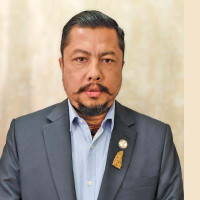
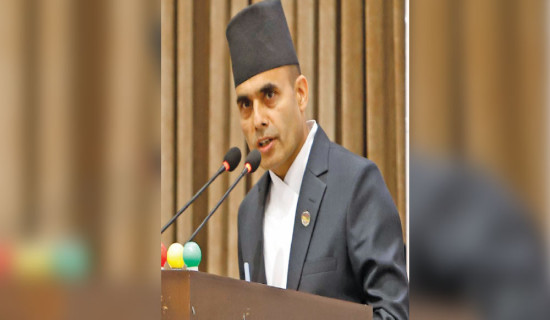
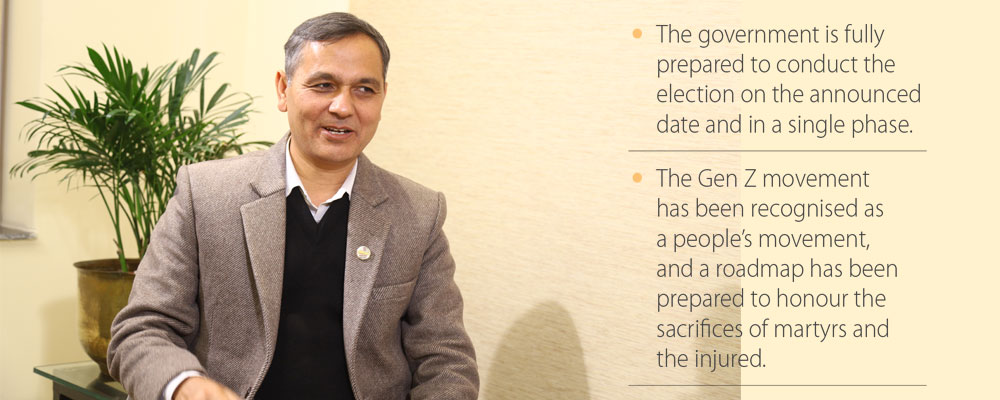
Peace and security remain at the centre of public debate. Issues such as escaped prisoners, looted weapons, coordination among security agencies, the morale of security personnel and engagement with youth movements continue to draw national attention. In this context, Pallav Bhusal of The Rising Nepal, along with a Gorkhapatra team, held an extensive conversation with Home Minister Om Prakash Aryal, who outlined the government’s security strategy, institutional preparedness and commitment to holding the election on schedule. Excerpts:
You assumed responsibility for the Ministry of Home Affairs at a time of serious political instability. Although the situation appears to be improving, concerns about peace and security persist. What preparations is the ministry making to ensure a free, fair and fear-free election on March 5, 2026?
To understand where we stand today, it is essential to recall where we came from. The events of September 8 and 9 placed the country in an extremely volatile and unpredictable situation. There was widespread fear that Nepal’s constitutional order, political stability and public safety were under serious threat. Citizens across the country felt insecure, anxious and uncertain. There was a genuine concern that large-scale violence, bloodshed and chaos could recur.
It was under these extraordinary circumstances that an interim government was formed. The responsibility entrusted to us was not merely administrative or political, it was a national responsibility. When we took office, institutions were weakened, public trust in the state had eroded and the morale of security agencies was low. Law enforcement structures had been attacked, police stations destroyed and authority openly challenged.
Our first and most urgent task was to restore the rule of law. This required decisive action, but also restraint. We focused on re-establishing institutional discipline, strengthening coordination among security agencies and reassuring citizens that the state was capable of protecting them. Gradually, public services resumed, the security situation stabilised and confidence began to return.
Today, I can state clearly that the necessary environment to hold the March 5, 2026 election has already been created. The situation is far more stable than it was during the unrest. Institutions are functioning, command structures are clear and coordination mechanisms are active. There is no basis for claims that security has deteriorated. On the contrary, the security situation has improved significantly and will be further strengthened as the election approaches.
Our overarching objective is to ensure that every citizen can participate in the election freely, without fear, intimidation or coercion. Removing doubt and restoring confidence in the state remains our central priority.
Compared to previous elections, how would you assess the level of security challenge this time? How has the Ministry of Home Affairs evaluated the overall situation?
Nepal’s democratic journey has always been complex, and elections have often been conducted under difficult and sensitive circumstances. If we reflect on our history, the first Constituent Assembly election held after the Comprehensive Peace Accord stands out as one of the most challenging. The scars of conflict were still fresh, armed groups were active and public confidence was fragile. Yet that election was held successfully.
Subsequent elections also faced serious obstacles. There were boycotts by political parties, sporadic violence, attempts to disrupt polling and deep political polarisation. Despite all this, elections were completed, demonstrating the resilience of Nepal’s democratic institutions.
In the current context, the primary challenge that emerged was political tension between younger generation, particularly Gen Z, and traditional political forces. Young people expressed frustration over corruption, weak governance, lack of accountability and limited opportunities. This frustration translated into protests and movements that, at times, escalated into confrontation.
However, this phase has now largely passed. Through dialogue, negotiation and engagement, representatives of the youth movement and the interim government reached an understanding. A political roadmap was jointly prepared, and there is now a shared commitment to addressing grievances through constitutional and legal means.
The fundamental principle guiding us is that elections are the ultimate democratic solution. Sustainable political change cannot be imposed through force or disruption. It must come through the ballot box. Those who enter Parliament through elections will bear responsibility for improving governance, strengthening institutions and responding to public aspirations.
At present, political parties, youth groups, civil society organisations and state institutions are all focused on the election. While vigilance remains essential, the overall atmosphere is more stable and constructive than confrontational.
You have been continuously participating in meetings of the Provincial Security Committees. Based on feedback and experiences from these meetings, have there been any policy or operational changes in security deployment compared to past elections?
These provincial-level consultations have been extremely important. We have already conducted comprehensive security meetings in most of the provinces, involving Chief Ministers, ministers responsible for internal affairs, chief secretaries, heads of Nepal Police, the Armed Police Force, the National Investigation Department, the Nepal Army and Chief District Officers.
During these meetings, we undertook a detailed analysis of the security situation in each province. We examined local dynamics, past experiences and present challenges. Where gaps were identified, directives were issued from the central level to address them promptly.
One of the most significant outcomes of these discussions was consensus on coordination and leadership. We agreed that the Chief Minister of each province would serve as the primary coordinator for provincial security. All security agencies will work in close consultation with provincial leadership and follow agreed roadmaps. This approach strengthens federal cooperation and ensures that security decisions reflect ground realities.
Equally important was our emphasis on coordination with local governments. Security cannot be imposed solely from the centre. Local representatives understand community dynamics and play a crucial role in early warning and conflict prevention. This inclusive approach has strengthened communication and trust.
Public cooperation has also been remarkable. More than 450 police stations and posts that were damaged or destroyed during the unrest have largely been rebuilt with the support of local communities and citizens. This level of public participation demonstrates renewed trust in state institutions.
At the same time, we have been working intensively to re-arrest prisoners who escaped during the unrest. A significant number have already been returned to custody. Most looted lethal weapons have also been recovered. These developments have substantially boosted the morale of security personnel and reinforced institutional confidence.
The issue of escaped prisoners and looted weapons during the youth-led movement remains a public concern. How serious is this challenge in terms of election security?
This concern is understandable, but it is important to view it in proper context. Yes, prisoners escaped and weapons were looted during the unrest. However, the situation has since been brought largely under control.
We have made substantial progress in re-arresting escaped prisoners. Importantly, we maintain detailed records of those who remain at large, including the severity of their offences. This allows us to prioritise our efforts strategically and allocate resources efficiently.
Regarding weapons, most of the looted items that have not been recovered are non-lethal, outdated or unusable, such as old tear gas launchers, damaged firearms and rubber bullet equipment. We have comprehensive data on what was taken and what has already been recovered.
The majority of lethal weapons have been recovered. The number of dangerous weapons still outside state control is limited and closely monitored. Based on our assessment, this issue does not pose a serious threat to election security and will not disrupt or prevent the polls.
At present, we do not view these initiatives as a major security threat. However, the Constitution is clear, maintaining law and order is the responsibility of legally mandated state institutions.
Our approach is based on prevention and dialogue. If any activity appears likely to escalate tensions or encourage violence, we will intervene early to prevent such outcomes. Dialogue remains our preferred option.
If prevention and dialogue are insufficient, we will act firmly but strictly within the framework of the rule of law. This is standard practice in democratic societies worldwide. Parallel authority, intimidation or violence cannot be allowed to undermine constitutional order.
How are the District Security Coordination Committees in all 77 districts being strengthened and made more election-focused?
These committees have been active for some time. At the national level, the Prime Minister chairs the National Security Council, which meets regularly to assess the overall security situation. Under my chairmanship, the Central Security Committee also meets frequently.
A unified security plan has already been approved and is being implemented nationwide. Election cells have been established at the local, provincial and central levels. At the provincial level, command posts led by chief secretaries and security chiefs are operational.
Joint patrols involving Nepal Police, the Armed Police Force and other agencies have already begun. However, deployment alone is not enough. Our approach prioritises trust-building with the public.
We are engaging closely with political parties, youth representatives and civil society organisations. Security becomes sustainable only when the public feels ownership and confidence in the process. At present, the overall security environment is stable and robust.
How many security personnel will be mobilised for the election, and how are logistical challenges such as transport, damaged infrastructure and morale being addressed?
Nepal Police, the Armed Police Force, the Nepal Army and Election Police will all be mobilised for the election. Election Police will be selected by Nepal Police and the Armed Police Force, with priority given to personnel who have demonstrated professionalism and integrity in previous elections.
Deployment will be determined by the sensitivity of polling stations and surrounding areas, following established electoral protocols. Higher-risk areas will receive enhanced security coverage.
Logistical challenges are being addressed systematically. Police buildings and vehicles damaged during unrest are being repaired or replaced. Efforts are also being made to restore morale through clear command structures, improved coordination and public recognition of the sacrifices made by security personnel. Confidence within the security forces is steadily improving.
What is the coordination mechanism among Nepal Police, Armed Police Force, Nepal Army, Election Police and the National Investigation Department?
Coordination is guided by a unified security plan developed by experts within the National Security Council. Roles and responsibilities are clearly defined. Nepal Police form the first security ring, followed by the Armed Police Force, with the Nepal Army deployed when necessary.
The National Investigation Department plays a crucial role in intelligence gathering and analysis. Over-mobilisation is avoided, as excessive visibility can itself create tension. Advanced technologies, including drones, are under discussion, and non-lethal equipment will be prioritised.
Training is also being emphasised, including disaster management, to ensure professionalism and preparedness under all circumstances.
A total of 133,980 election police are being recruited. How are they selected to ensure they are not influenced by politics, and how will they be mobilised?
We have established clear selection criteria, which Home Ministry has approved. These criteria are designed to eliminate any external influence and ensure that election police are selected fairly and transparently. Regarding postings, whether at polling stations, villages, or wards, there should be no suspicion, as most personnel will be experienced officers. All rules and procedures are documented in the official working guidelines, which will be reinforced during training to ensure compliance.
In past elections, security has been classified as sensitive, very sensitive, or acceptable. Is security this time determined solely by past patterns, or is the current environment considered?
We are coordinating closely with the Election Commission to develop appropriate security strategies. As the primary constitutional body responsible for elections, the Commission is independent, and we provide all necessary support to ensure a free and fair process. Likewise, we expect the Election Commission to facilitate coordination with civil society and political representatives. Discussions with these institutions are ongoing to maintain a secure and transparent electoral environment.
Why wasn’t security sensitivity determined based on geographical difficulties? In remote areas, mobilising security personnel or transporting materials may be challenging. How will such situations be managed?
We have prepared for rapid reinforcement of security where needed. In many remote areas, ballot boxes may have to be airlifted, and the security forces are ready for immediate deployment in any emergency. The allocation and mobilisation of personnel will depend on ground realities. Police deployed at key locations such as jails and airports will also be available as required. These measures are already incorporated into the unified security plan.
The government has pledged to conduct the elections without shedding a single drop of blood. How will it respond if there is an attempt to capture polling booths, create unrest, or disrupt voting?
Security forces will operate strictly under the rule of law. Rules of engagement dictate how and when the force may be used. International law and national policies guide all actions, the aim is to prevent violence and casualties among both citizens and security personnel. Force may only be used for self-protection or to maintain security, never to intimidate the public.
Due to extreme cold, some polling stations in 28 Himalayan districts may face difficulties. Mobilising personnel and ensuring voter access could be a problem. Is the government prepared to conduct second phase of elections in these areas?
No. The President has mandated that elections be held within six months of the formation of the interim government after the dissolution of the House of Representatives. The scheduled date of March 5, 2026 falls within this constitutional timeframe. While minor issues may arise at some polling stations, the government is fully prepared to conduct the election on the announced date and in a single phase.
Will there be further discussions to hold the elections in a simpler way or on an alternative date?
No. There is no scope for changing the schedule. The President has authorised the government to hold the elections on the assigned date. Both the government and the Election Commission are working towards this, and all political parties and representatives are expected to adhere to this timeline.
Some youths have expressed dissatisfaction with your working style. How will you ensure the elections are successful while including all parties?
Some have even called for my resignation, which I welcome, as it strengthens my determination to work harder. I believe my tenure demonstrates effective governance. There has been no repetition of political or social violence, and lawlessness has been replaced with order under the rule of law. Appointments and transfers within the government have been transparent and non-controversial.
We have engaged with Gen Z representatives, bringing their voices into mainstream politics and governance. The concerns of martyrs’ families and those injured in movements have been treated with utmost respect. While we continue to receive constructive advice, even critics now recognise the positive work of my ministry. Our focus remains on inclusive, lawful, and secure elections.
Finally, what message would you like to convey to voters, political parties, the Election Commission and security agencies for the success of the election?
Every stakeholder has a responsibility to ensure the success of this election. The country has emerged from a serious national security crisis, and the contribution of security agencies deserves recognition.
Traditional political parties suffered losses but chose restraint over revenge. Protesters also endured hardship but ultimately agreed to move forward within constitutional and legal frameworks. The Gen Z movement has been recognised as a people’s movement, and a roadmap has been prepared to honour the sacrifices of martyrs and the injured.
Going forward, the Constitution and the rule of law must prevail. No one should seek revenge. Accountability must be ensured strictly through legal processes. I urge all citizens and political actors to place national interest above all else and work collectively towards peace, stability and national progress.