- Sunday, 3 May 2026

Stone Age tools found in Tuhi Valley, Dang
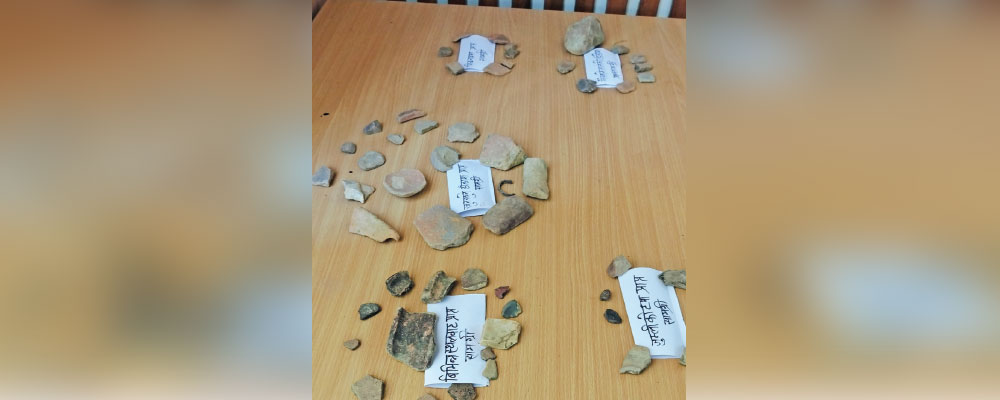
Photo: Gokarna Paudel Earthen artefacts found in the Tuhi Valley during excavation.

By Gokarna Paudel,Tulsipur, Jan. 7: Important evidence of human civilisation has been found in Dang district's Tuhi Valley. Remains from all three periods, Palaeolithic, Mesolithic and Neolithic, have been explored here.
The materials were found during a preliminary cultural and archaeological survey conducted by a team led by Prof. Dr. Dilliraj Sharma of the Department of Nepali History and Archaeology at Tribhuvan University.
According to Prof. Dr. Sharma, stone tools, blades, axes, small weapons, fragments of ancient pottery, stone structures and remains of water-flow systems have been found in the valley.
This evidence supports the gradual evolution of humans from nomads to community-based settlements in this area, Sharma said. The survey also incorporates findings previously studied by foreign researchers.
In 1978 (2035 BS), Randy Holland and Robert M. West studied Mesolithic small tools at 17 sites in the area, while Gudrun Corvinus had studied prehistoric stone tools approximately 40 years ago.
The team spent a week studying sites of prehistoric importance, including Gidhanya, Naukhane Tal, Devali Puja Hill, Satale Dhunga, Jhakri Dhunga, Khunkhune Dhunga, Barakuti, Raja Kot, Janti Dhunga, Jumli Kot and Sitadehi in Ward No. 13 of Tulsipur Sub-Metropolitan City. According to historian Ashok Tharu, a member of the study team, evidence suggests that settlements existed here during the Neolithic period, that the technology of making stone axes and weapons had developed, and that tools were produced using metal through clay-burning techniques.
Mohan Bishwakarma, an executive member and local resident of Tulsipur Sub-Metropolitan City, said that the area contains ancient stones, three oak trees, a place where a king once threshed rice, signs of a canal built from a stream in Til Kanya Lake, and evidence linked to early animal domestication.
Team coordinator Prof. Dr Sharma said the sites are at risk of extinction due to forest expansion, rain-induced landslides and human activities, and urged the authorities to immediately demarcate and conserve them.
He suggested conservation through the Department of Archaeology, inclusion in the local curriculum, student-centred research, collaboration with the forest sector, and incorporation into the five-year plan based on their educational, tourism and historical significance.
Tika Ram Khadka, Mayor of Tulsipur Sub-Metropolitan City, said the subject of Tuhi Valley has already been included in the local curriculum and that the sites where artefacts have been found will be protected.




-square-thumb.jpg)