- Friday, 17 April 2026

Educational opportunities and Musahar children in Nepal

Narayan Kumar Shrestha 
The Musahar community has faced systemic marginalization, including bonded labor and denial of basic rights such as land ownership, citizenship, and access to public services. These structural barriers directly impact children’s access to education, as families struggle with poverty and lack of resources to send children to school.
Even today, many Musahar parents often squatters and illiterate themselves, are landless, poor, and socially marginalized. They survive on daily wage labor, seasonal migration, or informal work. In such conditions, children’s education becomes secondary to household survival, and the family sees education as meaningful within their social and economic reality.
Musahar children enter school with their mother tongue, while teaching is conducted in Nepali or Maithili language. In early grades, children struggle to understand lessons; this results in poor academic performance, grade repetition, and eventual dropout. Teachers are rarely trained in multilingual or culturally responsive teaching, and Musahar culture is largely absent from textbooks and school activities. These are abstracting factors, reducing motivation to continue education.
Inside school, Musahar children face caste-based discrimination, being seated them separately, mocked by peers and, at times, by teachers on their language and appearance, or poverty, even discouraged from participation, and treated as weak students. This increases feelings of alienation in classrooms, irregular attendance, early dropout, especially among girls. In addition, early marriage, domestic responsibilities, and an unsafe environment, particularly for girls, further limit their educational opportunities, beyond primary level.
Musahar children’s exclusion from education is not due to a lack of legal provisions, but due to weak implementation, absence of targeted support, and failure to address structural disadvantages. Incentive interventions such as providing free textbooks, school meals, or transportation, scholarship facilitation, early-grade language support, and government relief programs for kids can go a long way in reducing school dropout rates. This results in improving children's overall active participation.
Grassroots NPOs such as Global Nepal can chip in to improve the socio-economic condition of the Musahar communities by implementing skill-based training and livelihood support programs for Musahar women with practical skills in tailoring, handicrafts, agro-processing, and small-scale enterprise management. Such training enables women to generate sustainable household income, improving family resilience and directly supporting children’s educational needs, including school enrollment, regular attendance, access to learning materials, and school-related expenses.
Beyond individual training, the formation of women's groups or farmers' cooperatives as community self-help groups (with a group consisting of 15-25 members) where, each member comes together to save collectively on a monthly basis, pooled savings are then distributed as loans among the group members, enabling them to invest in income-generating activities, managing household needs, or covering unforeseen expenses. In this way, the socio-economic status of Musahar communities uplifts, where education is a priority.
Agriculture is the backbone of Nepal’s economy, employing a significant portion of the population. It is important to focus on modern agriculture in Terai too. However, the sector faces numerous challenges, including low productivity, poor infrastructure, market access issues, limited technical manpower, and limited technological adoption. To address these issues and promote sustainable agricultural development, collaboration among key stakeholders across various sectors is necessary to create an enabling environment that accelerates agricultural transformation by improving productivity, market access, promoting enterprise-led employment creation, and enhancing value chains.
Global Nepal's locally grounded action through "Agri Transformation" in Dhading is a real example. Here, youth engagement should be a key priority, as climate change, inadequate infrastructure, and an aging farming community inhibit agricultural potential despite a growing population and increased demand for food. The work to address these issues by supporting farmers and farmers' cooperative groups to scale their production using sustainable technology solutions and increased access to finance, presenting agriculture as a promising and profitable livelihood opportunity for young people.
In Musahar communities, there's a need to encourage youth to participate in agriculture, as exactly like on the Agri Transformation initiative, provide incubation and financing for young entrepreneurs who are developing agritech solutions to address smallholder farmers' challenges. Also, award grants and offer ongoing support and mentorship to strong growth stage agritech innovators. By positioning agriculture as a tech-driven, an aspiring career, making this sector more appealing to the next generation and catalyze agricultural transformation in Terai region.
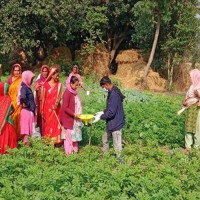
Development can be done differently. Advance climate-smart vegetable farming practices, i.e., provide training to local farmers from marginalized and indigenous communities, especially from Musahar families, in essential crop farming techniques, including tomato leaf trimming and side shoots, as well as practical guidance on pest control being focused on leaf miners (Tutaabsoluta) and diseases like late blight. Additionally, empower women through financial and digital literacy training to manage small businesses and access markets, carpet weaving training to enhance their economic opportunities. By strengthening farmers' livelihoods beyond extreme poverty or daily subsistence-level struggles, Musahar families would be able to send their children to school, purchase learning materials, or support extracurricular learning.
Connect women to government relief schemes, educational supports, and parental awareness programs, ensure marginalized families are out of extreme poverty, and help to prevent school dropouts among children from economically vulnerable households. Local governments, community leaders, and grassroots organizations are coordinating to make education an attainable and meaningful opportunity; also, parents themselves are creating solutions like supporting children's learning at home. Moreover, education policies are being implemented through community-led and locally accessible mechanisms; in this way, Musahar children are exercising their right to education fascinatingly.
Overall, in recent days the Musahar (alleged Dalit) families are transiting from marginalization toward economic stability, social inclusion, and educational opportunity.
[The author is pursuing M. Phil. in Development Studies from Kathmandu University School of Education]

-original-thumb.jpg)

-original-thumb.jpg)