- Thursday, 30 April 2026

Kathmandu comes alive for Paha Charhe
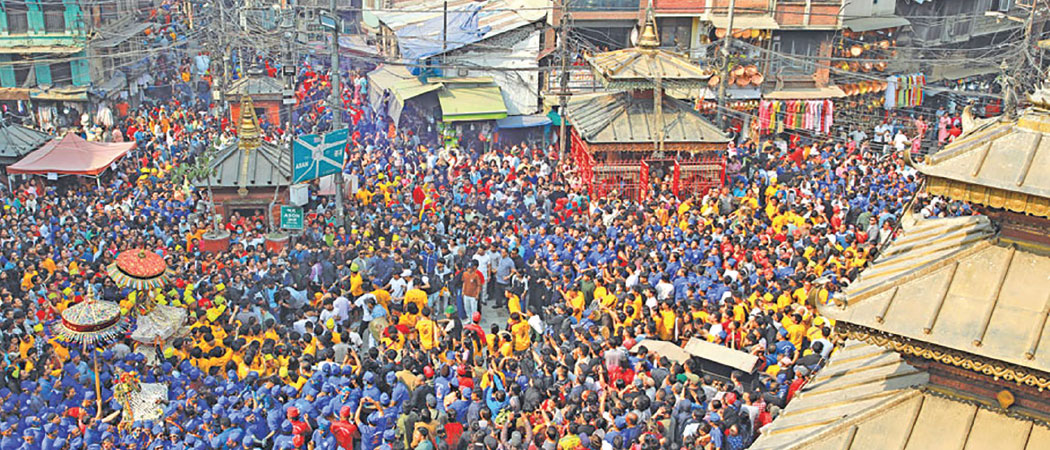

By A Staff Reporter,Kathmandu, Mar. 18: The Paha Charhe festival, celebrated by the indigenous Newa community of the Kathmandu Valley, began on Tuesday.
One of the main features of the festival is the worship of Luku Mahadyah, a hidden form of Mahadev. The head of the household worships this deity by offering sanctified food items, including meat and wine, and by holding feasts.
During the festival, a masked dance is also performed at the Dabali in front of the Nyata (Naradevi) Temple in Kathmandu. The dance, which starts in the evening and continues throughout the night, is known as the Nyatamaru Ajima Pyakhan or the Swet Kali Dance.
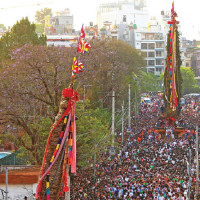
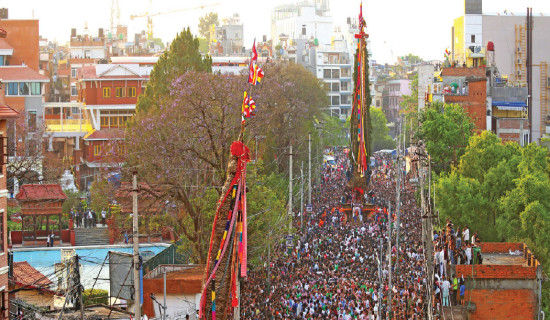
On the day of Ghode Jatra, the palanquins of three Ajimas—Kanga Ajima, Luti Ajima, and Lumadhi Ajima—are carried to Tundikhel, accompanied by a musical procession. This is also the day when people invite their married daughters to their homes and honour them with a feast. The horse parade and acrobatics performed by the Nepali Army at the Army Pavilion in Tundikhel add to the festive atmosphere.
On the last day of Paha Charhe, which falls on the day after Ghode Jatra, the palanquins of the three Ajimas, worshipped as mother goddesses, are brought together at Ason via specially designated routes.
The chariots are then crashed into each other in a ritual known as ‘Dya Lwakegu’. This is believed to represent the three sister goddesses meeting once a year.
Sujit Bajracharya, a local resident of Ason, said that each Ajima’s carriage is carried by members of the community in which she resides. These carriers, along with the musicians and other devotees who accompany them, are distinguished from members of other communities by the colour of their caps. Three localities are responsible for carrying the three Ajimas, and they wear red, blue, and yellow caps as a mark of identity.
In Nepal Bhasa, “Paha” means guest and “Charhe” refers to the fourteenth day of the lunar fortnight.
In addition to these traditions, individual families also worship various gods and goddesses during the festival, mainly Bhadrakali, Sankata, Mahankal, Seto Machhindranath, Bagh Bhairav, Kaal Bhairav, and Swet Bhairav.
Kankeshwari Ajima (Kang Ajima) holds an important place in the historical and cultural heritage of Kathmandu. The temple is located on the banks of the Bishnumati River and is considered one of the eight Ashtamatrikas of Kathmandu.
When King Gunakamdev built the city in the shape of a sword to protect it, he established eight Ashtamatrikas in the eight directions, of which Kang Ajima (Chamunda) is one.
In Newa culture, the Guthi system protects the temple and conducts the Jatra. The main Jatra of Kankeshwari Ajima is held during Paha Charhe. During this time, the Guthi is responsible for making the Ajima’s khat, performing rituals, and conducting a city procession.