- Saturday, 6 June 2026

Rani Community Forest emerges as study centre
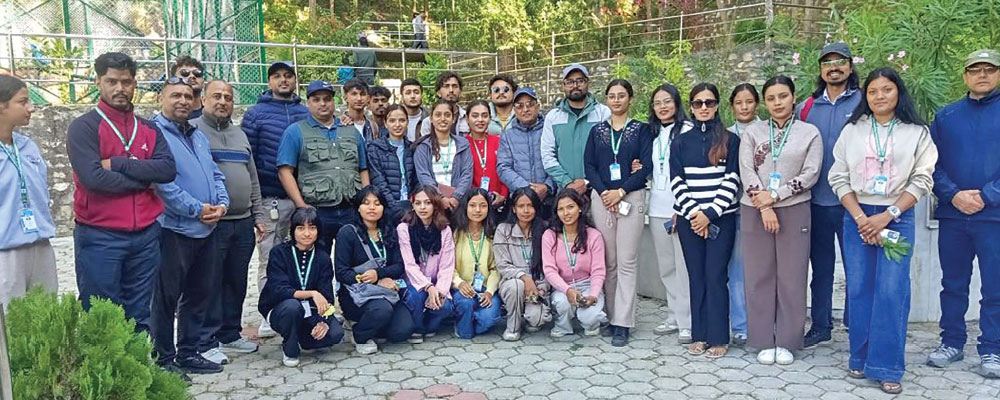
Photo: Anil Parajuli. BSc Forestry students from Sudurpaschim University observing Rani Community Forest during a study visit.

By Anil Parajuli,Hetauda, Jan. 4: Rani Community Forest in Chaughada, Hetauda Sub-metropolitan City-6, is gradually emerging as a study and observation centre due to the practices adopted by user group in forest conservation, management and community development.
The forest has become a popular destination for study visits because of its effective conservation efforts, transparent forest product distribution system, strong institutional development and active participation of forest users. These model practices have made the community forest a learning site for researchers, students and practitioners.
The forest has attracted not only domestic visitors but also foreign nationals. Teachers, students, forestry officials, community forest representatives and visitors from academic institutions of 50 districts of the country have visited the site for study and observation.
Educational institutions such as Kathmandu University and Pokhara Campus regularly send students for field visits.
According to the user group, visitors from Thailand, China, India, Australia, Cuba and Finland have also toured the forest.
Group chairperson Keshab Dhital said a total of 579 study and observation teams have visited Rani Community Forest so far. During observation visits, participants are briefed on forest conservation and management, institutional development, women’s participation, income generation, non-timber forest products, pangolin conservation, eco-tourism initiatives, social activities, and the national and international awards received by the group, Dhital said.
Basanta Raj Gautam, Forest Officer at the Division Forest Office, Makwanpur, said Rani Community Forest stands out among nearly 400 community forests in the district.
He said the forest has made an outstanding contribution to the conservation of the endangered pangolin, sustainable forest management and biodiversity protection at the community level. He also praised the forest for enhancing Makwanpur’s identity at both national and international levels.
Recently, a team of third-semester BSc Forestry students from the School of Natural Management under Sudurpaschim University also conducted a study visit to the forest. The team, led by Assistant Professor Hemchandra Joshi, studied local forest management and conservation practices.
The community forest received the Ganesh Man Singh Forest Conservation First Award in 2000 (2057 BS). Since 2006 (2063 BS), the group has been actively conserving the endangered pangolin, which is listed as a protected species.
To promote eco-tourism and raise awareness, the group has constructed a pangolin cage in Block No. 5 and the BP-Ganesh Man Smriti Peace Park in Block No. 6. Pangolin statues have also been installed in Chaughada Bazaar and the Peace Park to promote conservation awareness.
According to the group, more than three dozen pangolins are currently found within the forest area. The forest is rich in valuable plant species. It also provides habitat for wildlife, including leopards, deer, porcupines, peafowl and the endangered pangolin.
Office Secretary Bhimsen Poudel said the group has contributed not only to forest conservation and management but also to women’s group formation, income-generating activities, institutional strengthening, health, education and social welfare programmes.
He added that forest users are actively involved in forest fire control and that savings and credit programmes are being run for women from disadvantaged backgrounds.
The forest earns more than Rs. 3 million annually through the sale of timber, bark and firewood, as well as from membership renewal and new membership fees.
The group has received several awards, including the Bagmati Province-level First Award in 2023 (2080 BS), the Forest Conservation Youth Award, the Forest Goddess Award, and various district-level honours.
Established in 1988 (2045 BS), the community forest was officially handed over to the community by the District Forest Office on January 5, 1994. Spread over 138 hectares, the forest currently has 850 member households.