- Sunday, 24 May 2026

Sociology Of Nepal's Labour Migration
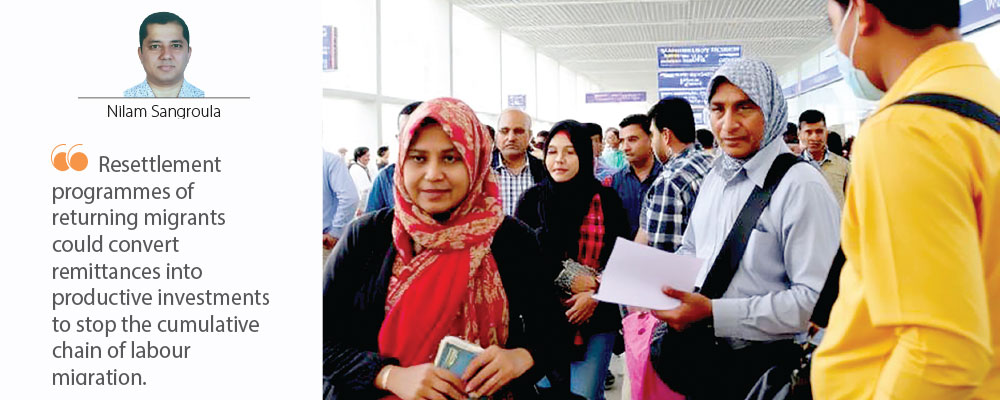

International migration for labour has become an integral part of Nepali society. Nowadays, it isn't easy to find a single household without a family member who has migrated abroad for labour. After the restoration of democracy in 1990 and the adoption of economic liberalisation along with the liberal migration policies, labour migration from Nepal increased drastically, which also coincided with the growth and the shortage of labour in the countries of the Gulf Cooperation Council (Bahrain, Kuwait, Oman, Qatar, Saudi Arabia, and the United Arab Emirates).
The unrestricted economic liberalisation opened the door for recruitment agencies and remittance companies to operate for profit. Labour migration from Nepal, in general, was further triggered by the decade-long conflict from 1996 to 2006. The economic uncertainty created by the devastating conflict and limited job opportunities within the border area push more people to seek livelihoods outside the country. The combination of internal economic, social, and political upheaval and external demand for cheap labour has created a favourable ground for labour migration.
Foreign employment policy
The six GCC countries and Malaysia remain the most popular destinations for Nepali labour migration, accounting for more than 85 per cent of the workers leaving Nepal. The enactment of the Foreign Employment Policy in 2019 has set new migration destinations to the USA, Australia, Japan, Korea and Europe (Cyprus, Malta, Poland, Croatia, Portugal, Serbia, and Bulgaria) for remittance. A total of 839,266 individuals received labour permits for foreign employment in fiscal year 2024/25. According to the Department of Foreign Employment (DoFE), the number includes 744,811 men and 94,455 women.
With the increase in the number of migrant workers, the country has also experienced an uptick in remittances, in absolute terms as well as relative to national GDP. Remittance inflows increased 19.2 per cent to Rs.1723.27 billion during 2024/25 compared to an increase of 16.5 per cent in the previous year. During mid-June to mid-July 2025, remittance inflows stood at Rs. 189.11 billion. The contribution of remittance to Nepal's GDP remained around 26.89 per cent.
According to Nepal's Ministry of Labour, Employment and Social Security, in 2023/24 alone, 460,102 Nepalis migrated to different countries for labour. The ADB studies have revealed that the impact of migration on paddy yield is negative and significant. Specifically, one additional migrant labour in the agriculture household is associated with a loss of about 163 kg per hectare of paddy. This is consistent with other studies that found the decline in agricultural production and the increase in agricultural wages due to the shortage of labour emanating from emigration.
A study estimated that around 37 per cent of arable land in Nepal is abandoned and one of the causes is due to the migration of youth for remittance. The negative effect of migration on agricultural yield may not have been compensated by remittances, as many studies found that migrants’ families spend about 72.3 per cent of remittances on daily consumption, 13.5 per cent on loan repayment, 2.0 per cent on buying household assets, 5.6 per cent on education and only 1.3 per cent on investments. Principally, high remittance inflows induced Dutch disease effects, i.e., the appreciation of the real effective exchange rate and shrinking of the tradable sector with respect to the non-tradable sector that leads to poor investment climate and low investments.
This eventually translates into low job creation at the origin and hence, increased migration for employment and remittance inflows. This inflow of remittance, however, hasn’t come without cost. The death of migrant workers in the foreign land is a challenging issue. Studies show that in just 10 months from July 2024 to April 2025, 1217 workers from Nepal lost their lives in the foreign lands. Labour migration is also associated with significant increase in divorce cases among migrant households. The Supreme Court, as well as district and high courts in Nepal indicates a surge in divorce cases, with the contributing factor identified as foreign employment.
Marxist theory views labour as a commodity that capital forcefully buys labour at the lowest possible cost that are not available in the domestic market. It extracts surplus value at the costs of workers’ lives. Many times, the capital discards the workers when it becomes unprofitable. This vicious circle in a capitalistic system creates a chain of continuous supply of cheap labour from the peripheral countries to the core countries. This trajectory creates a new international division of labour by sustaining capital formation in the core countries and creates an abyss of underdevelopment in the peripheral countries.
Thus, labour migration serves as a way to extend the extraction of resources from countries in the developing world. Marxist theory equates this process with the centre-periphery model, where the transfer of labour benefits core countries via cheap labour. Therefore, labour migration from peripheral to the core countries has become an integral part of capitalist reproduction to create global inequality. The global inequality creates a global hierarchy of exporting and importing nations. Therefore, the Marxist perspective on labour migration doesn’t interpret it as a catalyst for economic development; rather, it is an additional form of exploitation that contributes to the stagnation of the economy of countries that do not establish planned strategies for economic and social development.
The problem with the ruling political classes of Nepal – both rightists and leftists, and policymakers – is that they view labour migration solely as an economic activity. They pick up on the flow of the remittance into the country as an indication of the nation’s development. However, I believe that the remittance creates short-term benefits only for the households and the nation as a whole. It nurtures the culture of policy laxity among the policymakers. The repulsive part of the labour migration is that it creates a vacuum of workers in the home country.
Nepal is currently witnessing a demographic dividend, a situation when the working-age population is larger than the non-working age population (14 years of age and younger and 65 years of age and older). According to National Statistics Office, in 2025, the share of the working-age population constitutes 65.2 percent of Nepal’s total population, while the non-working population accounts for 34.8 percent in 2021. Nepal has to take advantage of this demographic opportunity. But unfortunately, we are sending our workforce abroad only for remittance.
Structural consequences
The dehumanising state policy regulates migration in such a way that it benefits the interests of capitalists by maintaining a vulnerable workforce. Therefore, migration for labour is not simply an individual choice; it is precipitated by the structural consequences of exploitation and inequality in the place of origin. This dependency creates the silent compulsion of economic relations that forces migrants to sell their labour abroad to feed their families back home, further posing a serious risk of becoming dependent solely on the migrants.
On the other hand, the spending culture of the remittance receiving households is creating a consumerist culture. People of migrants’ family spend the hard-earned money on acquiring and displaying perishable goods and services with the primary purpose of flaunting their wealth and social status. The remittance economy has been encouraging the state to focus on exporting its workforce and maintaining a remittance-driven economy rather than investing in production, innovation, growth and job creation. Resettlement programmes of returning migrants could convert remittances into productive investments to stop the cumulative chain of labour migration. In a nutshell, remittance is just a wobbly crutch rather than a panacea for development challenges.
(The author is a PhD scholar at the NIU-Noida, India.nsangroula@gmail.com)

-square-thumb.jpg)