- Saturday, 2 May 2026

Govt turns September protest into peaceful polls
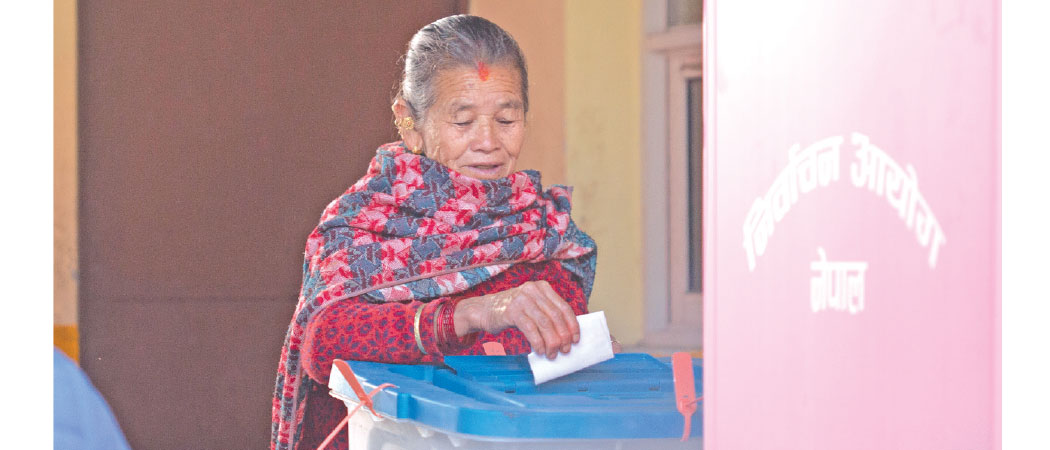

By A Staff Reporter,Kathmandu, Mar. 7: Against the backdrop of last year’s intense youth-led protests and fears of renewed unrest, the nation on Thursday successfully conducted the House of Representatives (HoR) election in a remarkably peaceful and bloodshed-free manner.
The nationwide vote held on 5 March 2026 passed without major clashes, violence or political confrontations. Many analysts and security experts observed that the nation’s political leaders and youth can transform a period of political turbulence into a democratic process.
Although vote counting is still underway, the Election Day itself witnessed only a few minor incidents. Security personnel fired warning shots into the air in one or two locations to control disturbances, but no casualties or large-scale disruptions were reported anywhere in the country.
Government officials and election observers have described the voting process as orderly, calm and largely free of intimidation. Minister for Home Affairs Om Prakash Aryal said the peaceful atmosphere demonstrated the effectiveness of the government’s preparations and the public’s commitment to democratic norms.
“The primary objective of the government was to ensure that the election is conducted without violence or bloodshed, and that goal has been achieved,” Minister Aryal said after voting concluded.
Political analysts say the peaceful outcome was not accidental. Rather, it was the result of several political and social developments that gradually redirected public anger into democratic participation.
Indra Adhikari, security and defence expert, said the election came six months after the country was shaken by the youth-driven Gen Z protests on September 8 and 9 last year, which eventually led to the collapse of the then government. But it was surprising that the nation successfully concluded the election process of the transition period without any major political turbulence and any unscrupulous activities during the Election Day, Adhikari said. The formation of a neutral caretaker government played a critical role in reducing political mistrust and calming tensions on the streets, she added.
Security analyst and retired Nepali Army Brigadier General Keshar Bahadur Bhandari said the interim government provided an institutional framework that helped prevent further escalation.
“The country needed a constitutional outlet for the frustrations that had built up during the protests,” Bhandari said. “Holding elections under a neutral interim leadership helped shift the political contest from the streets to the ballot box.”
Another important turning point came on December 11, 2025, when representatives of the interim government and leaders of the Gen Z protest movement reached a 10-point agreement aimed at addressing key political and governance concerns.
The agreement helped ease tensions by acknowledging many of the issues raised during the protests, including demands for greater political accountability and institutional reforms.
More importantly, it encouraged protest leaders and supporters to pursue their agenda through democratic participation rather than continued street agitation.
Analysts say the agreement effectively transformed a protest movement into a political force competing within the electoral framework.
Youth participation instead of confrontation
One of the most striking aspects of the election was the large participation of young voters. Many of the youths who had taken to the streets during last year’s protests later turned to electoral politics as a means of pushing for change, said former DIG Keshav Adhikari.
Election officials estimate that nearly one million new voters were added to the electoral roll ahead of the vote, a significant portion of them young citizens voting for the first time.
Rather than continuing confrontational protests, many youth groups focused on campaigning, political debates and supporting candidates who reflected their aspirations, said Adhikari.
Political observers say this shift from protest politics to electoral engagement significantly reduced the likelihood of violence during the election.
Robust security and administrative coordination
Extensive security deployment and careful planning by the authorities also contributed to the peaceful conduct of the election, claimed Joint Secretary and Spokesperson for the Ministry of Home Affairs, Ananda Kafle. The government had placed the Integrated Security Plan-2082 for ensuring free, fair and independent elections, he said.
Security agencies mobilised personnel across the country to safeguard polling centres, transport ballot materials and ensure a safe environment for voters. Over 325,000 security forces were deployed this time, he said.
Despite isolated incidents, including a few warning shots fired by security personnel, law enforcement agencies quickly contained potential disturbances, claimed Joint Secretary Kafle.
Digital mobilisation over street confrontation
Bijay Limbu Senihang, cyber security expert, said another notable feature of the election period was the growing role of digital platforms in political mobilisation.
After restrictions on social media were lifted, youth groups and political activists increasingly relied on online platforms to organise campaigns, communicate with voters and promote political agendas.
This digital engagement reduced the need for mass street demonstrations and helped channel political energy into campaign activities rather than confrontation, said Limbu.
-square-thumb.jpg)
-square-thumb.jpg)
-square-thumb.jpg)