- Friday, 29 May 2026

EV inflow continues at icy Korala
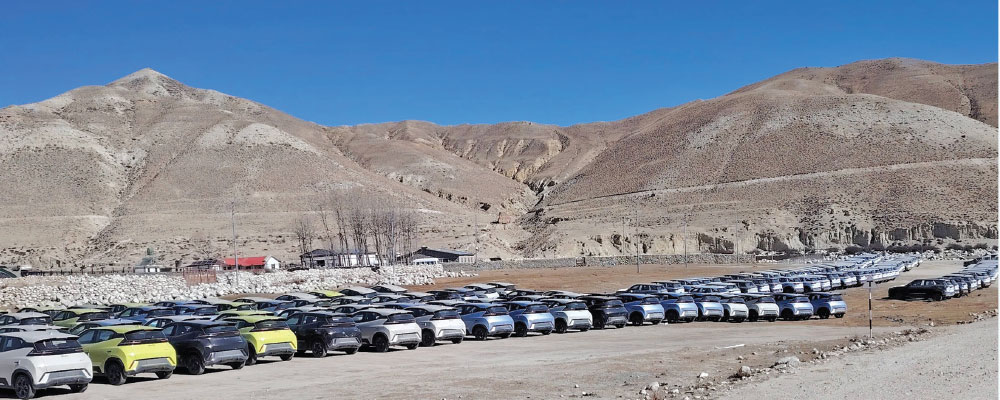
Photo: TRN BYD electric vehicles parked at the yard of Mustang Customs Office in Nechung, Chhoser, Lomanthang Rural Municipality–2, Upper Mustang.

By Harikrishna Sharma,Mustang, Dec. 26: Despite temperatures plunging to as low as minus 15 degrees Celsius in the mornings and evenings, electric vehicles (EVs) continue to enter Nepal in large numbers through the Korala border point in Upper Mustang.
Local traders operating around Pillar No. 24 along the Nepal–China border have already moved down to lower regions to escape the extreme cold.
Settlements including Chhoser and Lomanthang, which are usually lively, have fallen silent.
Hotels and restaurants in densely populated areas along the Korala–Jomsom road section have also shut down for the winter. However, while human activity has declined sharply, the inflow of electric vehicles from China’s Tibet Autonomous Region remains steady.
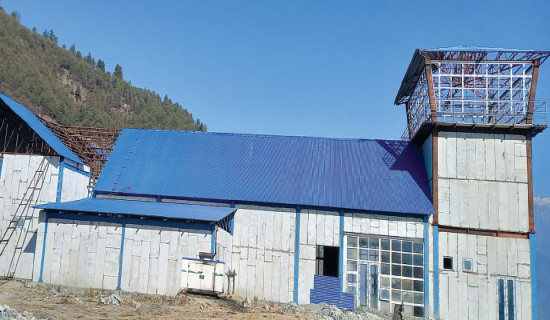
According to the Mustang Customs Office, around 200 electric vehicles have been cleared through customs at Nechung, Lomanthang Rural Municipality–2, over the past three days alone.
Customs Chief Ramesh Khadka said that more than 100 Chinese BYD vehicles are currently parked at the customs yard awaiting clearance.
“The pressure of electric vehicles is high. Despite the extreme cold, we are continuing the clearance process,” Khadka said.
Contrary to expectations that imports would decline during the month of December-January, the office has been receiving regular consignments of EVs along with trucks and containers carrying equipment and other goods.
With more shipments expected via the Korala crossing, the customs area has remained busy with vehicle drivers. Most EVs are driven directly to Pokhara after clearance.
Due to the freezing cold, charging stations built for electric vehicles are also experiencing heavy demand.
Drivers are compelled to break ice that forms on the road while transporting cargo trucks and EVs along the 14-kilometre stretch from the Korala border point to the customs office during the morning and evening hours.
The Mustang Customs Office has collected more than Rs. 4.97 billion in revenue as of December 23. During this period, a total of 1,974 electric vehicles and goods carried by 1,620 containers have been imported.
On the export side, 121 cargo vehicles and containers carrying Nepali-made handicrafts, garments and other products have been dispatched, according to Customs Information Officer Amindra Singh.
Although the Korala border point was formally inaugurated on November 13, 2023, it came into full commercial operation from September 15 of the current fiscal year.
However, poor road conditions along the 186-kilometre Korala–Jomsom–Beni road section have created difficulties for operating large containers. From Korala, vehicles must travel 251 kilometres to reach Pokhara, the capital of Gandaki Province.
Located at an altitude of 4,650 metres above sea level, the Korala border point had remained closed since the 1960s after the Khampa protest using Nepali territory.
Since its commercial reopening, the customs point has generated employment opportunities and boosted trade and exports for residents of Upper Mustang.