- Saturday, 6 June 2026

'Film co-production needed to deepen Nepal-China cultural relations'
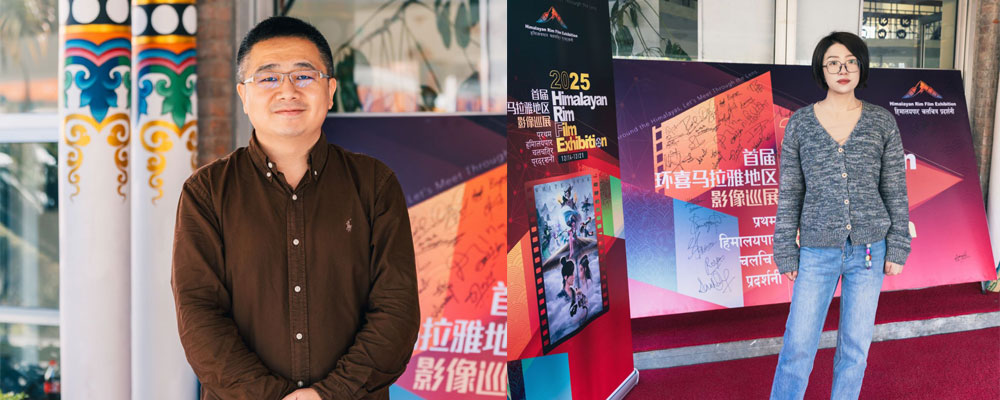
Jia Yuanyuan (Tony Jia), Overall Coordinator of the 2025 First Himalayan Rim Film Exhibition, Deputy Editor-in-Chief of 1905 Network Technology Co., Ltd and Li Qian (Nikita Li), Chief Curator of the Cultural Creative Display Zone for the 2025 First Himalayan Rim Film Exhibition, Deputy Editor-in-Chief of 1905 Network Technology Co., Ltd. were in Nepal for the weeklong Himalayan Rim cinema show that ended on December 21.
The Rising Nepal online held a short interview with Jia
and Li about the film exhibition and their experiences.
Excerpts:
Jia Yuanyuan
(Tony Jia):
Is this your first time in Nepal?
Yes, it’s my first visit, and I am deeply impressed
by the warmth of the Nepali people and the richness of the local culture.
How has your accommodation been, and how
are the activities and film screenings going?
The accommodation has been quite comfortable. During
the exhibition, audience interaction has been very active, especially during
the ‘Post-screening Creator Connection’ sessions, where Nepali students asked
questions that were both insightful and full of curiosity.
Your understanding of cultural relations between Nepal and China
Nepal and China are friendly neighbors connected by
mountains and rivers, with a long-standing cultural relationship deeply
nourished by Buddhist culture, Silk Road civilization, and the regional culture
of the Himalayas. Today, this relationship is reflected not only in traditional
fields such as art and folklore but also extends into modern society through
education, tourism, media, and more, forming a cultural resonance of ‘sharing
landscapes, respecting nature, and advocating harmony.
The role of film exchange in promoting
cultural relations
Film is the most intuitive medium for cultural
dialogue in contemporary times. By screening Chinese animated films in Nepal,
we hope that animation can transcend language barriers through visuals and
storytelling, allowing Nepali audiences—especially young people—to understand
Chinese values and contemporary life through universal emotions such as family,
friendship, and courage portrayed in Chinese stories, thereby promoting a more
multi-dimensional understanding of Chinese society among the Nepali public.
Specific suggestions for strengthening
cultural relations
Regarding specific suggestions for strengthening
cultural relations, we believe progress can be made in three key areas: First,
promote China-Nepal co-productions of films or documentaries focusing on issues
of mutual concern such as Himalayan ecological conservation and historical
figures, deepening cultural resonance through audiovisual language. Second, actively
utilize social media platforms to plan and launch topic-based columns and short
video series related to China-Nepal culture, fostering daily interaction and
exchange between the people of both countries, especially among the younger
generation. Third, continuously expand multi-level and multi-form exchange and
visitation programs, encouraging practical cooperation in fields such as
education, art, and cultural tourism, so that cultural relations continue to
thrive through dynamic interaction.
Li Qian (Nikita Li):
Is this your first time in Nepal?
This is my second time in Nepal. My first visit was
not long ago, for site reconnaissance in preparation for the exhibition, so it
was quite rushed.
How has your accommodation been, and how
are the activities and film screenings going?
After returning to China from the last
reconnaissance trip, I realized I had unknowingly gained 3 jin (about 1.5 kg).
Even though it was just a few days, Nepali cuisine left a deep impression on
me. The activities have been progressing very smoothly this time. The film
screenings have received enthusiastic responses, with Nepali teachers and
students showing great interest in Chinese animation. In particular, the
audiovisual effects and narrative styles of films like White Snake and The
Legend of Hei 2 sparked in-depth exchanges and discussions among the audience.
How do you understand the cultural
relationship between Nepal and China? How can film exchanges contribute to
this?
Nepal and China share the Himalayas, and their
cultures have been closely connected since ancient times. As an important
carrier of contemporary culture, film can intuitively convey emotions and
values, bringing the peoples of the two countries closer psychologically.
Through this film exhibition, Nepali audiences can gain a more direct understanding
of China’s contemporary creative industries, while also providing a dialogue
platform for creators from both countries, promoting content cooperation and
technology sharing.
What suggestions do you have for further
strengthening cultural relations?
It is recommended to carry out more regular cultural
exchange programs in the future, such as co-produced films, youth film talent
training programs, and mutual participation in film festivals. Additionally,
organizing online screenings and seminars can help overcome geographical
limitations and make exchanges more sustainable.






-original-thumb.jpg)
-original-thumb.jpg)