- Sunday, 3 May 2026

World Increasingly Embracing Meditation

Meditation is a science that brings peace to the mind and stability to consciousness. It originated in the Himalayan region of the Indian subcontinent. Because meditation is unique in both practice and understanding, and is based on a deep exploration of the human mind through experiment and direct experience, it does not have an exact literal translation in many Western languages. For a long time, it was narrowly understood as concentration or fixing the mind on a single object. In reality, meditation is a science of consciousness, deeply connected to lived experience in a broader and more holistic sense.
The art of meditation evolved within the unique geographical, cultural, and spiritual environment of the Indian subcontinent. From India and Nepal, it spread to Tibet, China, and East Asia. The Himalayan region, in particular, has always been fertile ground for meditation traditions.The first known teacher of meditation is Adi Guru Shiva, who is regarded as the original master of this science. The earliest documented record of meditation techniques is found in the Vigyan Bhairav Tantra, which describes 112 meditation methods taught by Shiva. These methods form the foundation of nearly all meditation techniques that followed. Later, teachers developed their own systems based on these original methods. Even Buddha’s Vipassana and Anapanasati practices are rooted in principles found in the Vigyan Bhairav Tantra.
Patanjali
Another major revolution in the world of meditation came with Patanjali. He organised meditation into a systematic eightfold path leading to the highest state of consciousness, samadhi. Today, Patanjali’s yoga is often misunderstood as merely physical postures and breathing exercises. In truth, those physical practices, later developed as Hatha Yoga by Swatmarama and Gheranda, represent only a small part of the path. Patanjali’s yoga focuses on stilling the fluctuations of the mind and realising non-dual awareness, a state of deep inner bliss. His contribution lies in presenting meditation as a structured science, beginning with ethical and social discipline (yama and niyama), followed by purification of the body and breath, inward awareness, and ultimately realisation through samadhi.
After Patanjali, Gorakhnath made another significant contribution. From him emerged many meditation techniques, as well as the foundations of Tantra. All later meditation teachers, in one way or another, have drawn from the work of Shiva, Patanjali, and Gorakhnath. Even modern teachers such as S. N. Goenka, who popularised Vipassana and Anapanasati worldwide, ultimately work within the framework laid down in the Vigyan Bhairav Tantra.
In the last century, a new revolutionary teacher emerged: Osho Rajneesh. Osho adapted meditation to the realities of the modern age. Earlier meditation techniques were developed in a very different social and physical context. People lived closer to nature, engaged in intense physical labour, and led physically demanding lives. As a result, traditional meditation methods were largely passive and still, focusing on breath or awareness in silence.
Modern life is very different. Technology and convenience have made human bodies increasingly inactive. Most people sit for long hours, perform minimal physical labour, and live with accumulated stress, anxiety, and psychological tension. Osho recognised that passive meditation alone was insufficient for modern humans, whose bodies and unconscious minds are filled with suppressed emotions. These suppressed energies often erupt in destructive ways, including violence, depression, and self-harm.
Osho’s great contribution was the creation of Active Meditation techniques. He introduced cathartic methods involving movement, breathing, dancing, shouting, crying, and physical expression before entering silence. These techniques enable individuals to safely and consciously release deeply buried emotions. Initially, Osho faced strong criticism. Many argued that meditation must be silent and still, and that such expressive methods could not be meditation. Osho ignored traditional resistance and explained the scientific basis of catharsis and emotional release.
Today, more than 55 years later, the world is gradually recognising the value of Active Meditation. These techniques are now used in psychology, psychotherapy, sports training, military and police programmes, and stress management. Practices such as Dynamic Meditation, Kundalini Meditation, and Chakra-based techniques are widely used. They have proven effective in helping people quickly release stress and emotional blockages. Passive meditation methods such as Vipassana or Zazen often become more effective when practiced after active meditation.
Another major transformation brought by Osho was breaking the divide between householders and renunciates. Traditionally, society was divided into householders, who worked and supported monks, and renunciates, who meditated and guided society spiritually. Osho dismantled this separation by creating “householder sannyasins,” people who live ordinary lives while practicing deep meditation. Meditation no longer required retreating to caves or forests. It could be practiced at home and integrated into daily life.
In Nepal, meditation was long misunderstood as a religious practice meant only for monks or spiritual seekers. Some people believed meditation was tied to a particular religion. However, meditation is not about religion. A truly religious person, in this context, is someone who lives with love, compassion, nonviolence, and a desire to make the world better. Meditation is for everyone, religious and non-religious alike. Mental peace, emotional balance, and physical health are universal needs.
International Meditation Day
This perception is changing globally. Even in Muslim and Christian countries, yoga and meditation are increasingly accepted. Earlier fears of religious conversion are slowly fading, especially with global recognition such as World Meditation Day. For nearly 10 years, the author consistently advocated for the declaration of an International Meditation Day. He proposed that Nepal first declare a National Meditation Day and later present the proposal to the United Nations with support from other Hindu and Buddhist nations. He emphasised that Nepal’s leadership in this effort could enhance its global image and establish the country as a centre for meditation, similar to India’s role in International Yoga Day.
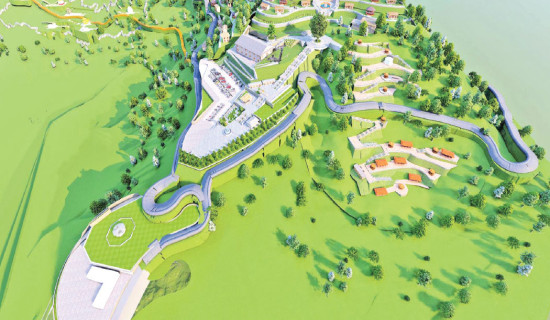
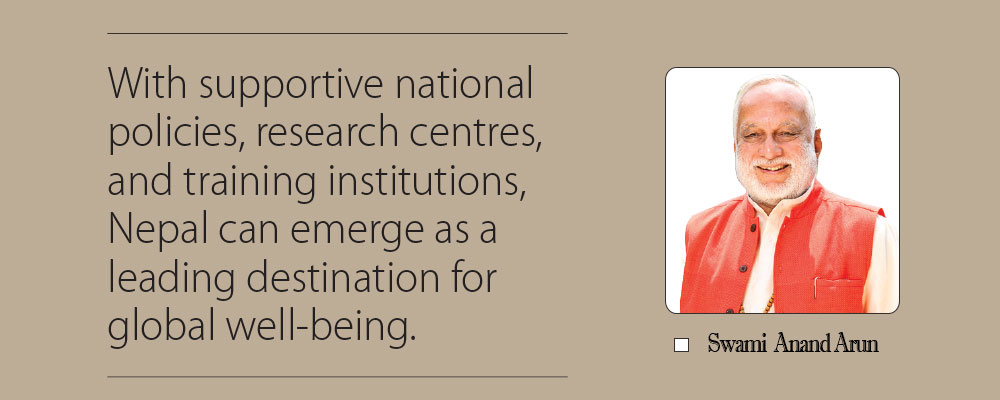
A breakthrough came in October 2024, when UN Secretary-General António Guterres visited Lumbini. Nepal’s Deputy Prime Minister and Home Minister, Narayan Kaji Shrestha, a well-wisher of Osho Tapoban, presented the World Meditation Day proposal, which was received positively. Two months later, on December 7, the proposal was passed, becoming a matter of national pride for Nepal. Meditation is not an imported culture for Nepal but an integral part of its original identity. With its mountains, forests, rivers, peaceful environment, and spiritual heritage, Nepal has immense potential to become a global centre for meditation. With supportive national policies, research centres, and training institutions, Nepal can emerge as a leading destination for global well-being.
(Swami Anand Arun is founding Acharya of Osho Tapoban, An International Commune and Forest Retreat Centre, Nagarjuna Hills)