- Sunday, 24 May 2026

How We Are Losing Privacy On Social Media

In this age of information and technology, social media has become an inseparable part of daily life. It has changed how we interact with one another and how we consume and share information. While social media offers numerous benefits, it has also given rise to serious challenges related to personal privacy. As the use of social networking platforms becomes increasingly widespread, concerns about security and privacy continue to grow.
Richard B. Parker, in his writing on privacy, states that “privacy is control over when and by whom different parts of us can be perceived.” By “different parts,” he refers to our body, our voice, and the products of our body. This also includes things that are closely associated with us and are accessible only to ourselves. Being “perceived by others” means being seen, smelled, heard, tasted, or touched by someone else.
Right to privacy
The right to privacy refers to an individual’s right to control the collection, use, and disclosure of their personal information. This includes the right to know what information is being collected, how it is being used, and the right to give or withhold consent for its use. In today’s context, where social media platforms collect and share user data, the right to privacy has become extremely important. In the current digital era, understanding and protecting these rights is essential.
Article 28 of the Constitution of Nepal (2015) guarantees the right to privacy as a fundamental right. The Constitution states that the privacy of a person’s body, residence, property, documents, data, correspondence, and character shall be inviolable except as provided by law. To effectively implement this constitutional right, the Privacy Act, 2018, and the Privacy Regulation, 2020, have also been enacted and enforced. Although these laws ensure the right to privacy of personal information, documents, correspondence, data, and character, they have not adequately addressed all sectors and aspects, nor have they fully covered data protection mechanisms.
Provisions related to the right to privacy are also included in other laws, such as the National Criminal Code, 2017, and the Organised Crime Prevention Act, 2013. Although the law has clearly recognised privacy rights, their implementation remains weak. At present, many people are neither aware of their own privacy rights nor of those of others. Influenced by misinformation and false news, people hastily express opinions and counter-opinions on social media without verification, which often drags themselves and others into legal trouble—knowingly or unknowingly.
Therefore, all citizens need to have basic knowledge about what privacy is, what the legal provisions are, what actions constitute a violation of privacy, and how these rights can be exercised and protected. Incidents involving the violation of privacy due to financial gain, greed, fear, intimidation, and threats have piled up at the Cyber Bureau. In the context of social media, the importance of privacy is often underestimated, leading to a rise in privacy violations.
News reports and anecdotal evidence reveal numerous incidents of privacy attacks against women and adolescents. The ability to post and repost information on multiple platforms has made it difficult for women to control and regulate the personal data they share. The viral spread of private photos and videos has become a common problem on social media. Many women have become victims of online violence. Cases involving economic exploitation, coercion, fear, harassment, and threats related to privacy violations continue to accumulate at the Cyber Bureau.
Today, social media platforms have become preferred spaces for hackers and other individuals involved in antisocial and criminal activities. These platforms provide vast amounts of personal data, ranging from birth dates, residential locations, and workplaces to family details and personal activities. In many cases, users unknowingly disclose information that can be both dangerous and inappropriate.
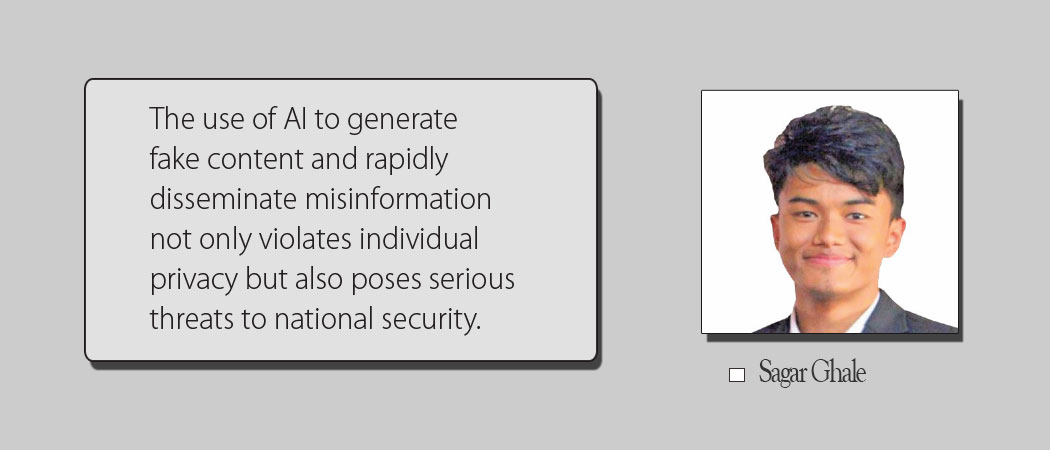
Emerging technologies such as Artificial Intelligence (AI) have also begun to interfere with personal privacy. The use of AI to generate fake content and rapidly disseminate misinformation not only violates individual privacy but also poses serious threats to national security. The failure to effectively protect human rights in the digital sphere and uphold the rule of law has significantly weakened both national and global security over time.
Why should social media privacy be a top priority? First, it is essential for identity protection. Publicly available information, such as birthdays, locations, and workplaces, can be combined by malicious individuals to steal identities or impersonate someone online, enabling them to exploit personal data for financial gain. Second, privacy helps prevent scams and phishing. Cybercriminals frequently use information found on social media to carry out fraudulent or phishing attacks, placing citizens’ financial and personal data at risk.
Risks
Third, privacy is crucial for protection against harassment. The more visible our activities and personal information are online, the greater the risk of unwanted contact, harassment, or stalking. Privacy and other rights guaranteed as fundamental rights by the Constitution and other legal provisions must be fully ensured. Media outlets and social media users must not present information or content that violates the privacy of victims, so that victims can continue to live in society with dignity and without fear.
Although humans are social beings, there is always a part of life that individuals wish to keep private or do not want to share with others. Everyone must respect this reality. In the pursuit of likes, followers, and online validation, we have gradually lost one of our most valuable assets—privacy. The natural boundary between our public and private lives has become increasingly blurred as we share more and more online.
From posting family photos to sharing our daily routines, we voluntarily expose personal moments to a digital audience that spreads far beyond our control. In the digital age, protecting privacy is not just important—it is essential. If we fail to do so, we risk losing both our freedom to manage our personal information and our ability to live real lives away from the constant gaze of the internet.
(The author is studying BALLB at National Law College.)