- Saturday, 2 May 2026

Voices Against Unilateralism

At the crossroads of a tectonic shift in the global power balance, nations need to cut the crap of a benevolent hegemon and scrap the related policies so pliantly followed for at least eight decades. Modernity is not necessarily — at least not invariably — what the West defines and does. Learn to respect where you want respect from others when dealing with sovereign nations, big or small, rich or poor.
Treatment on equal footing is the name of the game that is breached more than honoured in practice. Strategic interests cannot be at the cost of another nation’s core interests. Cultivating proactive strategic interests and defining them in accordance with expedient contexts and conditions echoes sheer hypocrisy. Validity of strategic interest should not be based on proactive expansion of its scope and interpretation flouting general norms and rules. Regional powers accuse bigger powers of activities they themselves inflict on weaker neighbours or distant nations.
Compromise should serve well. Not a pragmatic approach? Whatever the answers, the outcome is either peace or harmony against predatory tactics or the fuelling of conflicts. Connectivity requires not losing sight of the collective self as a nation or grouping. Hegemony is not a term exclusively engaged in by superpowers but also by lesser powers. For an individual country, the hegemons, whether regional or global, are bullies flexing muscles or brandishing economic sanctions, if not both.
Gaping gaps
Today, identity politics is making its presence felt all over the world. The US and Europe used to laud their emphasis on “melting pot” and “identity recognition”. Not any longer. Some of them make no qualms about the need for immigrants to “integrate” into their mainstream culture.
Reports from Washington have it that American President Donald Trump is mulling a new economic alliance called Core 5, consisting of the world’s five top economies. That would mean the US, China, Russia, Japan, and India. Russia and China are already in close cooperation sealed by “ironclad” emphasis just Pakistan and China are bonded by “all-weather friendship”. The US and Japan have had a strong rapport after they fought as enemies during World War II.
Uyghurs in China’s South-West Province of Xinjiang get regular coverage of sympathy and how the communist government there allegedly ill-treats them, encamped in prison-like conditions. Consistency is not in currency in the media's play up of an outright political nature. Known cases of regular torture and killings in “friendly countries” serving the strategic interests of some “advanced” democracies do not get the amount of deserving attention when serious misdeeds are perpetrated locally. Countries that dare defy foreign hegemony and interference are targeted for negative propaganda.
By now, it is well established that the Uyghur community is not discriminated, contrary to the narratives of elements sowing dissension for mass uprising that foreign sympathisers and sponsors might want. The world knows that China has been a one-party communist state since 1949, and has achieved what no Nobel Prize winner and legion of foreign experts ever indicated in the economic, technological, and diplomatic spheres it has achieved this century.
One’s objection is never against the media reports using facts with a due, all-rounded background. Only the despicable practice of angling stories for motivated purposes and lies is indefensible. Finding faults at every nook and corner of a target but overlooking something even worse elsewhere is professional prostitution in the case of news outlets, and an organised evil if a state is engaged in such unscrupulous practice.
Political patterns are changing, so are the pressures and pulls. Unity in diversity is melting in its value in the very countries that were at the forefront in promoting it with the loudest voices. Occasionally, adjustments and rarely compromises are called for, not to dominate or exploit a target country’s resources and cultural heritage but to address concerns over which there is a broad consensus. Compromise should prevent predatory tactics, which serve all well rather than only an aggressor. Another irony is that some regional powers accuse bigger powers of activities that they themselves inflict on weaker countries.
Checking exceptionalism
Is exceptionalism in cultural, political, economic and defence policies inherently Western privileges? For every action, there is a reaction, with immediate effect or in the long-term. Technology, energy and military power are the key elements of the power shift in the world order. The world can do well without any interventionist power.
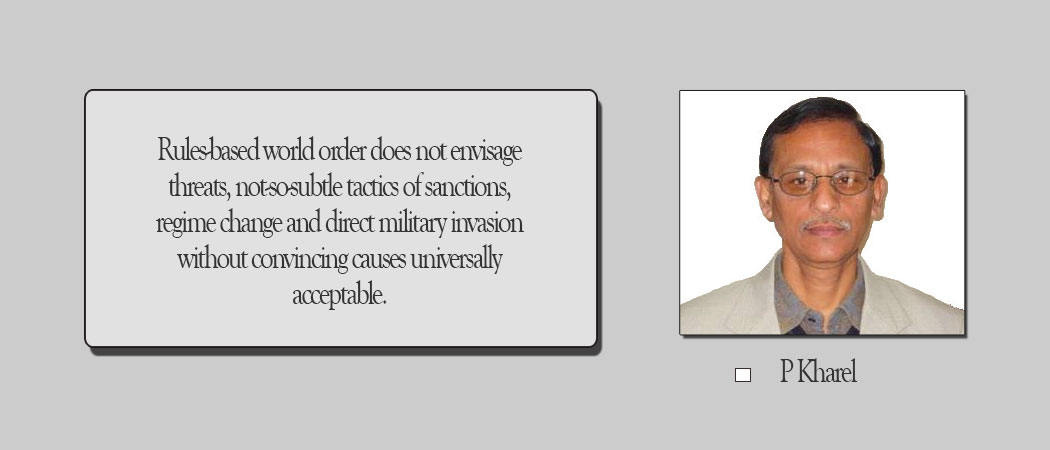
Perennial cheer leaders for the US for several decades, European nations are now voicing their dissenting views louder and more frequently. People will no longer allow arbitrary actions to go as predictably unchallenged as they did previously. Rules-based world order does not envisage threats, not-so-subtle tactics of sanctions, regime change and direct military invasion without convincing causes universally acceptable. But the world is in a position to survive with or without the once unquestioned global leaders in most spheres.
New partners are welcome, not necessarily by rejecting the traditional partners. Events in one corner of a continent can affect another spot elsewhere. That is the law of geopolitics. Geography might remain the same. Evolving politics involves new dimensions. Contain China and isolate Russia is a policy that has failed embarrassingly for the West. But the age of raw power is not yet all over. The likely logical outcome should be an open global secret.
(Professor Kharel specialises in political communication.)
-original-thumb.jpg)