- Friday, 5 June 2026

Conservation of 2,000-year-old King Birat’s Palace relics begins
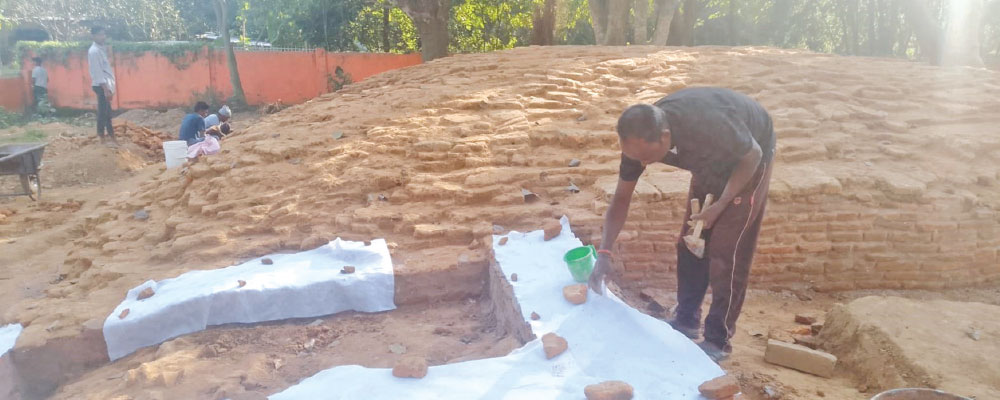
Photos: Shashidhar Parajuli Workers preserving archaeological structures in the Bhediyari area of Biratnagar, believed to be the historical palace area of King Birat.

By Shashidhar Parajuli,Biratnagar, Dec. 19: Conservation work has begun on a 2,000-year-old structure located in an area believed to be the palace of King Birat, in Bhediyari, Biratnagar-18, which holds significant historical and archaeological importance.
The Department of Archaeology has initiated the conservation work to prevent further damage to the structures dating back to the first and second centuries BC, discovered during the excavation of the historic ‘Bhediyari Dhisko.’
Ancient walls and chambers were first uncovered during excavations by the department in 1970 (2027 BS) and again in 2021 (2078 BS). The ongoing conservation aims to protect the structure, which has been deteriorating due to rain, sun, and human activity.
As part of the conservation process, workers are laying ‘geotextiles’ (special fabrics) over the ancient structures, covering them with new bricks, and making them watertight to prevent water infiltration.
Although local belief holds that this site was the palace of King Birat from the Mahabharata era, archaeological studies suggest it may actually be a temple.
Himal Kumar Upreti, Senior Archaeology Officer of the Lumbini Development Trust and the archaeologist assigned to this site, stated, “According to the excavation report by senior archaeologist Tarananda Mishra in 1970, there is a sanctum sanctorum of a temple here, and it appears to have been built in two phases.”
The structures were found to have been built in the first phase during the Shunga period (2nd century BC) and in the second phase during the Kushan period (1st century AD). According to Upreti, most of the bricks currently visible date from the Kushan period.
The 2021 excavation and geophysical survey revealed the foundation of a large structure in this area, measuring 46 feet long and 45 feet wide.
The ongoing work focuses on conservation rather than reconstruction. The walls, which were buried underground, risk rapid deterioration when exposed to the elements. Therefore, new bricks are being laid on top of the old ones to preserve them.
“We do not straighten old walls if they are broken or crooked. We preserve them in the condition in which they were found,” Upreti explained. “We place geotextiles in between to separate the old and new structures, so that future studies can easily distinguish the original from the restored parts.”
The bricks and mortar used for preservation are special. Instead of cement, a mixture of surkhi (brick dust), lime, and sand, in the ancient style, is used. The bricks themselves are much larger than modern bricks.
Hari Prasad Bhusal, an employee of the Department of Archaeology, stated, “The bricks used here were specially ordered from Kathmandu. They measure 32 to 40 centimetres in length. The bricks used in Lumbini were brought here.”
Currently, work is under way to cap the upper part of the main structure at Bhediyari to prevent damage by water. Some eight workers, along with a technical team, are involved, and the project is expected to continue until December 30.
“Our main challenge is to preserve this structure in its current state. It would be safe if it were buried, but then people could not see it. Therefore, we are raising some parts so they remain intact and can be displayed,” Upreti said.
Once the conservation work is complete, the area is expected to be developed as an open-air museum, allowing visitors to experience 2,000 years of history firsthand. The conservation techniques previously used in Kapilvastu have been adopted here as well.