- Sunday, 7 June 2026

From Rana regime to Gen-Z uprising
Overview of past elections in Nepal
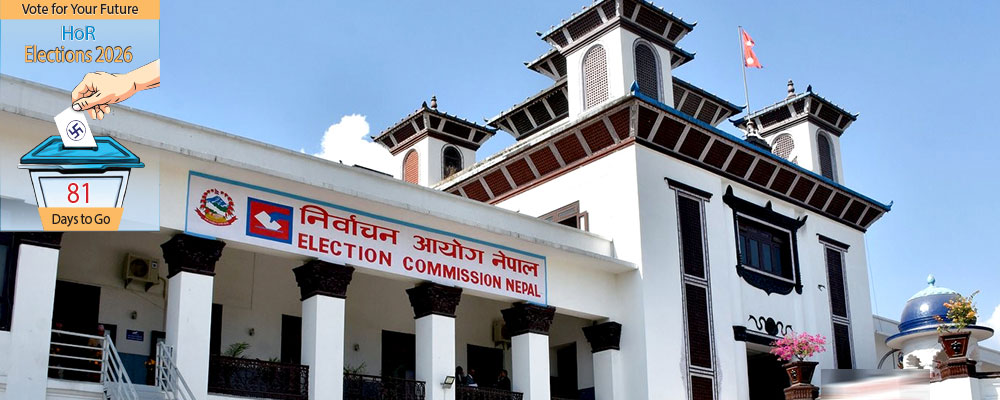
By Arpana Adhikari, Kathmandu, Dec. 14: Nepal’s history of election spans nearly eight decades. The foundation of Nepal’s electoral system was laid with the Nepal Government Act of 1948, which for the first time introduced elected bodies and granted voting rights to eligible citizens. The 1951 Interim Constitution established the Election Commission, giving it authority for voter registration, election and dispute management.
The country has conducted eight parliamentary elections since1959, when the first general election was held.
Since the restoration of multiparty democracy in 1990, seven parliamentary elections, with two elections to Constituent Assembly have been held, and now the country is gearing up for the eighth on March 5, 2026. However, it is the ninth in the nation’s parliamentary poll history.
Although elections were also held during the 30-year partyless Panchayat system, they lacked democracy in nature although the two last elections of Rastriya Panchyat in 1981 and 1986 saw overwhelming participation of people.
The March 5, 2026 election comes under different circumstances. Following the September 8–9 Gen-Z movement that toppled the elected government, the interim government led by Prime Minister Sushila Karki dissolved the House of Representatives (HoR) and announced the election to the House of Representatives. Experts see this as both a challenge and an opportunity, highlighting the importance of Nepal’s evolving electoral history.
First election
Nepal’s first election was held on June 1947, in the form of a Kathmandu Municipality election. Rana Prime Minister Padma Shumsher Jung Bahadur Rana had planned municipality over the country, but election was held only in Kathmandu Valley. Only men were granted voting rights, while women were excluded from the process, despite appeals made to then Prime Minister Padma Shumsher.
Ballot papers were distributed to households based on the number of registered voters. Separate ballot boxes were placed for each candidate, with each box marked by a different colour code and set up in open spaces. The voters turnout was 60 to 65 per cent.
The first parliamentary election
The first parliamentary election in Nepal was held from February 18 to March 11 in 1959. Conducted on the principle of a secret ballot, the 109-member House of Representatives was elected via the first-past-the-post system by citizens aged 25 and above, while the 36-member Upper House consisted of members aged over 31, with half elected by the Lower House and half nominated by the King.
It took 45 days to conduct the polls due to limited transport and technology. The final results were announced on May 11. The Upper House elections were held on June 30. Nine political parties fielded their candidates in 109 constituencies. Then the registered voters stood at 4.24 million and the turnout was 42.18 per cent.
The Nepali Congress won 74 seats in the House of Representatives and 13 seats in the Upper House, and a 19-member cabinet was formed under NC leader BP Koirala.
Candidates from six other parties and four independents were elected.
The election was managed by Chief Election Commissioner Subarna Shumsher and Election Commissioner Pradhumna Lal Rajbhandari. According to EC Information Officer Suman Ghimire, budgetary and other detailed records of the period are not available.
Rastriya Panchayat elections, 1975 and 1986
After King Mahendra introduced the Panchayat system by abolishing the 1959 Constitution and promulgating a new constitution in 1962, two elections of the 135-member Rastriya Panchayat were held.
According to the book entitled Nepal’s Election History, the 1986 election was conducted in three phases, with 9,034,583 registered voters and 1,548 candidates, including 73 women. A total of 11,394 polling centres were set up and around 50,000 election staffs were deployed. The election was largely peaceful.
1991 general elections
After the democracy was restored in 1990, the first general election was held on May 12, 1991 to elect 205 members to the House of Representatives. The Constitution of Nepal, 1990 had a provision of bicameral parliament. The polls took place in 205 constituencies and saw 1,345 candidates, including 80 independent ones.
Of them, only seven were elected. There were 11,191,777 registered voters, and the voter turnout was 65.15 per cent, with 4.43 per cent of the votes invalid.
The majority of the seats of HoR were won by Nepali Congress (NC), with 110 seats and CPN-UML won 69 seats. Total eight parties and three independent candidates secured seats in the HoR. The government led by NC leader Girija Prasad Koirala dissolved the parliament in July 1994, announcing a snap poll.
The mid-term parliamentary election was held on November 1994, with 24 political parties contesting the polls. Five parties and seven independent candidates won seats, with the CPN-UML emerging as the largest party by securing 88 seats, followed by the NC with 83 seats. The remaining seats were won by other three parties. UML leader Manmohan Adhikari became Nepal’s first communist Prime Minister after 1994 snap polls. Although 86 women contested the election, only seven were elected. There were 12,327,329 registered voters and voter turnout was 61.86 per cent with 3.14 per cent of invalid votes.
General elections 1999
Nepal’s 1999 general election was conducted in two phases on May 3 and 17, with 39 political parties contesting the polls. Six parties succeeded in securing representation at the national level.
The NC emerged as the largest party with 111 seats, while the CPN-UML won 71 seats. The Rastriya Prajatantra Party won 11 seats, and both the CPN (ML) and the Nepal Sadbhawana Party secured five seats each. Samyukta Janamorcha and the Nepal Majdoor Kisan Party won one seat each. Twelve women were elected.
There were 13,518,839 registered voters, with a turnout of 65.79 per cent and invalid votes at 2.75 per cent, the lowest recorded.
First CA election
The first Constituent Assembly (CA) election in Nepal was held on April 10, 2008 to promulgate the Constitution. There were 17,611,832 voters, with turnout of 61.70 per cent and invalid votes at 5.1 per cent. The CA had a total of 601 seats, with 240 filled through the first-past-the-post (FPTP) system, 335 through proportional representation (PR), and 25 nominated by the Council of Ministers. The then UCPN (Maoist) emerged as the largest party, winning 226 seats, and its leader, Pushpa Kamal Dahal, became the Prime Minister.
Following mergers with smaller parties, the Maoist tally increased to 240 seats. The Nepali Congress and CPN-UML secured 109 and 103 seats respectively.
Originally, 19 parties were represented in the CA, which later expanded to 32 due to splits among minor parties. Two independent candidates also won. The CA was ultimately dissolved in 2012 after failing to fulfil its mandate of drafting a new constitution.
Weeks before the election, political clashes across several districts turned violent, with attacks on candidates, activists, journalists and election officials. The report also documented many violent incidents, including explosions, particularly in the Tarai belt and hill districts. Around 50 deaths, more than 1,200 injuries and 100 kidnappings were recorded in the polls.
Second CA elections
The second CA election took place on Nov 19, 2013. The total registered voters stood at 12,147,865 and the voters' turnout stood at 78.34 per cent, with 4.96 invalid votes. There were sporadic violent incidents and disruptions across the country despite overall high voter turnout and largely peaceful polling.
The government led by the then chief justice Khil Raj Regmi conducted the polls. NC emerged as the largest party with 196 seats, while the UML and Maoist party came second and third after winning 179 and 80 seats respectively. Sushil Koirala of NC became the Prime Minister with the support of the UML. The second CA drafted and promulgated the new constitution of Nepal in September 2015.
2017 general election
The first parliamentary and provincial level elections under the 2015 constitution were held in two phases on Nov 26 and Dec 3, 2017. There were 15,427,731 registered voters with 68.68 per cent voters’ turnout and 5.16 invalid votes. According to the EC, Rs. 6.41 billion was spent in this election. Ayodhi Prasad Yadav was the chief election commissioner at that time.
Under the FPTP category 55 political parties and under PR 49 political parties participated in the elections, 165 lawmakers were elected under the FPTP system and 110 under the PR category. The UML emerged as the largest party securing 121 seats, while the NC came second with 63 seats. The Maoist party secured 52 seats. Soon after the elections, the UML and Maoist merged to form the Nepal Communist Party (NCP), the largest communist force in Nepal’s political history. KP Oli then became the Prime Minister. Altogether 10 parties reached the HoR.
Second general election
The second general election of HoR was held on November 20, 2022. A total of 57 political parties filed nomination papers to contest the polls. This election resulted in a hung parliament, with no single party securing an outright majority, leading to coalition negotiation among major and minor parties. NC won 89 seats, CPN-UML 78 seats, CPN (Maoist Centre) 32 seats, Rastriya Swatantra Party, 20 seats, Rastriya Prajatantra Party 14 seats, Janata Samajwadi Party 12 seats, CPN (Unified Socialist) 10 seats, Janamat Party six seats and Loktantrik Samajwadi Party, Nepal four seats.
There were 2,412 candidates including 225 women. The total registered voters stood at 17,988,570 and voters turnout was 61.63 per cent. During the election, 5.19 per cent votes turned invalid. A budget of Rs. 6.54 billion was spent. The election held under the leadership of Chief Commissioner Dinesh Kumar Thapaliya remained largely peaceful.
Challenges to upcoming elections
Dolakh Bahadur Gurung, former Acting Chief Election Commissioner and key figure in the 2008 and 2013 CA elections, noted that both polls were held in a post-conflict context and marked by security and legal challenges but were successfully conducted with cooperation from the government, Election Commission, political parties, and former Maoist rebels. Despite some boycotts, voter participation was strong.
He said the current situation is more favourable, with all major parties participating and voters actively registered. Gurung emphasized that successful elections depend on political dialogue, party engagement, voter participation, security, and the commitment of the government and Election Commission.
Former Chief Election Commissioner Neelkantha Upreti emphasised that the upcoming election faces several challenges, including a sensitive post-Gen-Z security environment, safeguarding voting and inter-constituency rights, controlling cost and irregularities and enhancing youth and marginalised communities’ representation.
He recommended integrated planning, adaptation of technology and robust security measures to ensure a credible and inclusive elections.
EC plans to hold credible election
EC’s Acting Chief Election Commissioner Ram Prasad Bhandari has said the EC is fully prepared to conduct the upcoming election in a free, fair and credible manner.
“The Election Commission has worked closely with the government, political parties, and security agencies to ensure a safe and favourable environment for the elections,” said Bhandari.
Security forces are fully prepared to manage all polling centres, including highly sensitive areas, he added.
The Commission affirmed that the election will proceed as planned, with all parties participating, prioritising security, voter safety, and smooth election management, and with full support from all stakeholders.
This time 114 parties are registered with EC for the elections while the number of total voters was 18, 168,230 as of November 2, and 837, 094 new voters were added.