- Sunday, 3 May 2026

Mountain festival begins in Pokhara
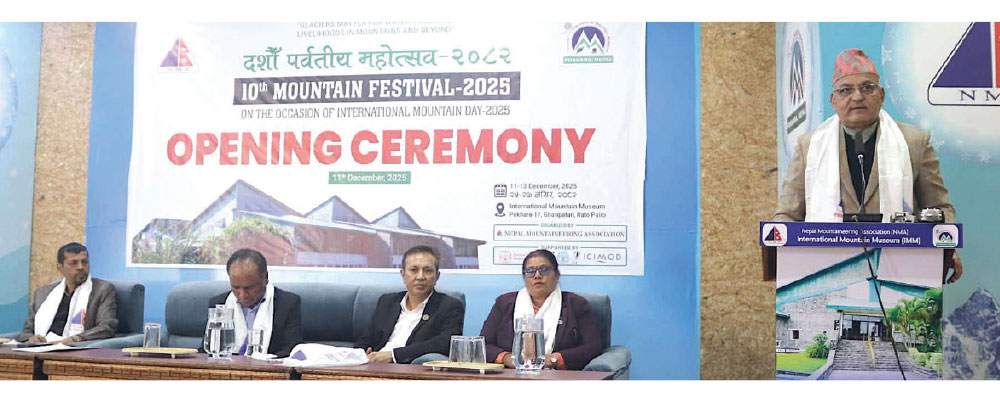

By Phadindra Adhikari,Lekhnath, Dec. 12: Speakers at the 10th Mountain Festival in Pokhara have stressed the need to conserve mountains and use their resources wisely to safeguard life across mountain regions and the world.
At the event, organised by the International Mountain Museum on Thursday to mark International Mountain Day with the theme, ‘Protect Mountains to Save Lives’, they said that mountains and the Himalayas form the very foundation of life. International Mountain Day is observed every year on December 11.
Addressing the programme, Surendra Raj Pandey, Chief Minister of Gandaki Province, said that countries like Nepal are suffering from the consequences of the climate crisis.
“We are paying the price for the wrongdoing of others. Developed nations must support us in responding to the climate crisis. This issue is being raised at national and international forums,” he said.
Chief Minister Pandey said the provincial government was prepared to work with all stakeholders to extend tourists’ length of stay and maximise tourism benefits.
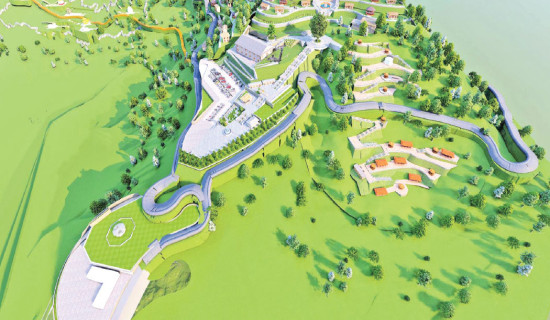
With world-renowned trekking routes shrinking and deteriorating because of expanding roads, he stressed the need to find alternatives. He also announced that the provincial government would develop a model botanical garden at the International Mountain Museum. The provincial government has allocated Rs. 20 million this year to develop the garden.
He added that efforts were underway to expand direct air links from the province to all provinces within the country and to international cities. “Our nature is unparalleled. Preserving our culture while promoting tourism can lead us towards prosperity,” he said.
Bhesh Bahadur Paudel, Gandaki Province Minister for Forests and Environment, said the garden project had been initiated considering land availability, management capacity and commitment at the museum.
“A full botanical garden may cost around Rs. 2 billion, but we have made a start. “Its detailed project report has been prepared. It could become a key attraction for Pokhara’s future tourism and for upcoming generations,” Minister Paudel said.
Phur Gyalje Sherpa, President of the Nepal Mountaineering Association, said the museum had already proved useful in attracting international visitors. With digitisation and the botanical garden, the museum could achieve even greater prominence, he said.
According to the United Nations, nearly two billion people worldwide --particularly indigenous communities -- depend on rivers and streams flowing from mountains. These populations rely on mountains and river systems for their livelihoods, daily needs and cultural identity. Around 150 million people are said to be at risk from glacial lake outburst floods.
International Mountain Day was established to highlight the importance of mountains, their ecosystems, and the lives of people who inhabit them, as well as the climate-related challenges they face. This year’s theme focuses on the vital role of glaciers for livelihoods, food and water.
The day is observed worldwide under the leadership of the UN’s Food and Agriculture Organisation (FAO). Taranath Pahari, chairperson of Pokhara Tourism Council, Ishwari Paudel, Senior Vice-President of Nepal Mountaineering Association, General Secretary Rajendra Bahadur Lama and member Nisha Bhote were among the speakers.
The festival, which began on Thursday at the Museum, will run until Saturday. A discussion on glaciers, food and livelihoods has been scheduled for Friday, along with a mountain exhibition for students.
On Saturday, the festival will feature an exhibition by the Swiss Alpine Museum. Museum Executive Director Nirmala Kumari Neupane has urged the public to participate, saying that the museum attracts more than 200,000 visitors annually.