- Saturday, 6 June 2026

Need For Revitalising SAARC

Exactly 40 years ago, the South Asian Association for Regional Cooperation (SAARC) was launched in Dhaka, Bangladesh, after more than five years of preparatory work at the level of foreign secretaries and foreign ministers of the region. All SAARC member states, in euphoric mood, hoped for a new era of regional cooperation for the promotion of peace and progress, mutual trust and goodwill in South Asia. South Asian leaders who addressed the first SAARC summit on December 8, 1985, described the launch as an expression of the common desire of all seven member states (Afghanistan was included as the 8th member in 2007) in the region to promote the welfare of the peoples of South Asia and to improve their quality of life.
As a member of the Nepali delegation led by late King Birendra, I recall attending the first SAARC summit in December 1985, which was like a South Asian festival, giving rise to high hopes and great expectations among the common people of South Asia for long-cherished peace and prosperity in the region. The agenda of the Dhaka summit was comprehensive as it included wide-ranging issues such as poverty alleviation, environmental preservation, improving the quality of education and health services, food security, and, above all, cooperation to expedite the realisation of common objectives like regional peace, stability, and prosperity.
Combating terrorism
Terrorism was, and remains so, an issue of common concern. The third SAARC summit, hosted by Nepal in 1987, focused on the issue of terrorism and unanimously adopted the SAARC Convention on Suppression of Terrorism and Additional Protocol dealing with the Prevention and Suppression of Financing of Terrorism. The New Delhi summit in 2007 called for continued collective efforts at the regional level to combat terrorism as most of the region’s member states continue to be victims of terrorist violence, resulting in the senseless killing of innocent civilians, including women and children, and widespread destruction of public property. Terrorism is at the center of strained relations between India and Pakistan.
It has been four decades since the first SAARC summit. SAARC’s activities and its evolution over the years, including achievements and setbacks, have been critically reviewed and analysed by South Asian experts, academics, and scholars. Prof. Yadu Nath Khanal, one of the architects of Nepal’s foreign policy, described SAARC as a promising but difficult undertaking. He was fully aware of the continued tensions in Indo-Pak relations ever since both India and Pakistan gained independence in 1947. The centrality of India in SAARC has been pointed out and emphasised by several scholars and experts. Dr. Yuba Raj Khatiwada, an eminent economist, observes that the success of SAARC as a regional organisation for cooperation and development is contingent upon India’s initiative to promote a cooperative atmosphere in South Asia.
SAARC is different from other regional organisations in the sense that the SAARC Charter categorically states: while contentious and bilateral issues shall be excluded from the formal SAARC deliberations, all decisions are to be taken on the basis of unanimity. The practice of holding the SAARC summit annually attended by eight member states was discontinued after the 18th summit, hosted by Nepal in 2014. It decided to request Pakistan to host the 19th summit in Islamabad in 2016, not 2015. Pakistan had communicated to all fellow members of SAARC its readiness to host the 19th summit on the scheduled date with adequate preparations and necessary arrangements. There was a setback when India refused to attend the 19th summit, as a sizable number of its soldiers stationed in Kashmir were killed by terrorists allegedly aided and abetted by Pakistan. Pakistan has, however, continued to deny outright its involvement in the killing of Indian soldiers.
The 19th summit scheduled to take place in Islamabad in 2016 has been indefinitely postponed, giving rise to speculations that SAARC’s future is bleak and uncertain. SAARC has, no doubt, remained in a state of coma or limbo for more than 10 years, despite the current SAARC chair, Nepal’s fervent appeal to member states to bring SAARC back to life as a vibrant regional forum or platform capable of dealing, as effectively as possible, with all issues of regional interest and concern. Most observers hold the view that Nepal’s leadership as SAARC chair is crucial to revitalise this regional organisation with enormous potential and resilience to thrash out existing problems and emerging challenges within a regional framework in a spirit of cooperation and partnership among all member states.
Prolonged stalemate
The evolution of SAARC over the years cannot be dismissed as being insignificant, despite setbacks from time to time threatening the very survival of this organisation. In fairness to SAARC and its relevance, it must be stated that SAARC, since its inception, has positively contributed to a resurgence of South Asian consciousness over the years. Assertion of a South Asian identity is the outcome of such consciousness. The need for people-to-people contacts is a recurring constant in all SAARC summits. While inter-governmental meetings and agreements do facilitate the process of regional cooperation, for a much wider and more effective impact of such cooperation, it is essential to strengthen inter-governmental efforts by responding to the aspirations of the peoples of South Asia, particularly their spontaneous desire to communicate and cooperate at the people-to-people level.
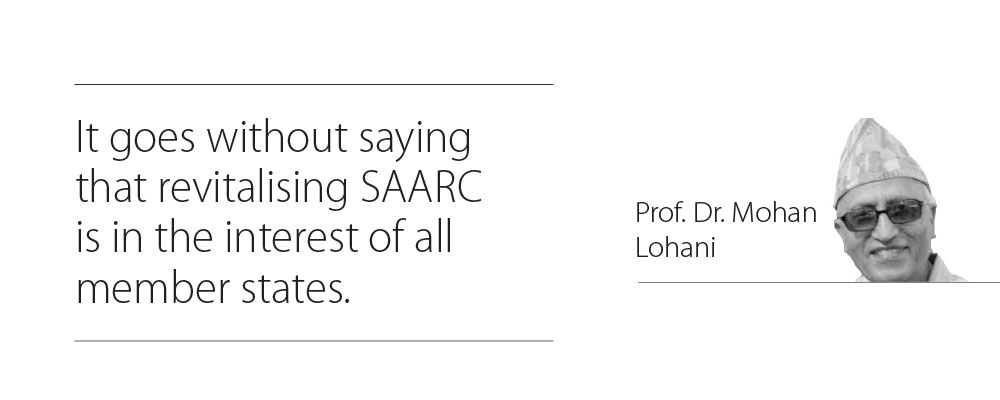
In conclusion, the prolonged stalemate over SAARC should not and cannot be allowed to continue for long. It goes without saying that revitalising SAARC is in the interest of all member states. It is this writer’s firm conviction that SAARC has come to stay, and both India and Pakistan also need it to maintain and promote peace, prosperity, and stability through regional cooperation.
(The author is Nepal's former ambassador to Bangladesh.)