- Thursday, 4 June 2026

Gorkha school relocated to avoid cold

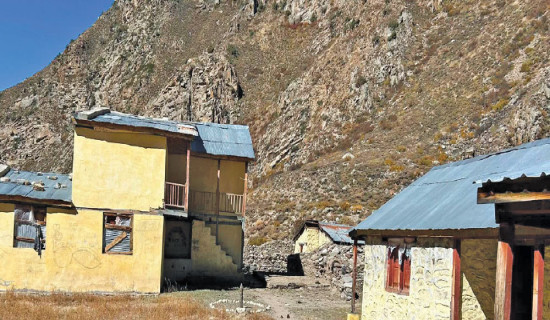
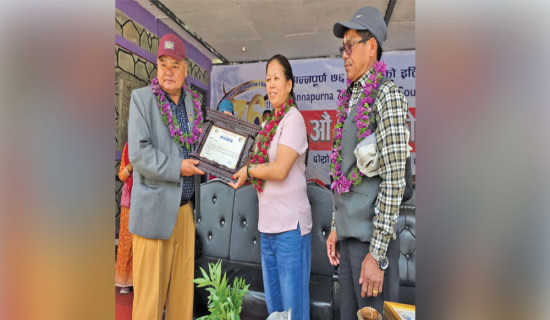
Photo: Gun Bahadur Roka\TRN Lho Pema Sambhava Secondary School of Syala, Chumanuwri Rural Municipality-2, has been relocated in Kokhetar, Arughat Municipality-4, to avoid extreme cold in winter.

By Gun Bahadur Roka, Sulikot, December. 6: Lho Pema Sambhava Secondary School located in the high-altitude northern Gorkha region of Syala, Chumanuwri Rural Municipality-2, has been relocated to Kokhetar, Arughat Municipality-4, to avoid extreme cold in winter.
The school, located at an altitude of around 3,500 meters above sea level, faced severe snowfall and cold temperatures, prompting its transfer to a safer teaching environment in Kokhetar. The school now operates from its own building in Kokhetar.
The transfer process was challenging, as teachers and locals had to endure a four-day arduous journey, carrying the school’s documents, materials, and student laboratory equipment along the remote mountainous paths.
Baburam Dhimal, the school’s headmaster, shared the immense difficulty they faced while moving the school to the warmer area. Due to the unbearable cold in Syala, the school was relocated with the health and safety of students in mind.
Dhimal explained, “During the winter months, the temperature in Syala can drop well below freezing, making it impossible for students to stay in classrooms. Therefore, alternative arrangements had to be made.”
The continuous biting cold and frozen paths made teaching extremely difficult, and the school was moved to prevent disruptions to the academic year.
The school operates in Syala from Mid-April to mid-Novemeber and in Kokhetar, Arughat, from mid-November to mid-April. “During winter, the temperature in Syala drops significantly, snow accumulates, and water freezes, making it almost impossible to conduct classes. Hence, we relocate the school in Kokhetar ru run classes in the winter season,” said Dhimal.
Currently, the school has 253 students enrolled from grades 1 to 10, along with around 300 staff members.
Of these students, 98 benefit from government-provided scholarships and hostel facilities, while the remaining students, teachers, and staff are supported by local Sonam Dorje Rimpoche.
Before the 2015 earthquake, the school was forced to close for six months, according to Dhimal. “Since the school moved to Kokhetar, both students and teachers have found relief and the teaching environment has improved,” he added.
The school building in Kokhetar was rebuilt as part of post-earthquake reconstruction efforts, and it is now safe, well-maintained and more suitable for the climate. The relocation is expected to increase student attendance, improve learning conditions and reduce health risks.
This year, the school has faced even more severe winter conditions, and the timely relocation has been seen as a positive measure to prevent disruptions in education due to the harsh mountain cold.