- Saturday, 6 June 2026

Resolving Multiplexity Of Societal Challenges

Complexity denotes a singular web of challenges, while multiplexity implies its plural nature, where each cluster of complexity is embedded in the other in a layered and varied manner, thus making them tough to resolve. When challenges are systemically linked with several structural and behavioural properties, they add extra complexity. Many causes of malaise have produced disproportional effects beyond the ability of Nepali leadership to address. Appropriate knowledge and experience about the contextual multiplexity of problems is vital for leaders to resolve them and mitigate their future sources by responding to the flow of negative feedback.
Borrowed tools, policies, ideas, laws, and ideologies may be useful in addressing external stimuli, rather than the sources arising from its political culture. Nepali leaders need to indigenise them, attuning to the vital force of its culture, resilient experience and the living spirit of its people for national freedom. Now, Nepalis are experiencing a crucial moment of history riddled with the multiplexity of problems. What does it mean for the nation’s future? People know it is not only politics that has become important in their lives. Many non-political territories, such as ecology, modern communication, technologies, leadership culture, organizations and geopolitics are affecting national progress.
Information revolution
Information revolution gyrating under the command and control of the global digital platform has enlightened the young generation of Nepalis and helped them to define a fresh vision of polity where each has a voice, visibility and opportunity to build participatory democracy. Youth activism in Nepal is calling for the performance of leaders as per their promises and constitutional vision beyond sheer electoral and charismatic legitimacy. It demands a paradigm shift from a skill in ideological rant to an ability to manage interlocking issues. Their density has turned Nepali politics intricate, where each actor claims political space, less sensitive to the oppressive condition of people choked by crippling strikes, deaths, destruction of property and eternal regime change.
Nepalis often seek to conquer alienation for better standards of life, liberty and dignity. Participatory democracy, embedded in popular sovereignty, is less likely to flourish without a robust foundation of social justice, broad-based economic growth, and the redistribution of necessary income to the people. Fulfillment of essential needs makes them autonomous, less desperate for uproar in the streets and exercise a life of choice in public affairs. The tumultuous time of the nation demands national solidarity beyond the conventional politics of personality, ego inflation, hierarchy, patriarchy and patronage, mere flow of interaction of netizens in the digital web or theatrical politics without policy substance.
Equality of Nepalis in digital access, creation of an equal playing field and a fair share in the public goods can build trust in the polity. Peril to conventional politics springs from those who are fighting for justice. They have fervent desire for social, economic and political transformation and ability to avert the atavistic impulses of patriarchs that nullifies the infinite possibilities of the future, nihilists who despise the nation’s unbounded free spirit of the past, radicals who seek to escape from the past misdeeds and opportunistic ones who swing between different poles of power without any interest to lift up the necessities of Nepalis lives. Neither of them has any interest in converting popular demands into policy.
Nepali youths’ determined refusal to defy the old political, economic and media establishment aims to refresh the democratic promise of accountable rule. But they need to reflect on the life of those disproportionally suffering from scarcity, poverty, joblessness and lack of access to health, education and information and switch necessity into choice. The complexity of Nepal’s internal challenges arises from the opposing stand of political parties in the state. Radical left parties and Madhesis talk about restructuring it to make its structures inclusive while Nepali Congress and CPN-UML seek only reforms in its functions. The other contested area is the constitution. No party fully owns it.
A section of NC, CPN-UML and Maoists want to retain a secular, federal democratic republic, while Rastiya Prajatantra Party prefers to replace it with constitutional monarchy, Hindu state and a unitary polity; the latter aspect is endorsed by Rastriya Swotantra Party and Rastriya Jana Morcha Nepal and the bulk of NC. Gen Z groups are imprecise on this issue. One set prefers the spirit of the constitution but sees the need for admin and political reforms, while another set favours the closure of federalism but wishes for new leadership with a clean image who can control corruption and uphold national unity and integrity.
A group of leaders from NC and RPP wants to trim the swollen size of political and admin classes. Maoists, Madhesis, certain elements of Gen Z and RSP desire direct election of the executive head. The nature of the economy also polarises Nepali parties. General consensus exists among big parties, the corporate sector and technocrats to continue with neo-liberalism, while progressive forces insist on the execution of a socialism-oriented economy embraced by the constitution to realise its vision of an egalitarian society. The execution of constitutional rights of Nepalis is not feasible under neoliberal indulgence. It has rendered the Nepali state fiscally and institutionally weak to realise them and open job opportunities.
The contradictions in the constitution keep the polity tottering. Radical left and patriotic forces are critical of NGOs and civil society as they find them not attuning their activities to national priorities of poverty alleviation, social cohesion and aid alignment; indulge in partisan politics and social engineering, subverting Nepal’s social and cultural cohesion. Debate is raging about giving powers to local self-rule, controlling youth migration and a self-reliant economy. The parliamentary election on March 5 has also polarised the political spectrum, though all parties have registered with the Election Commission. A powerful section of Gen Z is racked by the struggle of disunity and feels less content with a security void.
The Gen Zers feel the risk of robbing the zeal for political transformation. Its struggle reaffirms the need for a productive economy so that no one has to self-exile to the global labour market for livelihood. Its revolt against fatalism is expected to create an open moment for imagination about social emancipation. Another section of Gen Z, Prasain group and UML do not feel comfortable with the present government holding elections, which they call illegally constituted outside the constitutional and parliamentary frame.
All groups of Gen Z demand legal action against corrupt and criminals for killing their comrades before the elections, which the government fears for its risk to dampen the electoral prospect. The out-of-power parties pursue multiple strategies in the race: engaging in legal battles in the courts and exerting pressure on the President to restore the parliament, mobilising fans against the government, banding together with other parties and gaining muscular leverage for electoral games. In no way can the last option provide the authority to act. It breeds a political culture ill-assorted to electoral legitimacy.
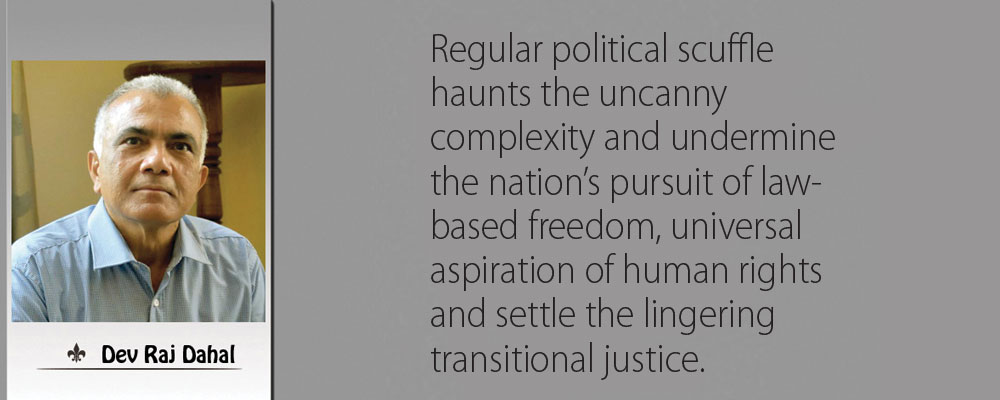
Regular political scuffle haunts the uncanny complexity and undermine the nation’s pursuit of law-based freedom, universal aspiration of human rights and settle the lingering transitional justice. So long as the politics of negation continues, the nation’s future will become its past. Can elections set Nepal’s political path on a normal course and restore performance legitimacy against herd mentality? Politics of negation, adversarial moves and boisterous stasis can turn the political climate complex, portending a slide into multiplexity. It is vital to overcome institutional atrophy by impersonal performance of government and bond intergenerational chasm by cultivating reciprocity and maturity.
Lending equal proportional concern to each generation can overcome the deficits of trusts and spur cooperation. External challenges of Nepal linked to the multiplexity are: geopolitics, climate change, communication, trade deficits, aid dependence and transactional networks and overlapping settlement of population that makes national sovereignty, population and economy incongruent. Each offers entry points for outsiders to meddle in national affairs and secure their clout in Nepal. To resolve the geopolitical complexity, the nation has to help resolve the security dilemma of neighbours, control internal cauldrons drifting into global boundaries and innovate policies for safe adaptation to the shifting power balance so that national interests are not set aside for regime survival.
Nepalis are living in a morally contaminated milieu. They are craving for rule-based order, justice and peace. The leadership has to renew its civic culture in deep snooze covered up by the high-stakes ferocity of party politics and bring old sanity back to animate all-inclusive dialogue to resolve the interlinked problems one by one to resolve the web of multiplexity. This requires political leaders to step out of their partisan boxes and converse with others as bearers of national conscience.
Empirical burden
Similarly, Nepali scholars, dignified more by long-cherished empirical burden, scientific objectivity and detachment, need to shift to engagement with people’s needs, feelings and emotions and supply rational inputs to leaders for establishing the autonomy of public institutions, improving their impartial performance and resolving the multiplexity of problems. It is important to disentangle each complexity; otherwise, they together create a vicious circle and their transformation into a virtuous circle or synergy becomes intricate.
Fractionalisation or disconnection of each from the other is necessary to unravel them, perform rational diagnosis and create common ground for their systemic mitigation. Elongated irresolution of challenges creates enormous costs proportional to their multiplexity. But their solutions remove the destitute condition of political trust, discover common causes among national forces and evolve a shared path. Lives without the reasonable regulation of society stoke unreasonable passion, ideas and identities hard to coordinate for political stability, sustainable economic development and democratic governance.
(Former Reader at the Department of Political Science, TU, Dahal writes on political and social issues.)