- Sunday, 7 June 2026

Army HQ awaits formal deployment for election
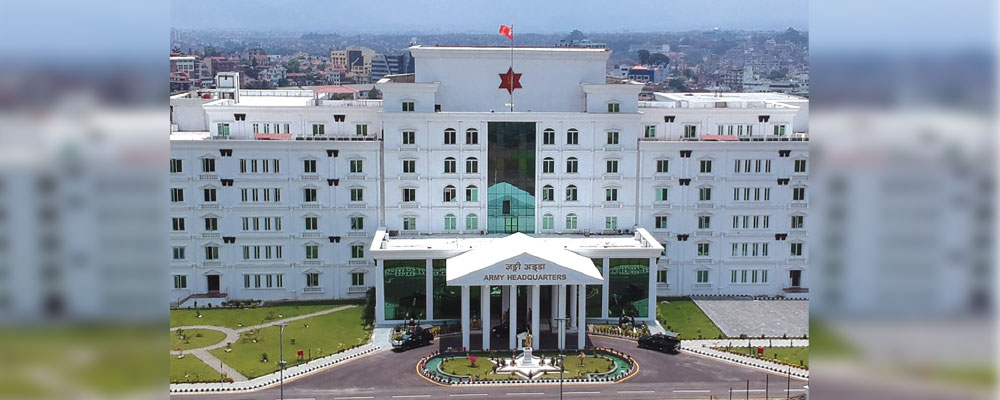

By A Staff Reporter,Kathmandu, Dec. 6: It has been a week since President Ramchandra Paudel approved the deployment of the Nepali Army for the upcoming elections scheduled for March 5, 2026, yet the precise date for troop mobilisation in the field has not been officially announced.
Acting on the recommendation of Prime Minister Sushila Karki, who is also looking after portfolio of Defence Ministry, the President authorised the army’s deployment on November 27. The following day, Prime Minister Karki addressed senior army officials at the Army Headquarters, directing them to prioritise election security and adapt to the evolving security environment.
Generally, the army has been deployed only about a month before elections. However, citing deteriorating law and order following the Gen-Z movement, authorities opted for earlier preparations this time.
Brigadier General Raja Ram Basnet, spokesperson for the Army Headquarters, said that while the official deployment schedule is still awaited, internal preparations are already in progress.
“Each unit has developed detailed plans for coordination and operations in the field. Districts and provinces are preparing their respective strategies, and Provincial Security Conferences are underway to finalise these plans,” he said.
To strengthen election preparedness, the government conducted security workshops in Lumbini and Sudurpashchim provinces, instructing participants to draft and implement security plans for their districts.
A Nepali Army general officer attending the Sudurpaschim Provincial Security Conference in Dhangadhi on Tuesday said that the army was preparing security arrangements for all polling centres, including those identified as highly sensitive, in coordination with the province and district level security officers from Nepal Police and Armed Police as per the meeting of the District Security Committee chaired by CDO.
Following the Gen-Z movement, troops previously engaged in joint patrols and security duties have returned to barracks, with a current focus on election-specific deployments.
Highly sensitive polling stations determined by population size, prior incidents of unrest, or booth occupation, will receive heightened security attention.
Troop numbers and deployment locations will be coordinated with the Election Security Police, Nepal Police, and Armed Police Force.
While earlier government proposals suggested joint operations to recover weapons or apprehend fugitives, the army clarified that such operations fall under p olice jurisdiction, with military support limited to intelligence sharing.
The army is also preparing for logistical needs, including transport, accommodation, and other support for officers deployed in districts.
Spokesperson Manoj Kumar Acharya of the Ministry of Defence said that the current security situation justified the government’s decision for early army mobilisation.
He added that the timing of the formal deployment letter will be coordinated with the Election Commission of Nepal.
A separate committee, including members of the Election Commission and all security agencies, has already been established to oversee implementation.
Although the National Security Council previously approved army deployment until the conclusion of the elections, the exact commencement date has yet to be determined.
Election security has been categorised into three phases: pre-election, during the election, and post-election, with the army’s role clearly defined for each stage. Officers emphasise that early mobilisation, unlike in previous elections, is expected to significantly enhance voter safety and confidence.
In addition to securing polling stations, the army will safeguard ballot printing, transportation, and other electoral logistics.
The Election Commission has added 75 new polling stations and relocated 93 existing ones, bringing the total to 10,967 polling centres nationwide.
Over 3,500 have been identified as highly sensitive. District authorities have been instructed by the Home Ministry to finalise detailed operational plans, ensuring a coordinated security approach across the country ahead of the elections.