- Monday, 4 May 2026

Need For Media Information Literacy

Today, as digital technology has reached its utmost development, education and learning skills have taken on a different meaning. Learning, entertainment, and shopping all happen online. News and information on everything is accessible online. At such a time, Media Information Literacy (MIL) is a requirement for all age groups. There is the facility of getting information at the tips of our fingers, but there is also the possibility of getting cheated, harassed, and abused online. MIL is defined as the ability to access, analyse, evaluate, and communicate using various media forms effectively and responsibly.
There have been several cases of people’s wealth being siphoned off by online predators who keep track of individuals online. Many people rely on banking transactions via online platforms. Elderly people have been susceptible to several scams where they were lured into investing in retirement plans, retirement homes, and entertainment, only to realise later that their money was looted. Similarly, children have been drawn into sexual exploitation, kidnapping, and trafficking through online communication with web prowlers. People of all age groups have been victims of online harassment and crimes.
Vulnerable populations
Therefore, it's imperative that governments worldwide incorporate MIL into their curriculum, both in the formal education system and through awareness campaigns in the informal sector, so that vulnerable populations are made aware of how to protect themselves. The mode of education needs to evolve with time. Right from the day a child is born until the day he or she dies, learning needs to be a continuous process. In the beginning, there is a need to learn and develop life skills to pass through a person’s life cycle. Then, as people age, they need to learn ways of keeping themselves engaged to make sure their mental and physical needs are met.
According to the UNESCO 2025 report Media and Information Literacy for All: Closing Gaps, while 171 out of 194 UNESCO Member States reference MIL or related competencies in national frameworks, implementation remains uneven and fragmented. The report mentions that 43 percent of the countries have integrated MIL into the school curriculum and 29 percent focus solely on digital skills training. Europe and North America lead with 91 percent integration, whereas Africa, Asia, and Latin America continue to lag, revealing persistent global inequalities in access to critical information skills. The report stresses the fact that MIL should be offered in such a way that it helps embed critical thinking, media analysis, and ethical digital engagement in education. Mostly, MIL has been integrated across multiple subjects rather than being made a stand-alone subject at the secondary education level.
I have been involved for the last two decades in advocating for life skills courses to be included in Nepal’s education system. It was a happy moment to see that the Nepal Government included this as part of the high school curriculum. However, it has been included as part of the optional social studies course. Therefore, not all students get to learn this. Life skills can start from babies learning to tie shoelaces to elderly people developing the habit of remembering to take their medicines on time, even if they may not have family members or house helps with them 24 hours a day.
For children leaving high school, they should be equipped not only with education on different subjects like science, technology, history, and geography, but also with knowledge on how to develop a budget to help them keep track of their finances and not overspend. They need to learn how to choose friends and partners who do not lead them towards bad habits, and they need to learn negotiation skills on how to be team players to achieve goals. These are important life skills in which now MIL should be included too.
In the government curriculum on life skills, which is not mandatory, digital literacy is also included, but it is not in a format that serves the purpose of MIL. All these skills that teach children to face the world should be mandatory, not optional, so that when they leave high school they are equipped with skills beyond the traditional schoolbook curricula.
Cross-cultural approach
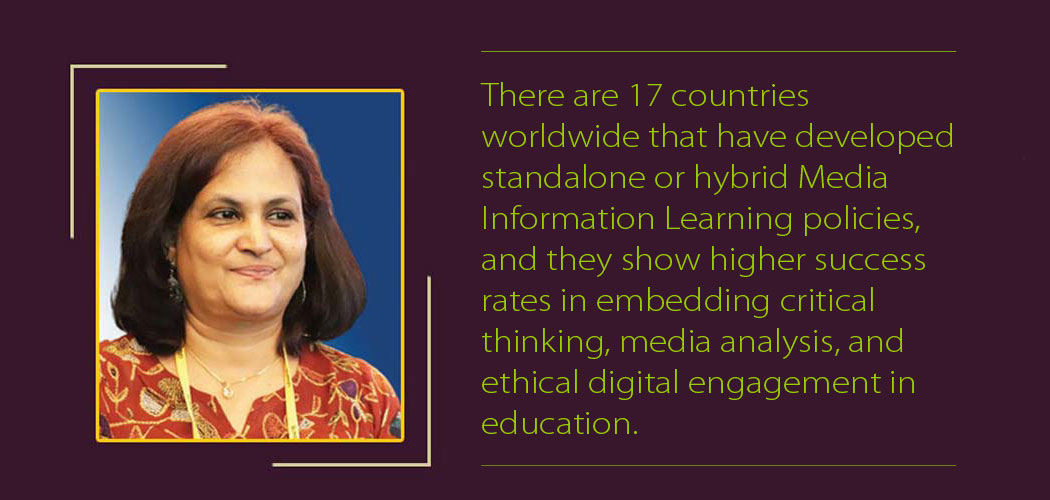
The UNESCO report of 2025 mentions that a cross-cultural approach helps connect MIL to real-world issues but makes progress difficult to track and sustain. The report mentions that there are 17 countries worldwide that have developed standalone or hybrid Media Information Learning policies, and they show higher success rates in embedding critical thinking, media analysis, and ethical digital engagement in education. The report also states that, in contrast, systems that limit MIL to technical digital literacy risk neglecting the broader competencies needed for navigating misinformation, AI-driven content inclusion, and resilience in an increasingly complex information environment.
UNESCO recommends that MIL should be treated as a core twenty-first-century competency, essential for democracy. In countries like Nepal, where discrimination is still prevalent across various wealth, class, caste, rural, and urban contexts, governments and civil societies need to come up with a framework where all get access to MIL. This can be done by including a course in secondary and high school that must be made mandatory for all. Being literate in media information also helps in strengthening the democratic system.
(Sharma is a senior journalist and women’s rights advocate. namrata1964@yahoo.com or on X @NamrataSharmaP.)