- Tuesday, 5 May 2026

Implications Of US-Saudi Arabia Deal
 Bishnu Pukar Shrestha
Bishnu Pukar Shrestha
Bishnu Pukar Shrestha
On May 13, 2025, during President Donald Trump's visit to Saudi Arabia, it was announced that Saudi Arabia would invest $ 600 billion in the US. The two countries have significantly deepened their economic ties through a series of high-profile agreements spanning defense, technology, energy and finance. The US-Saudi Arabia deal can have a significant global impact on the economic, geopolitical and energy sectors. Their collaborations are reshaping global markets, influencing geopolitical dynamics, and raising critical questions about the future of technological sovereignty and international alliances.
As the US restriction on advanced exports to China tightens, American tech giants are redirecting their focus to the Middle East. This deal has eased them to invest heavily in artificial intelligence (AI) infrastructure. This shift not only opens new markets to the US but also positions Saudi Arabia as the US's key ally and an important player in the global geopolitical landscape. The pact mainly aims to reduce the Chinese influence in the region.
Strategic military access
One notable impact of these deals is on the military and security. The agreement includes a $142 billion arms deal that will strengthen Saudi Arabia’s military capabilities significantly, including advanced missile defense systems, drones and transport aircraft. This could encourage Saudi Arabia to get involved in the regional conflicts in which Iran, Yemen, and Syria are already their part. Iran may respond by accelerating its own military programmes or by bolstering alliances with Russia and China. The US-Saudi partnership may provide the former with strategic military access in the Middle East to counter Iran, Russia and China, while enhancing the US's leverage in counterterrorism operations, intelligence sharing, and rapid military deployment in the region.
This development will give rise to arms buildup, escalating risks and tensions in the Middle East. The countries like Iran, Turkey and Israel may join arms races to bolster their position. Similarly, the multi-billion-dollar accord is expected to diversify the oil-based economy of Saudi Arabia. Its Vision 2030 seeks to reduce oil dependency and accelerate investment in AI, defense and infrastructure.
The accord is likely to strain US relations with Iran, which already has hostile relations with the former, while widening the rift between Qatar and Turkey, which have competing visions for regional leadership. There will be a significant impact on the global south and non-aligned states. When Saudi Arabia develops and increases its tech capacity and high-end defense, the developing nations will be encouraged to develop a similar strategy, reinforcing the authoritarian development models. As a result, political reform will be sidelined for the sake of economic benefit.
This will certainly impel China and Russia to accelerate arms deals and infrastructure investments with Iran and other Gulf states. China might expand the Belt and Road Initiative (BRI) projects in the Gulf. Analysts argue that the US is compromising its human rights stance by strengthening ties with a regime known for repression, especially after the murder of journalist Jamal Khashoggi. This may weaken the U.S.’s credibility in promoting democracy and human rights globally.
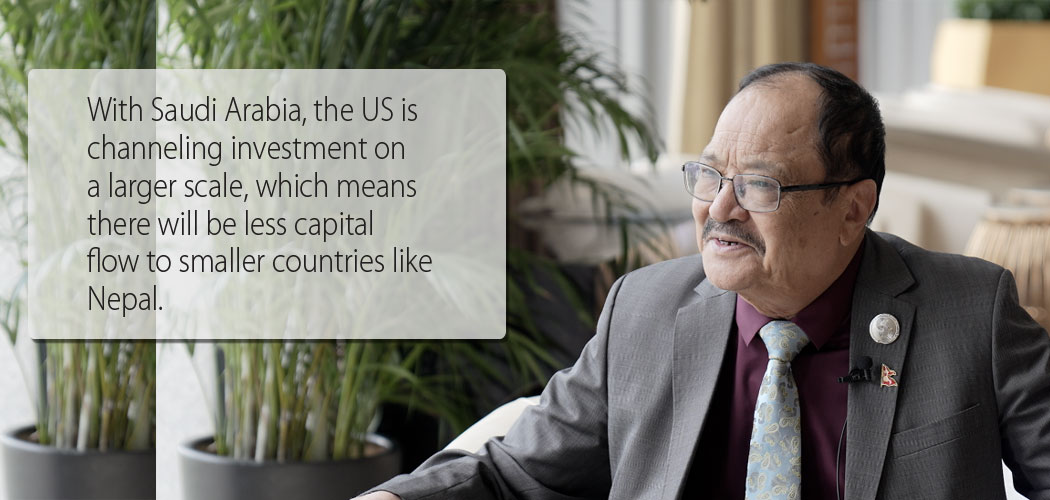
The strengthening of US-Saudi Arabia ties will have several ramifications for developing nations like Nepal. This will give the Gulf nations stronger leverage in global politics. For Nepal, this could mean the greater need to navigate diplomacy carefully between major powers like the US, China, India and the Gulf. It gives us opportunities in geopolitical balancing and diplomacy, requiring a neutral position for economic or educational partnership, especially in areas where Saudi Arabia wants to showcase soft power. With Saudi Arabia, the US is channeling investment on a larger scale, which means there will be less capital flow to smaller countries like Nepal. But there is also an opportunity to benefit from the competition for influence by countries like China. China may increase engagement with South Asia, including Nepal.
Investment
Gulf investment may be diversified and may expand investment in other regions. It may open new funding opportunities for infrastructure and energy projects in Nepal. A large number of Nepalis are working in the Gulf countries. So Nepal should send skilled and semi-skilled human resources to Saudi and the Gulf nations because there will be a low market for traditional labour but we have to enhance the skills of aspirant Nepalis by providing them with vocational and technical education. Nepal should focus on diplomacy and infrastructure to tap into new regional networks and diaspora-driven growth. For a developing country like Nepal, there are always risks of being left out if it cannot adapt to the changing scenarios.
The US-Saudi Arabia business deal has far-reaching consequences, from oil markets and tech innovation to great power competition. Depending on the situation, it could either stabilise global economies or heighten geopolitical tensions. This has brought a geopolitical shift and increased the US influence in the Middle East.
(The author is a former ambassador to China.)





-original-thumb.jpg)