- Sunday, 7 June 2026

Historic Lomanthang awaits touristic development
Dharmendra Jha
Lomanthang (Mustang), May 14: The
historic place of Lomanthang in Mustang, located about 180 kilometres away
along the Kaligandak River from the district headquarters of Beni in Myagdi, is
significant in terms of its religious, natural and touristic treasures.
The people's representatives here
have expressed concerns that the area has not attracted the expected number of
foreign tourists due to various government policies, despite its immense
tourism potential.
As Marpha, Jomsom, Kagbeni and
Muktinath Temple receive thousands of foreign tourists and pilgrims every year,
a limited number of tourist visit Lomanthang, a pristine site at the distance
of 75 kilometres from Mustang's district headquarters Jomsom.
Chairman of Lomanthang Rural
Municipality Tasi Nharbu Gurung viewed that tourism development could not take
place here as expected due to government's restricted policy for the entry of
foreigners in Lomanthang.
"The foreign tourists have to
pay 500 US Dollars for 10 days to visit Lomanthang and Lo-Dhekar Damodarkunda
rural municipalities. We could not bring in the expected number of tourists due
to this provision," Chairman Gurung said.
He observed that the living
standards of people here could be impressively increased by welcoming thousands
of foreign tourists if the state takes some measures of facilitation.
Lomanthang also shares border with
China's Tibet.
The government has established the
Immigration Office at Korola point but has not run well.
"There are sufficient bases
for increasing economic activities as Lomanthang shares border with China. We
have failed to seize benefits due to non-operation of the Immigration Office at
Korola point," Chairman Gurung shared.
In October 2024, Home Minister
Ramesh Lekhak had inaugurated the Immigration Office and Border Out-Post (BOP)
of the Armed Police Force, Nepal at Nechung in Lomanthang-1.
With the establishment of
Immigration Office and BOP, the local residents had hoped for increased
economic activities. "But, that could not take place," Gurung
bemoaned.
According to Chairman Gurung, food
and livestock quarantine unity is also required for the operation of the
Immigration Office.
Lomanthang was a popular trilateral
trade route between India, Nepal and Tibet until 20th century from 15th
century.
Now, this trade point is almost
halt, he added, stating that the local residents have also faced challenges for
lack of trade.
In Lomanthang, the rescue job for
patients is also a key challenge as the stakeholders should take an approval
from the Home Ministry for flying helicopters.
Gurung said, "Sometimes,
untimely death of patients are reported due to delayed in approval for flying
helicopters."
The local level has built a
hospital but the local residents have not taken advantages from the health
facility for lack of human resource and equipment. Gurung added that their
repeated requests for the arrangements were unheard from the province and
federal governments.
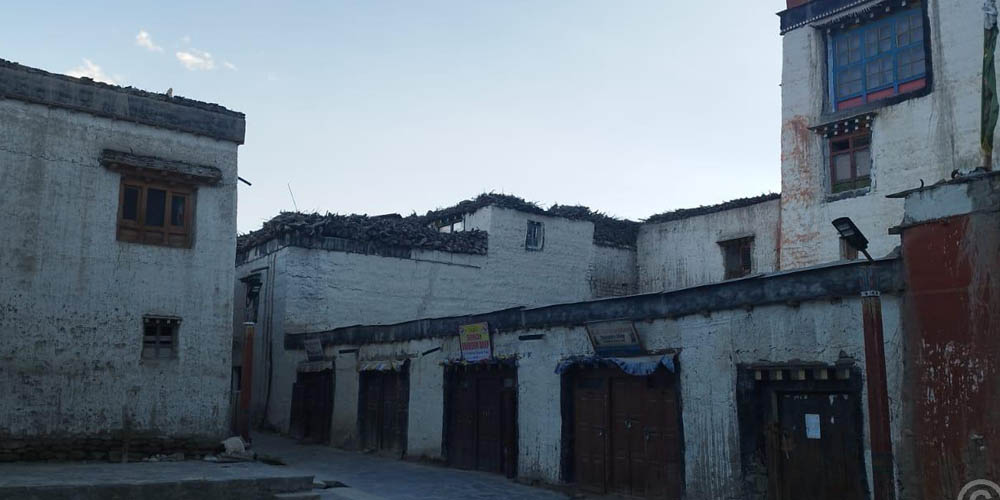
The total population of Lomanthang
is around 2,000 and the settlement here is spread in an extended area, which is
believed to be some 600 years old. This settlement encircled with the mud wall
is on the lap of a dry mountain.
A naturally beautiful village,
Lomanthang is equally rich in terms of cultural heritages. The palace,
monastery, cultural king, Mukhiya tradition, shared cultures of Tibetan
community and lifestyle are the identities of Lomanthang.
Visitors could also witness a cave
built by poking the hill some 2,000 years ago and the cave has almost 60 rooms.
This historic and touristic site carries immense potential but we have failed
to take advantage of this, Gurung stated.
Situated at an altitude of 3,850
metres, Lomanthang is also an entry point for Upper Mustang.
As per the history, this area was
the headquarters of the Lo State in 13th century.
Despite Nepal's unification in 18th
century, the local rulers reigned Mustang and Lomanthang as the Buddhist
kingdom until the establishment of republic system in Nepal.
Jigme Dorje Palbar Bista was the
last king here.
Chairman Gurung said that this site
is equally important to those who have deep interests to the history and
religion.
Lomanthang is a centre of Tibetan
and Buddhist cultures for millennia, which are still visible in the ancient
monasteries, buildings and crafts. (RSS)
-square-thumb.jpg)