- Sunday, 7 June 2026

PM Oli calls for integrated Mountain to Sea initiative
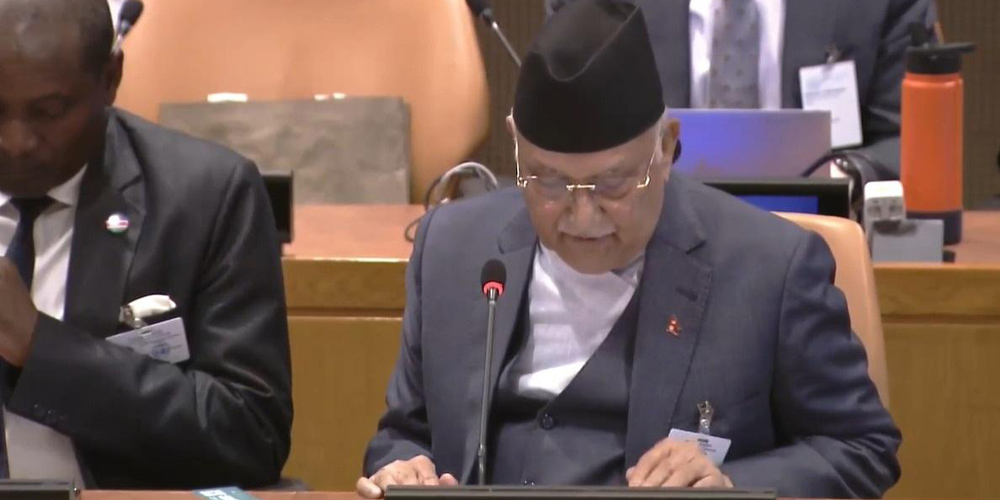
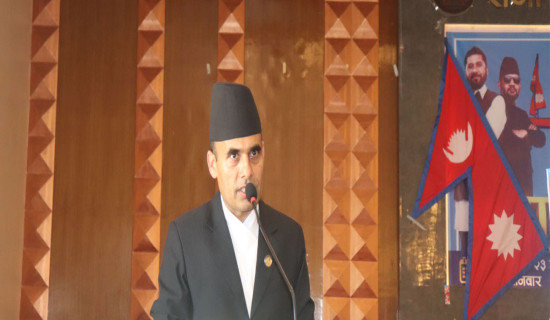
New York (USA), Sept 26: Prime Minister KP Sharma Oli has called for adoption of an integrated approach, a ‘Mountain to Sea’ initiative in our climate actions, recognizing the inherent connections between this ecosystem.
"Their coverage should span from
Everest to the Indian Ocean, from the Pamirs to the Pacific, and from the Andes
to the Atlantic Ocean, recognizing environmental and ecological
inter-linkages."
In his statement at the High-Level
Plenary Meeting of the 79th UN General Assembly (UNGA) on the theme
"Addressing the Threats Posed by Sea Level Rise" earlier today, Prime
Minister Oli said we must take bold, decisive actions to limit the global
temperature rise to 1.5°C. "This is not just a number—it is the threshold
for survival."
Even 1.5°C is too hot for the
Himalayas, as ICIMOD states, because the elevation dependent warming will
amplify its impacts equal to a 2 degree-increase. The Himalayas and other high
mountains are natural refrigerators and recharge system, cooling all the air
blowing through them and recharging the river systems downstream.
Calling for collective global
effort to tackle rising sea levels, to build resilience in our nations, and to
adapt to the changes, he said hand-in-hand, we must control release of pollutants
that generate acidic clouds and other effects as the pristine glaciers are
turning into the depository of various contaminants. "Most importantly, we
must deliver climate justice. Wealthy nations must lead from the front to
support vulnerable countries."
Prime Minister Oli also called upon
the UN General Assembly to convene a high-level meeting next year, dedicated to
addressing the existential threats posed by climate change to both mountain
nations and island states.
As global warming threatens the
ecosystem between mountains and seas, mountain nations like Nepal and the
coastal nations including the Small Island Developing States (SIDS) will turn
into its conjoined victims, he said, "For the SIDS and other coastal
nations there is a direct threat to their existence as by 2100 the coastal
regions are likely to submerge with nearly two and a half meters in
seawater."
Representing the nation of Mt.
Everest and the mighty Himalayas, also known as the ‘Third Pole’, I propose to
start our deliberations keeping in mind a long connecting chain—the melting of
ice and glaciers in mountains and polar regions that ultimately results into
sea level rise (SLR).
"Our actions to prevent the
SLR are integral to what we do to stop alarming loss of ice and snow from the
mountains, to stop avalanches and glacial lake outbursts", he added.
A set of dry but dreadful figures
illustrate the ecosystem from mountain to sea, which includes the contribution
of glacier melt to the sea level rise, the amount of ice Nepal lost in just
over three decades and the estimated loss of the Himalayan glaciers by 2100 A.
D. under the current level of emissions.
For the billions dependent on
snow-and ice-fed rivers, this will mean the drying of their lifeblood, and
ultimately decimation of river-based civilizations, Oli said, "Because
when two-thirds of the Himalayan glaciers are gone, Asia’s at least 10 river
systems will also dry."
During his statement, Prime
Minister Oli also urged to stop reckless burning of fossil fuel in the name of
development to save our planet for future generations to come. RSS