- Saturday, 9 May 2026

Civil Service Bill tabled in House
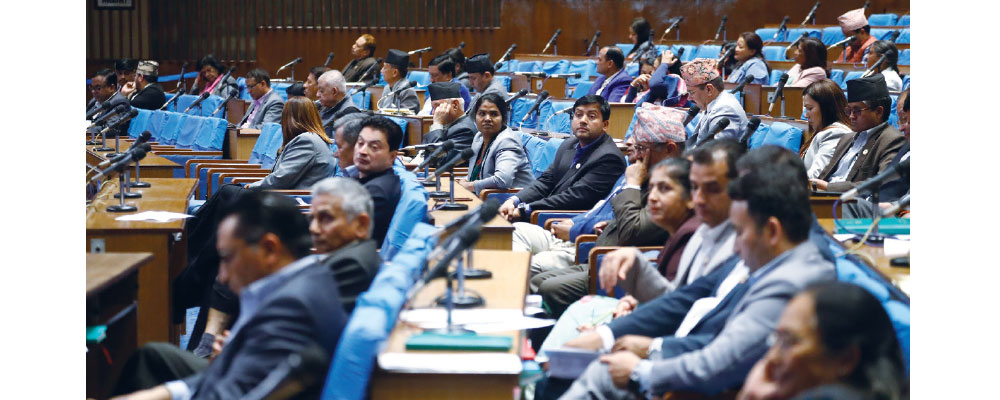

By A Staff Reporter,Kathmandu, Mar. 15: Amid speculations, the much-awaited Federal Civil Service Bill has been tabled in the House of Representatives.
Minister for Federal Affairs and General Administration Bhanu Bhakta Joshi tabled the Federal Civil Service Bill- 2023 in the meeting of the House on Thursday.
Tabling the Bill, Minister Joshi underscored the bill’s necessity, stressing its alignment with the state’s restructuring. He emphasised that the bill aimed to address the operational requirements of the federal civil service, ensuring compliance with federalism in managing laws related to civil services, conditions and facilities.
According to Minister Joshi, introducing the bill was crucial to establishing a well-organised, functional and result-oriented administrative system in line with the government’s framework. He highlighted the importance of fostering politically neutral, professionally competent, inclusive and ethically upright civil servants to efficiently operate state services.
However, the presentation of the Federal Civil Service Bill faced challenges. The majority rejected the opposition notice by MP Prem Suwal.
The Bill registered in the parliament on March 4, aimed to provide a framework for the formation, operation, and conditions of service within the Federal Parliament.
Likewise, the House of Representatives approved the proposal to consider the Construction Materials Management and Regulation Bill, 2023. The proposal, tabled by Minister of Federal Affairs and General Administration Joshi received unanimous support.
The deliberations on the proposal witnessed active participation from various MPs, including Raghuji Pant, Damodar Poudel ‘Vairagi’, Chanda Karki Bhandari, Vasudev Ghimire, and others. Speaker Devraj Ghimire announced that MPs wishing to propose amendments to the Bill had a 72-hour window to submit their notices.
During the session on Thursday, the lawmakers expressed expectations for the newly formed government to prioritise good governance and prosperity. Representatives from various parties raised concerns and demands regarding infrastructure development, relief distribution for earthquake victims, and economic issues such as sugar pricing and border management.
Additionally, the MPs utilised the zero-hour to address pressing issues such as violence against women, fair compensation for land acquisition, and timely implementation of agreements with the usury victims. They called for increased government investment in education, health, and agricultural initiatives, reflecting the aspirations of their constituents.
The session of the House of Representatives underscored a proactive approach toward addressing the nation’s challenges and fostering development and progress.



-square-thumb.jpg)