- Sunday, 10 May 2026

Stories That Propel Readers Beyond Expectation
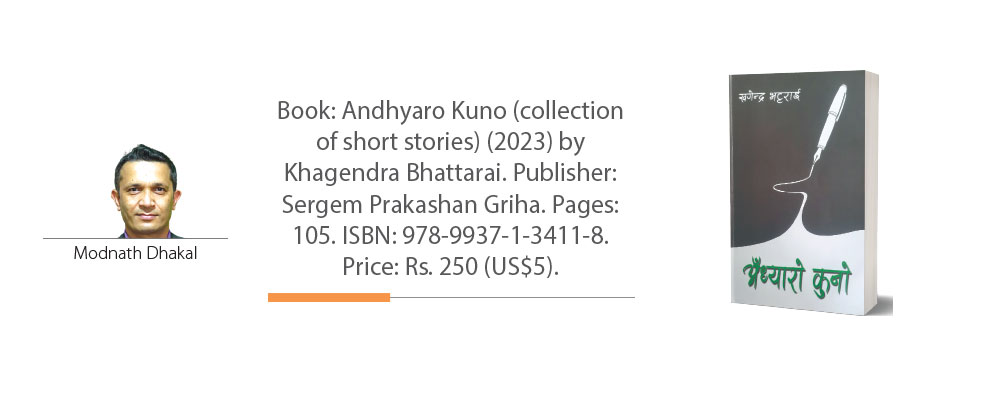

Nepali readers get a rare chance to come across a piece of literature that deals with sexuality and talks about the issues on the topic in the societies here. Sex is taboo, as is sexuality. People hesitate to talk about it, even with their doctors. There are many couples who don't talk about it openly, even in their private spaces. However, a good number of writers have tried to tread into this genre in Nepali literature. From Bishweshwor Prasad Koirala to Saru Bhakta, Nepali literature has some precious gifts that deal with sexual psychology.
Many critics consider Koirala's short story 'Chandra Badan' as an entry point to such a genre in Nepal. Saru Bhakta's 'Taruni Kheti' is a novel that talks about sexuality in imagery, similes, and metaphor, without which it would have just remained low-grade pulp fiction sold at the bus stands. Sita Pandey, Prashu Pradhan, Parijat, Krishna Dharabasi, Prema Shah, Daulat Bikram Bista, Bhawani Bhikshu, Tarini Prasad Koirala, Pushkar Lohani, Bijaya Pandey, and their other contemporaries have dealt with sexuality in their literary creations.
Khagendra Bhattarai has dared to continue the trend and picked issues from our surroundings to craft some beautiful short stories. His recent book, 'Andhyaro Kuno' (The Dark Corner), has hit the market and will certainly hit your senses as well.
It has been quite a while since Nepali literature received a creation like this, delving directly into the arena of sexual psychology and bringing issues that are of utmost importance but less talked about to the readers. Sexuality is a part of human nature. In societies that are typical of South Asia, people use symbols while talking or communicating about sexuality or talk in a way that one has to read between the lines to get the meaning.
For example, Lakshimaya didi (sister) in 'Sallako Rukh' has a pine tree, planted by her husband, in her courtyard. Her husband dies in the armed conflict, and she wants the tree to fall on her. She says the tree slowly sings and teases her. It is a strong metaphor for 'sex' as a woman wants something to press her or crush her!
'Sallako Rukh' story is a strong representation of the Maoist-led armed conflict as well. This story talks about the brutality of the guerillas cutting the vocal cords of their comrades who were severely wounded in the attack or landmine blast. Fighters who lost their body parts in the attack would shriek bitterly in agony, which would terrify others and discourage them from fighting the war. So, a special team would cut out their vocal cords.
The book has fourteen stories that deal with sexual psychology. A couple of them have found their setting in the decade-long armed conflict. The author has used the language of everyday people, which has made the stories more authentic, and readers will immediately relate to them. Boys in the story address a beautiful girl as 'maal' (goods).
'Phulawa' is a story about the divide between people from the Tarai and Hill regions. The setting of the story is familiar, and readers will quickly understand that it is the story of a 'Pahadiya (people from the hills) master' teaching in a school in the Tarai region of the country.
About a year and a half ago, the divide was stark. The communal hatred culminated in the Gaur Massacre, where 17 Maoist cadres were brutally killed. It highlighted the ethnic and regional tensions in the plains. However, 'Phulawa' presents a better side of humanity. Top of Form
The first story of the book, 'Leela', presents the setting of a school in a typical underdeveloped village and less-sensitive teachers who control their students like a shepherd controls his sheep. Many Nepalis who completed their primary-level education at a school in a remote village surely have experienced somewhat the same situation. Without showing any sexual behaviour or a crime, the author has vilified 'Gopi Guru'. When the story comes to an end, readers don't want to halt there and begin to further the story out of their own creativity.
Khagendra takes his readers on a journey of mixed reactions in 'Thatta'. The readers may smile, sympathise (or empathise), enrage, or laugh when they read a story bearing an anecdote about a man who takes goat medicines and never grows taller than a 'he goat'. 'Malai Surahi Banaideu' (turn me into a water jar) is another powerful metaphor for suppressed sexual desires. The story ends so suddenly that the reader feels a punch and waits for a while to get more to read. It seems that the author knows where to end his tales so that his readers will be challenged to think beyond it.
Every story in the book forces you to think beyond its ending. The author has given an abrupt ending to his creations at such a point that you might close the book for a while and just wonder what could have happened after that. Some contemplations will surely amuse you, while others might surprise you. The stories in the book will surely shake your long-held belief or fortify it. They will tell everyone about the sexuality of the 'opposite sex'.
The author has made a significant contribution to Nepali literature with the publication of this book. Readers will get a chance to have a new taste with' sexuality spices' and might get an opportunity to peep into a part of society that they wouldn't have explored otherwise. The book can be read in one sitting, but you should consume it slowly to digest it fully.
-square-thumb.jpg)