- Sunday, 10 May 2026

Sculptors in Sagarhawa carving historical events on rocks
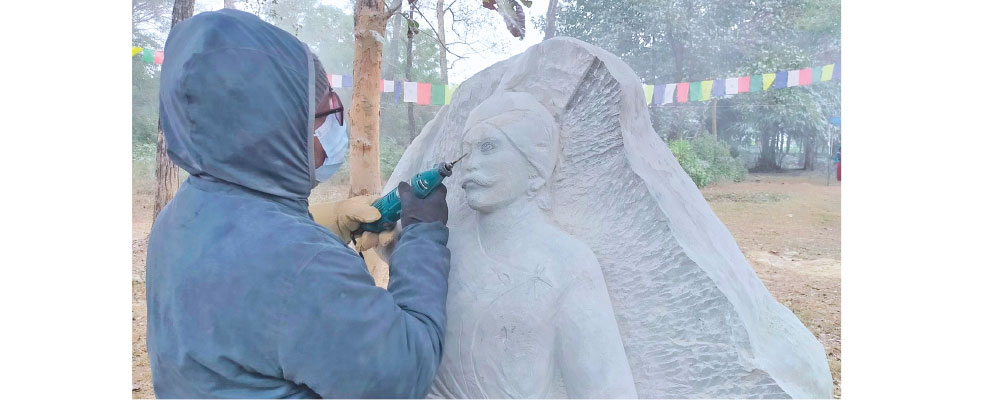

By Bhuwan Karki,Kapilvastu, Jan. 25: In the vicinity of Lambusagar Lake in Sagarhawa, in the archaeological site of Kapilvastu, a group of sculptors were diligently shaping lifeless stones into vibrant artworks.
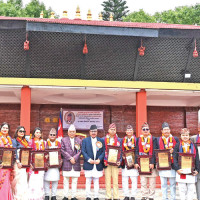
Using iron tools on challenging rock surfaces, they endeavoured to convey a message of historical diversity, etching reminders of past events onto the enduring stones. Dineshwor Mahato, the head of the Sculpture Department at the Nepal Academy of Fine Arts, enthusiastically participated in a 15-day sculpture workshop organised by the Lumbini Development Trust.
Reflecting on his experience, Mahato expressed joy in creating statues that vividly capture historical narratives.
Another sculptor, Sushmita Moktan, also shared her satisfaction after investing considerable effort in infusing the stones with artistic expressions.
During discussions with the media, Mahato delved into the historical and archaeological significance of Sagarhawa. This location is recognised as the site where, towards the end of Shakyamuni Buddha’s life, the Sakyas faced a massacre orchestrated by King Virudhaka, the son of Prasenajita Raja of Kosala, seeking revenge.
Situated 9 km away from the Kapilvastu’s district headquarters Taulihawa, 6 km north of Tilaurakot, and 7 km from Bangai on the East-West Highway, Sagarhawa also stands as the second bird reserve of Nepal, located south of Jagdishpur Lake. In the 7th century, Chinese pilgrim Huian Tsang mentioned in his travelogue the construction of numerous stupas on the west and south sides of Lake Sagarhawa in memory of the massacred Shakyas.
The first excavation in 1897 AD by Dr. Alois Anton Fuhrer revealed 17 large square stupas and numerous smaller stupas at Sagarhawa, containing materials like bone, gold, silver, crystal, and ruby. The area of Sagarhawa near Jagadishpur Lake spans in 52 bighas of land.
Seventeen idols depicting characters involved in the Shakyas massacre have been crafted during the 15-day workshop from January 8 to 22. Dhundiraj Bhattarai, treasurer of Lumbini Development Trust, shared that 15 sculptors, aided by 15 helpers, dedicated their efforts to crafting these statues.
Emphasising collaboration with the local community, Bhattarai highlighted the innovative approach taken to showcase the historical significance of the archaeological site and boost tourism.
Naradamani Hartmchhali, the Chancellor of Nepal Academy of Fine Arts, characterised the sculpture workshop in Kapilvastu as a comprehensive endeavour encompassing academic, cultural, technological and historical dimensions. He emphasised the need for establishing academic institutions at provincial and local levels to support such artistic and academic endeavours.
Sudip Paudel, the Mayor of Kapilvastu Municipality, said that the Trust’s initiative in conducting the sculpture workshop was lauded.
Supported by various organisations, the sculpture workshop, as noted by Kapil Gyawali, Secretary-General of Lumbini Tourism Journalists Association, has not only engaged the local community but also generated excitement. Financial support for the sculptors' expenses was provided by the Lumbini Development Trust through the Nepal Academy of Fine Arts, amounting to Rs.2.6 million.
-square-thumb.jpg)
-square-thumb.jpg)
-original-thumb.jpg)