- Sunday, 10 May 2026

Resilient South Korea Overcomes Challenges
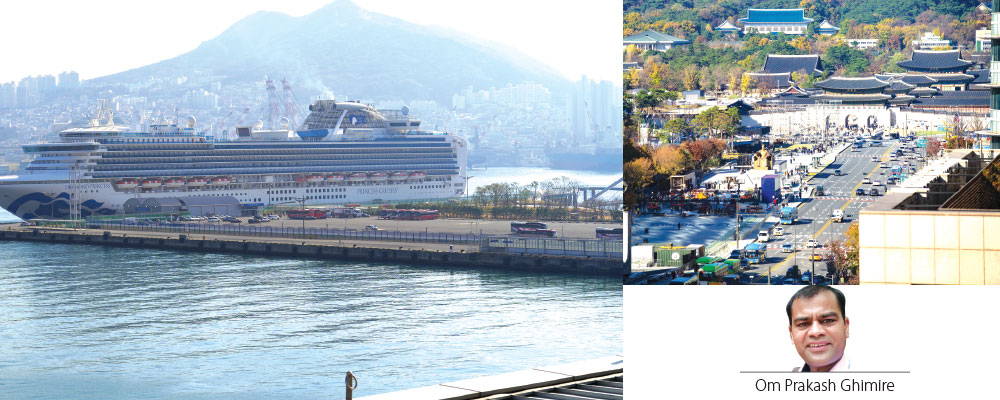

The 'Global Knowledge Exchange and Development Centre' is a knowledge hub located in Seoul, the capital city of South Korea. Within this centre, Korea’s development history is documented and demonstrated in a systematic manner.
During my recent visit to the Industrial Development Hall, one of the three halls of the Centre, a staff member pointed to a chart and said, “Despite the fact that Korea began its industrial development journey much later than the western world, it was able to achieve industrial progress within 50 years. For the western nations, it took nearly 200 years.”
This information sparked a curiosity in me to further understand the nation’s success in industrial development. Having gained independence in 1945 after 35 years of Japanese colonisation, the Korean Peninsula was divided into North Korea and South Korea. At the time of separation, South Korea lacked industries and factories. Also, it was going through a severe energy crisis, as about 80 per cent of energy sources were located in the North. The severe devastation caused by the Korean War (1950–July 1953) compelled the leadership to focus on addressing the basic needs of the citizens. Overcoming those challenges to realise the dream of a prosperous post-war Korea was necessary, but the leadership had to promptly tackle numerous other prevalent issues.
With the vision of transitioning the agriculture-based economy into an industrial one, thereby paving the way for the country's prosperity, Park Chung-hee, the immediate past president, who ascended to power through a military coup, articulated new goals and strategies for economic development. Aligned with his vision, in the 1960s, Korea formally declared its entry into the industrial era, leading to the establishment of the Korea Trade Promotion Institute and other agencies, along with the enactment of laws to boost exports. The same far-reaching thinking that guided Korea through its struggle to save the lives of its citizens has become the cornerstone of today's prosperous Korea.
Export-oriented policies
Until 1960, South Korea's economy heavily relied on agriculture, which constituted nearly 40 per cent of its industries. As the country was reeling from an acute shortage of energy, the then-Korean government prioritised production of goods requiring low energy consumption and initiated industrialization. Beginning with heavy machinery production, a long-term plan was devised. As part of that plan, the country adopted the policy of discouraging the assembly of imported parts from Japan. With the enactment of the Comprehensive Automobile Protection Act in 1962, the nation began manufacturing cars. In 1964, the Comprehensive Automobile Development Plan was endorsed, encouraging domestic car production. This plan is considered to be the starting point for Korean automobiles to exert influence on the global market today.
The government focused on energy savings for immediate consumption and creating employment opportunities for the production and export of light industrial goods. The effectiveness of that strategy is evident in the substantial increase in the export of light industrial products. In 1970, Korea's synthetic wig, a niche product, gained widespread popularity in the global market, resulting in a $94 million export value. This success highlights the prominence of Korea's third-largest export commodity at that time. Moreover, in the 1970s, Korea became the world's third-largest exporter of textiles. According to government statistics, textile exports in 1980 were 283 times higher than those in 1963.
In 1971, Korea’s total exports comprised of 72 per cent of light industrial goods. However, signs of a decline in the export of such goods observed in the same decade led the government to shift its focus to the production of deep-seated items such as automobiles, steel, ships, and other heavy-duty products.
To promote long-term benefits for the private sector, the government introduced specific initiatives in 1967, including low-interest loans, land management, targeted manpower training programmes, and assistance in the pre-investment sector. The government implemented six laws to attract investments in major industries such as automobiles, shipbuilding, and steel production. In 1986, those laws were consolidated under the Industrial Development Act, replacing outdated regulations. This initiative streamlined Korea's industrial development and exports, contributing to a substantial average growth of 16 per cent between 1960 and 1980.
Implemented in 1973, the Automobile Promotion Plan discouraged the production of assembled cars, and in line with this plan, in 1976, the "Pony" car from the "Hyundai" company became the first car exported to Ecuador, opening up the global market for Korean automobiles. The Pony gained immense popularity, selling over 1.5 million cars annually in the American market within the first seven years of its launch. After successfully passing 288 tests, Korea began producing its own Alpha engine in 1991. By 1995, it had become the fifth-largest car-producing country in the world. Today, Korea has established itself as a dominant force in the global car market. In the 1990s, Korea achieved remarkable success in the production and export of ships as well. The industrial development has laid a strong foundation, contributing significantly to its economic growth.
New horizons from crisis
In the second half of the 1990s, the global economic recession observed in many countries, such as America, led to a fall in Korean trade and the economy. Bankrupted major companies and bank interest rates were hiked to 25 per cent. The pace of the buildup of foreign currency reserves slowed alarmingly. To address this situation, a move was undertaken in 1997 where the citizens gave an amount of gold that is equivalent to US$2. It was through the combined effort of citizen and government action that this momentum played a role in enabling Korea to transcend the crisis, setting it firmly on a path for further growth.
After the 1990s, Korea achieved notable success in the export business of automobiles, ships, steel, and mobile phones, as well as electrical appliances. Currently, Korea holds a significant 25 per cent share of the global smartphone market.
In 1953, the per capita income of Korea was only $67. At that time, Korea was one of the most underdeveloped nations in the world. According to government records in 2018, this figure has significantly risen to $31,350 per person, marking an increase of more than 440 times. Currently, Korea is not only included in the list of developed countries, but it also holds global economic and industrial leadership. Its development model has become a lesson for the world. Koreans assert that today's prosperity was born from a moment of crisis. They take pride in this achievement and consider it a source of national pride.
Even in times of crisis, the leadership that makes sincere efforts for the country's development and wins the trust of the people will receive widespread public support. The lesson to be learned from Korea is that a nation can be built through such a trustworthy partnership.
In 1950, Nepal had an income of $50 per person, but now it has risen to around $1,200. However, in 1961, South Korea had a per capita income of $94, and today it has surged to over $32,000. This might be one of the reasons behind this level of public trust in the government.
The example of South Korea illustrates that when the state works diligently towards development, it not only achieves progress by breaking barriers and crises but also gains increased trust from its citizens.
(Ghimire serves as a development journalist and social science researcher.)
-square-thumb.jpg)
-original-thumb.jpg)