- Sunday, 10 May 2026

Waterbirds decline in Narayani River
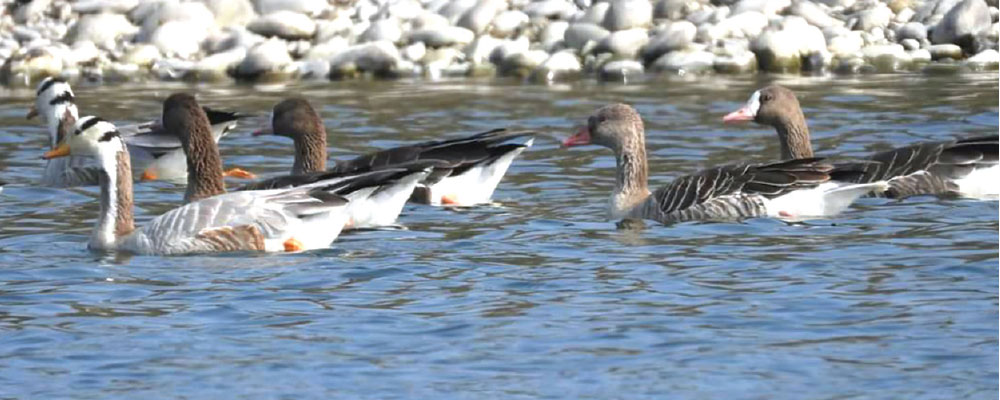

By Meena Kandel,Kawasoti, Jan. 18: The number of waterbirds visiting East Nawalparasi has decreased due to human activities, coupled with recent developments around the wetlands.
The waterbird census reveals a consistent decline in the number of birds found in the area each year, attributed to the destruction of the wetlands.
Ruddy Shelduck, commonly called Chakhewa in Nepali, used to be abundantly seen along the Narayani River towards Nawalpur. DB Chaudhary, the Bird Count Coordinator of Chitwan National Park West Sector, said that the number of birds has decreased by 50 per cent this year.
In the bird census conducted in 2021, 47 bird species were recorded in the area, whereas in 2022, only 37 species were documented. In last year's bird count, 43 species were identified, and this year, the number has further decreased to 41 species in the Narayani River area.
According to Chaudhary, the decline in the number of birds is attributed to both natural causes and human activities. Additionally, disruptions in their migratory routes, likely caused by changes in the environment, have contributed to the decrease. He added that two species were found in fewer numbers compared to the previous year.
The Eurasian Wigeon (Sindhure Hans), Common Pochard (Kailetauke Hans), Kentish Plover (Alak Chandra Raj Putrika), Wood Sandpiper (Ban Sud Sudia), and Dunlin (Thulo Jal Rang) were observed for the first time in the Narayani River, which were absent during last year's bird count.
Chaudhary reported that eight bird species observed last year were not present this year, while six new bird species were identified during the current year's bird count.
The decline in bird numbers is attributed to the disappearance of habitats essential for their migration, thanks to global warming. Chaudhary added, “The rivers are becoming increasingly polluted with the daily mixing of sewage and garbage into water sources, causing water bodies to dry up.
And the current bird population has significantly decreased compared to the past.”
A total of 162 bird species inhabit the water areas of Nepal, with 41 species identified in the Narayani River area this year. Out of the overall avian population in Nepal, over 200 species are reliant on water, including 100 species categorized as visiting birds.
During winter, visiting birds seek refuge in wetlands near rivers. Wetlands, often referred to as the kidneys of nature, are currently facing a crisis due to recent destruction.
In East Nawalparasi, bird counting was conducted in four groups, covering the areas from Sighrauli Golaghat to Amaltari, Sighrauli to Pitholi, Pitholi to Amaltari, and Amaltari to Triveni Gandak Barrage.
Every year, visiting birds from Siberia, China, Russia, Mongolia, Thailand, Korea, Burma, and other countries migrate to the Narayani River and its surrounding areas during this time. As a result, bird counting activities are conducted in the Narayani River region annually to monitor their presence.
The global bird census, initiated in 1967, commenced in Nepal in 1987. Since the same year, bird counting activities also began in the Chitwan National Park area. Concurrently, Tiger Tops Tharu Village and the Jatayu Restaurant Management Committee have been organising an annual bird count in the Chitwan National Park, West Sector, and East Nawalparasi, as mentioned by Tiger Tops manager Bhagirath Chaudhary.
Chaudhary said that the primary challenges contributing to the decline in the number of indigenous birds in the Narayani River and wetlands, including the park, are habitat loss, the absence of a comprehensive protection plan from relevant agencies, and illegal poaching.