- Sunday, 10 May 2026

Hard Time For Herders

Climate change is taking disastrous toll on the farmers in Manang district. Dwindling grazing land has increasingly pushed them out of agriculture and animal husbandry, their traditional occupations. As pasture land shrinks more and more every passing year, so does the number of grazing animals, begetting another grave problem: increasing threat of snow leopards. Unable to find enough prey which once used to be in abundance, snow leopards are increasingly foraying into human settlements in search of food. Feeling endangered by the increasing encounter with the wild beast, natives who have lived there for generations have been leaving what they have called home in droves. Those who had vowed to stay behind until a few years back despite the exodus of their neighbours, are now finding it unbearable to stay on. They are migrating to make new settlements in regions in lower altitudes.
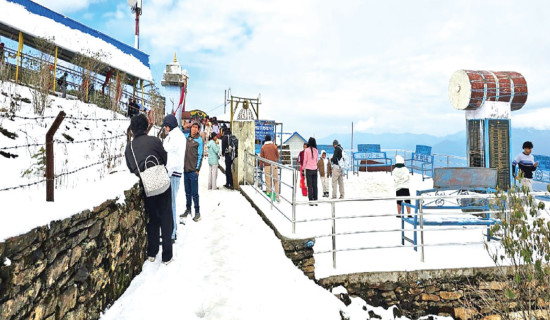
Despite the calendar approaching mid-January, Manang has received minimal amount of snowfall. The absence of snow has hindered the growth of grass, posing a significant threat to the livelihood of farmers in the area. Yak herders like Yangchu Khanda Lama, 60, in the district's Ngisyang Rural Municipality-5 used to store dry grass to feed cattle during the winter. But that is no longer the case, as the dire dearth of water makes it hard for grass to grow. This has added to the challenge to store and reserve dry grass to feed their cattle for another season. Earlier, yak used to graze without herdsmen in pasture. But nowadays, the farmers complain that the fear of snow leopards has made it impossible to be a herder.
Warming climate means glacial melt has accelerated in the Himalayas. Land once used for growing crops has turned barren. As temperature has risen, mosquitoes carrying diseases like malaria and dengue have started making their presence in the upper region where until recently that was unheard of. Climate scientists have warned that even if the world's most ambitious climate change goal was met, one-third of the Himalayan glaciers would melt by 2100. Climate change is remaking the Himalayan region, putting millions of people who depend on its water resources at risk and driving mountain dwellers from their homes.
In a country where a bulk of its population rely on agriculture for survival as well as livelihood, reduced water supply can shrink food production, which in turn can lead to rise in food prices. And food prices climbing to unaffordable levels is a recipe for instability and widespread violence, which we have seen in several countries. What's more, it also risks reversing the hard-earned gains in poverty alleviation and development. There is another danger: rapidly melting glaciers giving rise to glacial lakes, which threaten settlements and infrastructure downstream as the meltwater continuing to feed them will eventually lead to their bursts.
The glimpses of warmer future are everywhere, and so are its impacts. In the face of imminent perils that can bring even more devastation, we have no option but to adapt. Climate migrants must be the number one priority. The government should consider granting legal rights to the new land such migrants are now living in, having been driven out of their ancestral land. And those who have to abandon their traditional livelihood deserve to be given new means to make a living. This is where the green climate fund, particularly the one meant to redress the climate impacted loss and damage, should be used.