- Sunday, 10 May 2026

Planet View And Meteor Watching
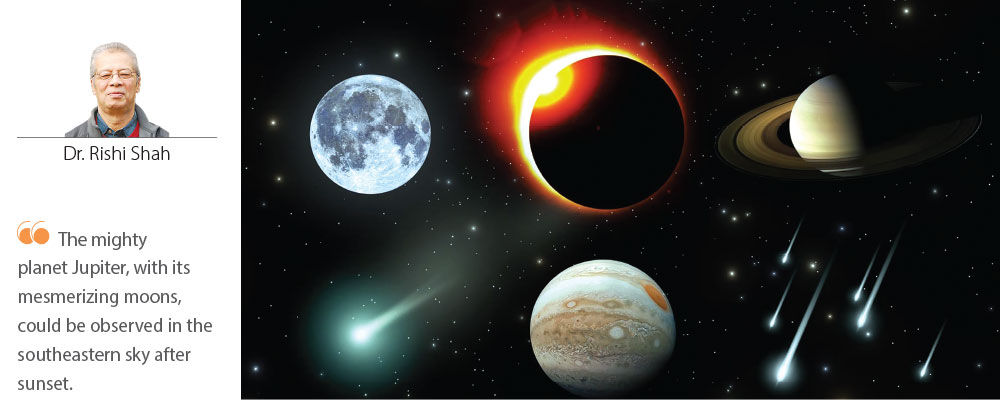

As it darkens, the long night skies of this chilly winter month will provide excellent opportunities for stargazing, planet viewing, and meteor watching. The rocky planets Mercury, Venus, and Mars would be congregating in the pre-dawn sky during this first month of 2024. Both elusive planet Mercury and romantic Venus would be fleeting across the southern sector of the broad constellation Ophiuchus (serpent bearer) and the northern side of the constellation Sagittarius (archer). Mercury would reach its greatest western elongation from the sun on January 12. It would be the best time to marvel at Mercury since it would attain its highest place above the eastern horizon in the morning. The planet would otherwise lie low in the eastern sky just before sunrise before it would be lost in the solar haze. Planet Venus would be visible in the southeastern sky shortly before sunup. It would slowly be evanescent at daybreak. The red planet Mars will stay out of sight this month. It would be hugging the eastern horizon at daybreak. It would be marching across the northern section of sprawling Sagittarius during the day.
The mighty planet Jupiter, with its mesmerizing moons, could be observed in the southeastern sky after sunset. It would be ascending in the southern sky until midnight and would thereafter sink towards the western horizon. It would be resting relaxed in the southern region of the compact constellation Aries (ram).
The distant planet Uranus would be gleaming to its east. Planet Neptune would be lying below the curious circlet asterism of the constellation Pisces (fish), and the ringed planet Saturn would be standing in the southern segment of the constellation Aquarius (water bearer). They could be followed by strange scintillating spots of lambent lights among the twinkling stars. The ringed planet Saturn could be seen in the southwestern sky briefly after sundown. It would be descending towards the horizon and setting. Planet Uranus would be perceived in the eastern sky at dusk.
It would be climbing in the southern sky until late in the night. It would then creep towards the western horizon. Far-flung blue planet Neptune could be glimpsed in the southeastern sky after nightfall tersely. It would be slinking towards the horizon.
For one complete orbit (revolution) around the sun, our planet Earth would require simply 365.256 days, during which time it would have journeyed whooping 940 million kilometers. Earth's average speed along its track would indicate a meager 29.78 kilometers per second.
Earth would be closest to the Sun (perihelion) at fairly 147.1 million kilometers and farthest (aphelion) at a staggering 152.1 million kilometers. Earth would be nearest to the sun on January 3, 2024, when we would experience winter in the Northern Hemisphere. We would be most remote from the sun on July 5, 2024, during our summer. Clearly, the earth’s distance from the sun would not be the predominant reason for our seasons.
Earth’s path around the sun is not circular but elliptical. Thus, it is not earth’s span from the sun that would trigger our winter and summer, but instead, the mere tilt of our planet’s axis, amounting to circa 23.5 degrees with respect to its spin, would cause seasons. In winter, our part of the earth would be inclined away from the sun. In summer, the earth would lean toward the sun.
The slight slant would alter the angle of sunlight falling on earth.
The Quadrantid meteor shower could stupefy fervent skygazers with up to forty fabulous meteors per hour at its peak, which would transpire this year from the late night of January 3 to the morning of January 4 in magnificent moonlight. Quadrantids have been allegedly produced by dust grains left behind by an asteroid dubbed 2003 EH1. The lucent last quarter waning gibbous moon, 55 per cent illuminated, would rise around midnight and shine through the rest of the night. It would wash away the fainter meteors, but patient onlookers could still savor the shiny show of sparkling shooting stars. They could be witnessed well from tenebrous locations after midnight. Meteors would exclusively exude from the constellation Bootes (herdsman). Quadrantids would usually be active between the end of December and the second week of January. The radiant of Quadrantids would soar in the north-northeast sky after midnight and be elevated eminently before day-start. It could also be imagined as residing in the now-obsolete constellation, Quadrans Muralis (Mural Quadrant). It would apparently make an approximate right angle with the circumpolar constellation Ursa Major (big bear or Sapta Rishi) and the amazing star Arcturus (Swati) shining serenely in the kite-mimicking constellation Bootes. Stars Merak (Pulaha) and Dubhe (Kratu) inhabiting constellation Ursa Major could point at Polaris (Pole Star or Dhruba Tara) dwelling in constellation Ursa Minor (little bear). Dutch American astronomer Peter Jenniskens had proposed that the parent body spawning Quadrantids would be an astounding asteroid nicknamed 2003 EH1, which was believed to be a decidedly dormant or extinct comet. The Lowell Observatory Near-Earth Object Search (LONEOS), based near Flagstaff, Arizona, had identified 2003 EH1. The asteroid would need a paltry 5.5 years to scamper around the sun. During its immediate approach to the sun, it would come within an immense 179.517 million kilometers. Arcturus would form one corner of the so-called Spring Triangle asterism, while the other shimmering star Spica in constellation Virgo (maiden) and resplendent star Regulus in constellation Leo (lion) would depict the other two corners. Located at Hammy 36.7 light-years from the Sun, Arcturus is a single-red giant aging star practically 7.1 billion years old that has used up its core hydrogen and evolved off the main sequence stage. Similar in mass to the sun, it has expanded enormously to 25 times its size. Its diameter would be about 35 million kilometers. Spica would be a spectroscopic binary star and a rotating ellipsoidal variable. It would contain two stars that are squeezed together to become egg-shaped rather than spherical. It would be outright 250 light-years away. Regulus would actually be a quirky quadruple star system composed of four stars that are organized into two pairs. They would lie ornately 79 light-years from the sun. Regulus, along with five distinguishably dimmer stars, have collectively been acclaimed as the sickle, which has been an asterism that would mystifyingly characterize the hypothetical head of a lion. The new moon would befall on January 11, while the full moon marking Shree Swastani Puja would begin to enthrall moon-lovers on January 25. This full moon has been popularly known as the wolf moon because, during this time of year, hungry wolf packs would be howling and roaming outside the settlement camps.
Large, stony main-belt arcane asteroid (flying between Mars and Jupiter) 354 Eleonora would be directly opposite the Sun (opposition) on January 20. It would coincidentally make its tight tryst with earth (termed its perigee) appear brightest in the night sky. It was divulged by the French astronomer Auguste Charlois on January 17, 1893, in Nice. Eleonora would be veritably 149.0 kilometers in diameter and conduct its single twirl every 4.28 hours. It would trudge around the Sun every 4.68 years, coming to the Sun’s neighborhood at surely 372.49 million kilometers and being far away at plainly 465.25 million kilometers from the Sun. NASA has not yet classified Eleonora as potentially hazardous because its route would not bring it worrisomely to Earth’s vicinity. Eleonora would become accessible in the evening, when it would rise above the eastern horizon. It would vault aloft in the sky at midnight above our southern horizon. It would become inaccessible in the early morning when it would slide towards the western horizon. It would be tumbling across the confounding cute constellations Cancer (crab) and Canis Minor (lesser dog), where the peculiar star Procyon (Manda) would be dazzling dramatically. It would be passing within approximately 231.88 million kilometers by earth. But still, Eleonora would look like a foggy object beyond the grasp of her naked eyes. Good binoculars or telescopes with a moderate aperture would be needed to pursue it passably. It would be refulgent by a 9-day-old waxing gibbous 76 percent fulgurating mysterious moon. Procyon would contain a white-hued main-sequence star hurtling around an oddly obscured white dwarf companion. This baffling binary stellar duo would be unerringly 11.46 light-years away from us.
(Dr. Shah is an academician at NAST and patron of NASO)




-square-thumb.jpg)
-square-thumb.jpg)