- Sunday, 10 May 2026

Asian Openbill Sanctuary In Kapilvastu
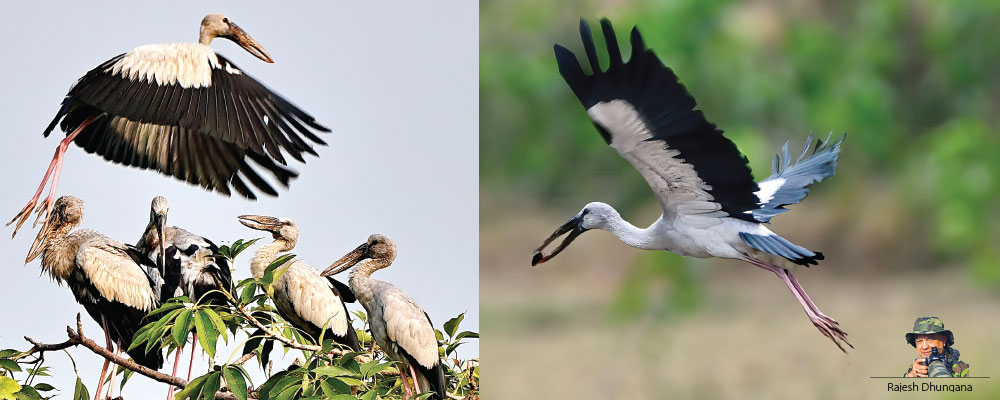

Kapilvastu, an ancient city in Nepal, has rich biodiversity and is a habitat for various bird species and small animals. Among its notable physical features is the expansive Jagadishpur wetland, the largest man-made bird sanctuary in the area, surrounded by small lakes, ponds, canals, and rivers. The region is renowned for its cultivation of paddy, wheat, and mustard, creating an environment conducive to the proliferation of snails.
One prominent resident bird found in the area is the Asian openbill, scientifically known as "Anastomus oscitans" and locally referred to as "Ghughifor" in Nepali or "Ghoghila" in the local language. This large wading bird, a member of the stork family Ciconiidae, lives in groups, often resting on trees across the landscape. The Asian Openbill's primary diet is snails, fish, and small aquatic creatures, including freshwater crabs.
In the winter, migratory birds visit Jagadishpur wetlands, with some opting to make it their permanent home. This influx enhances the ecological diversity of the region. The Asian openbills are useful for Kapilvastu farms because their droppings, which are full of nutrients like phosphorus and nitrogen, gather under their nesting trees. When it rains, these nutrients flow into the fields, making the soil better for farming and benefiting the local farmers a lot.
Historically, the Asian openbill was first definitively recorded in Nepal in Kuria Mahan of Chitwan National Park in 1964–65. Subsequent research by ornithologists documented their presence in various locations, both within and outside protected areas, including Rupandehi and Kapilvastu. According to local residents, the population of Asian openbills has increased significantly in recent years, emphasising the importance of preserving their habitat and recognising their ecological contributions to agriculture.
Features
The main distinguishing features of the Asian openbill are its long bill and legs and the hollow point of its bill. Its feathers are white, grey, and black, especially the wings. During breeding season, this bird is very bright, and the legs are light pink. The tail of this bird has 12 feathers and is tufted into a gland. After breeding, their colour becomes lighter, and the droppings appear grey. These birds are bigger and fatter than great egrets and smaller than cranes. This bird is called an openbill because of the opening in the middle of its beak. The shape of the beak helps the snail break out of its hard shell and eat it. This bird is completely carnivorous.
The cutting edges of mandibles have a fine, brush-like structure that gives them a better grip on snail shells. These birds look like white storks or oriental storks from a distance. Asian openbills are broad-winged and depend on hovering between warm air thermals for sustained flight. This bird rests in flocks while sitting in trees. The average body length of the Asian openbill is about 68 to 81 cm. Its wingspan is 147 to 149 cm, and its weight ranges from 1.3 kg to 8.9 kg. This bird stands at a height of 68 cm.
Ecology and habitat
Asian openbills tend to ascend thermals during the warmer part of the day and descend quickly to their feeding areas. Groups of birds may forage together in shallow water or marshland, where they can walk slowly and steadily. Asian openbills feed mainly on large molluscs, especially Pila species, and they use the tip of their beak to separate the shell from the mollusc's body. The lower tip of the beak is often turned to the right. The tip is inserted into the snail's shell, and the body is pulled out with the bill underwater. Thomas Caverhill Jerdon, an ornithologist, mentions that this bird is able to catch snails even with a blindfold. Small snails are often swallowed whole by this bird.
This bird is found in Nepal, Bangladesh, Cambodia, Bhutan, Laos, India, Myanmar, Sri Lanka, Pakistan, Vietnam, and Thailand. This bird is a resident that migrates locally depending on the water conditions.
Breeding
The Asian openbill faces severe threats, primarily from the loss and degradation of wetlands, ponds, and lakes, coupled with tree felling, illegal hunting, and pesticide use in agricultural fields. The species is particularly vulnerable due to a lack of public awareness, leading to locals climbing trees, creating obstacles, and stealing eggs and chicks. Additionally, young chicks in nests are preyed upon by various birds of prey like imperial, steppe, and great-spotted eagles. Samjhana Kawan, a biologist with extensive experience researching large bird species, identifies Kapilvastu as an ideal habitat for the Asian openbill. This district boasts the highest number of lakes and ponds among Nepal's lowland regions, supporting massive paddy plantations through irrigation canals and boreholes during the monsoon.
The wetlands, paddy fields, and scattered tree patches with tall trees like Peepal (Ficus religiosa) and Seemal (Bombax ceiba) provide an optimal environment for both the Asian open-bill and its prey, the apple snail (Pila globosa). Despite being widely distributed, the apple snail faces harvesting pressure, particularly from the Tharu community, which makes up 12.3 per cent of the district's population. Notably, Kapilvastu hosts more than 80 Asian openbill nests in a single tree, underscoring its significance as a highly suitable habitat for this species.
(The author is a wildlife photographer. The photos used in this article are by the author himself.)



-square-thumb.jpg)
-square-thumb.jpg)