- Sunday, 10 May 2026

Lesson From Gulf Nations’ Rise

The development momentum, achieved by the Gulf countries during the past few decades, has astonished the world, providing valuable lessons for other smaller countries which are struggling to lead their people to prosperity. Among the Gulf countries, Saudi Arabia, United Arab Emirates (UAE) and Qatar have achieved a miraculous transformation, lifting their people from dirt poverty 50 years ago to the frontline of prosperous nations. As these countries edge closer to geopolitical central stage on the strength of their economic prowess, they are also offering a huge job markets for unemployed youths from many countries of South Asia and South East Asia where the rate of unemployment is high.
Nepal alone has over 1.2 million youths working in various Gulf countries. But little do these countries appear to realise that they could gain more insight from their success stories than from their employment markets. One of the smallest countries Qatar, with tiny geography confined within 11,571 sq. km, has set an example on how a small country surrounded by hostile circumstances and limited resources can become prosperous and developed in a short span of time, achieving one of the highest GDP rankings in the world.
Qatar’s miraculous success
Qatar’s journey from an economically challenged country sustained by limited conventional resources like trade in pearls and marine foods extracted from the sea with the help of professional divers and limited trade with Saudi Arabia through surface road to a modern educated and prosperous country is unbelievable. Its ability to successfully organise FIFA World Cup Games-2022 gathering cumulative 3.4 million people in Doha has held the world in thrall.
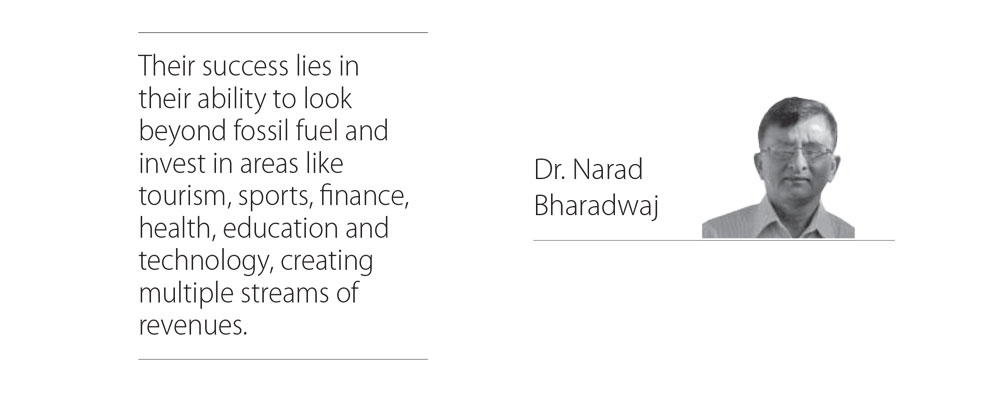
There is no doubt that almost all the Gulf countries have been endowed with massive reserves of oil and gas resources. But history shows that existence of resources alone is not sufficient to make countries prosperous and modernised. A careful study of the development paradigm followed by Arab countries shows that a visionary and determined leadership, farsighted strategic planning and prudential investment in sustainable future is critical for attaining development goals. Their success lies in their ability to look beyond fossil fuel and invest in areas like tourism, sports, finance, health, education and technology, creating multiple streams of revenues.
Qatar’s successful organisation of FIFA World Games -2022 was one of the major policy initiatives taken to diversify the sources of economy. Qatar, UAE and Saudi Arabia are now using the economic boom achieved through the sale of oil and gas resources as leverage for attaining goals of Vision-2030.They have a strategic goal of making their countries highly developed capable of ensuring decent standard of living for their people by 2030. As the Gulf region comes under intense impact of extreme weather conditions brought about rapid climate change, they are feeling the urgency of building resilient economy to cope with the unexpected climate emergencies.
In the face of surging heat index, rising sea level and the looming specter of having to shift from petroleum based to renewable energy resources in the near future, the Arab nations are already re-drafting their economic roadmap for the future. In response to the call for achieving the goals for Vision-2030, the largest and the richest country of the Gulf region Saudi Arabia has embarked on accomplishing a mega city project worth $500 billion to be built along the shore of the Red Sea. The dream city extending over 450 km will be totally run through renewable energy providing housing for 9 million people. Upon completion, this city is said to earn yearly revenue of $100 billion, contributing to $ 48 billion to GDP by 2030.
United Arab Emirates (UAE), too, is going all out to create economic resilience to sustain the shock of post petroleum era by building futuristic infrastructures in the field of commerce, tourism, sports, sustainable agriculture and other sectors with a view to provide a secured living for the people. It is making unbelievable investment in the field of air transport, railway networks, world class hotels and high-tech malls. Burj Khalifa, the tallest building in the world, Dubai Mall, one of the largest in the world and Palm Jumeirah, Earth Island are some of the iconic projects which the Emirate has invested on to ensure that revenue streams based on green resources will continue to sustain its economy even after weaning away from fossil fuel.
As a major strategy for diversified investment and laying emphasis on creating multiple revenue streams, almost all the Gulf countries are also investing sizeable amount of their revenue on sustainable food security through promoting cutting-edge technology to support agricultural projects. In 2020, the UAE decided to form a task force for developing modern agriculture to achieve self-sufficiency in foods. It is, now, investing a huge amount of resource in agricultural research in addition to supporting FAO’s efforts towards sustainable foods security in the world. According to a news report published on September 11, 2020, UAE has a plan to achieve 30 per cent self-sufficiency in foods by 2025.
Circuitous path
Saudi Arabia is also making serious efforts to reduce reliance on food import and create buffer against disruption in international supply chain. It has already achieved near self- sufficiency in poultry (70 per cent) meat (57per cent), fish (60 per cent). In dairy products Saudi Arabia and Qatar have already achieved self-sufficiency and are selling their surplus products to international markets. According to an Arab News article http://arab.news/c9jxm), Saudi Arabia has achieved 63 per cent self-sufficiency in value added agriculture sector.
The Gulf countries have travelled circuitous path to reach where they are today but the experience they have gained constitute rich knowledge resources for the countries negotiating their path to prosperity through the quagmire of problems. The lessons of their success stories could be that if a country’s leadership is visionary to identify sustainable resources and harness them prudentially, diversify revenue streams, make strategic planning aligning them with long-term goal and invest in future anticipating unforeseen geo-political, climatic and demographic challenges, a nation can successfully carve its path to development and prosperity.
(Dr. Bharadwaj is former ambassador and former chairperson of Gorkhapatra Corporation. bharadwajnarad@gmail.com.)