- Sunday, 10 May 2026

The Lure Of Electoral Office

El Salvador’s President Nayib Bukele, 42, has technically withdrawn from the presidency. Clearly, he has sounded the bugle for his candidacy to the high post that elections will decide probably by next June. The country’s Constitution does not allow more than a single term to a president. The Central American state of seven million people in the land of volcanoes and frequent earthquakes installed Bukele in office on June 1, 2019. El Salvador’s Supreme Court has given a verdict that a president out of office for a period of at least six months is eligible to run for a fresh term. This is how Bukele seeks to circumvent the spirit of the fundamental law of the land.
More than half of the 67 million eligible Egyptian voters in a country of 110 million last fortnight went to the polls to decide who their executive head of state would be. Incumbent President Abdel Fattah el-Sissi registered a comfortable victory to rule for another six years.
A career military officer, el-Sissi led a military overthrow of an elected Islamist president and was elected president in 2014 and also in 2018 with baffling ease. In an interesting twist in 2019, constitutional amendments were introduced and approved in a national referendum, which awarded two additional years to his second term. The new laws allowed him to run for a third term. Thousands of his critics have suffered intimidation and thousands of others jailed. That Arab world’s most populous country’s economy is in a shambles did not change the electoral results, though.
Lost in lust
Avid attraction to power and its attendant official trappings prompt some of those at the helm of public affairs to retain and prolong their stay through machinations. Limited term to an executive head envisages self-check on temptations to misuse position and bend existing regulations. However, in practice, principles get sidelined frequently. The United States is the first country that established the practice of no more than two terms for any president — a precedent set by its founder President George Washington.
Efforts to breach the precedent later on were unceremoniously defeated. In 1952, the world’s shortest constitution was amended to formally offer no more than two consecutive terms to anyone holding the nation’s top job. In the 1980s, a trend took hold to bar individuals from holding more than a fixed number of years in office. The single- or two-term constitutional ceiling became mandatory.
Misuse of office by elected executive heads of state, including unbecoming manipulation and dubious means, gave compelling reasons to people for having fixed terms so that the best side of an elected leader might get the better of him or her without. It was hoped that the elected executive head might thus have little incentive to compromise decisions and get involved in machinations with constant sight on extensions in the high office they begin to get addicted to.
Two South East Asian nations in the 1980s drew much world attention when they, almost back-to-back, had approved constitutions that allowed only a single term to their elected presidents. Following the 1986 People Power movement, led by assassinated leader Benigno Aquino’s widow Corazon Aquino, Filipinos had a new Constitution that allowed a fixed term of six years to a president. This was a direct outcome of the experience they had under the just ousted President Ferdinand Marcos, who went on self-exile on the advice of the US.
After Marcos became elected in December 1965, he grossly misused state machinery for enriching his family and coterie. His greed for power made him shed all qualms about throwing to the winds the ethical standards expected of the high office. Yet Marcos won election after election, even as popular disenchantment soared. Money power and other fraudulent methods combined to get him elected. The 1985 election was widely believed to have been rigged to the extent that massive crowds joined demonstrations on the streets of Manila for days until the Marcos family and his close relatives left for Hawaii, where the US gave him
Trying to cast aside the original spirit of the popular movement and the framing of the Constitution, Corazon Aquino who served as interim president and got elected for a four-year term was not satisfied even after staying in power for six years. She made moves to amend the Constitution to allow her contest for another term. A storm of protests against the bid made her to back out quickly.
Aquino endorsed Vice-President Gen. Fidel Ramos to succeed her. The army general, who had joined the People Power Revolution as it gained massive momentum on the streets of Manila against Marcos, was elected president. As his four-year term came close to end, he, too, nursed a desire for another term, only to drop it amidst heavy criticisms, including those from his one-time patron and predecessor Aquino.
In 1987, democracy movement champions in South Korea were impressed by the single-term constitution ceiling adopted in their fellow ASEAN member country, the Philippines. As a result, a provision for a four-year single term was adopted.
Hard facts
South Korean leaders have been smart enough not to digress from the popular will to serve their political expediency. Roh Tae-woo was South Korea’s first democratically elected president (1988-1993). Chun Doo-hwan came to power (1980-88) after a military takeover in 1979. It was during this period that his country recorded economic growth in dazzling speed and hosted not only the 1986 Asian Games but also the 1988 Olympics.
However, Chun and Roh, both buddies since their military academy days, were convicted in 1996 for the Gwangju army massacre in which up to 2,000 youth were said to have lost their lives. Chun received death sentence and Roh was given 22 years in prison, though a year later, the duo received presidential pardon under Kim Young-sam.
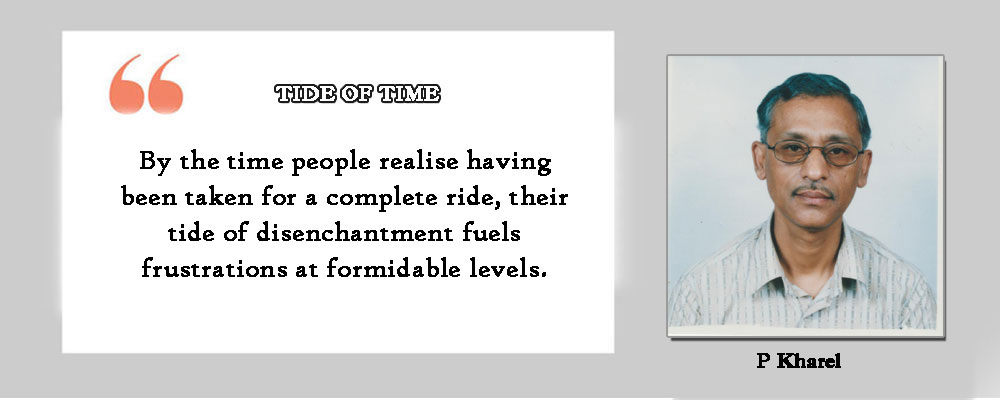
What will leaders do to honour the lofty pledges they make to the voting population? Banking on God-gifted quality in governing a nation does not buy anything enduring. Politicians in many countries in the past several decades have scaled the heights of unassailable position that at first were thought to be unattainable. By the time people realise having been taken for a complete ride, their tide of disenchantment fuels frustrations at formidable levels.
Term limit or not, delivery is the first concern of most voters. More so in countries where even the most basic of needs go missing. Proven credentials are cash crops that can be converted to lasting credibility.
(Professor Kharel specialises in political communication.)