- Sunday, 10 May 2026

This winter is going to be rainy: DHM
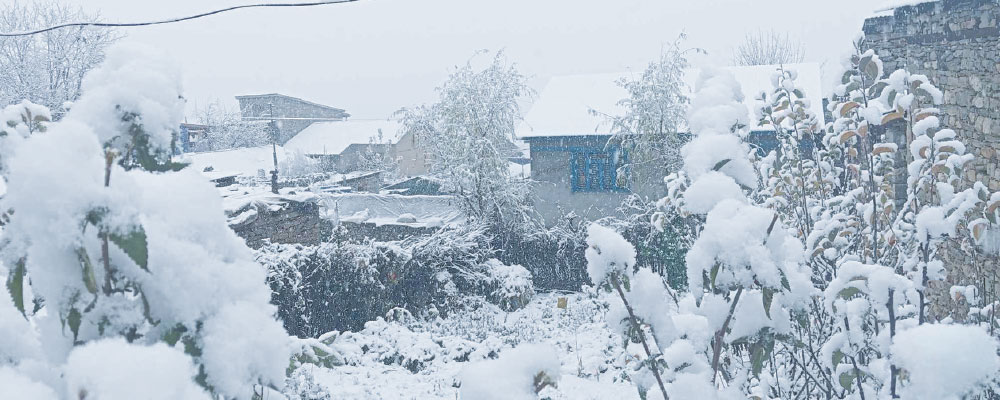

BY A STAFF REPORTER,Kathmandu, Dec. 12: The Department of Hydrology and Meteorology has forecasted above-normal rainfall in many areas of the country during the three winter months spanning from December 17 to February 17.
According to a bulletin issued by the Department of Hydrology and Meteorology (DHM) on Monday, it has mentioned that the maximum temperature in the central and northern parts of Sudurpaschim, Karnali, and Gandaki Provinces is expected to remain below average while the remaining provinces will experience above-average temperatures.
Additionally, the minimum temperature in Karnali, Gandaki and Koshi Provinces is forecasted to be below average during this period.
The DHM also predicted that there would be an increase in rainfall in the hilly and mountainous regions compared to the usual rainfall. The probability of above-average rainfall is between 55 per cent and 65 per cent in the northern and western parts of Sudurpaschim Province, the northern part of Karnali and Gandaki Provinces.
Likewise, there is a likelihood of above-average rainfall ranging from 45 to 55 per cent in the southern and southeastern regions of Sudurpaschim, the southern part of Karnali, the eastern section of Lumbini (excluding Bagmati), the northern part of Gandaki, and the northern and western areas of Koshi Provinces.
The likelihood of above-average rainfall is between 35 and 45 per cent in the northern part of Sudurpaschim, the western part of Lumbini, the central and southern regions of Bagmati, the northern part of Gandaki, and the northern and eastern sections of Koshi Provinces.
There is a possibility of below-average rainfall, ranging from 35 to 45 per cent, in the southern part of Koshi Province and the central and southern areas of Madhes Province, according to the DHM.
The department is conducting a global and regional level climate assessment by generating information on the World Meteorological Organisation (WMO) standards as well as the assessment of the DHM in the Himalayan region.
According to the bulletin, this assessment is prepared in coordination with the National Oceanic and Atmospheric Administration (NOAA) and is based on the current situation of El Nino and Southern Oscillation (ENSO) and the Indian Ocean Dipole (IOD) in the Pacific Ocean.
The present status of the El Nino in the Pacific Ocean is observed, and future climate predictions include the continuation of El Nino. Similarly, the two polarities of the Indian Ocean Dipole (IOD), which play a crucial role in the climate system, are also analysed and prepared for the upcoming seasons, the bulletin said.
The assessment includes the current temperature status and the final level of the ocean’s surface temperature in the vicinity of the equator. While seasonal climate predictions are challenging in various climate models and numerical models, the evaluation is critical in understanding the impact on global climate systems, land use practices, and local communities during changing seasons, it stated.
The term “Normal Rainfall and Temperature” sets a 30-year benchmark for climate data, defining a range of 33.3 per cent to 66.6 per cent for both variables.
“Below normal” or “above normal” conditions indicate that if the observed data falls below 33.3 per cent, it is considered below the typical range, and if it exceeds 66.6 per cent, it is regarded as above the typical range.