- Thursday, 23 April 2026

APEC: A Forum For Rapprochement
The 21 member economies of the Asia-Pacific Economic Cooperation (APEC) gathered in San Francisco in November (13-19) that brought together the United States President Joe Biden and Chinese President Xi Jinping. San Francisco came again into global spotlight, as it was here on June 26, 1945 that the United States along with the leaders of the 50 other countries “put pen to paper.” APEC summit is said to be the largest gathering since 1945.
The origin of APEC is traced back to a speech Australian Prime Minister Bob Hawke delivered in Seoul in January 1989. Founded in 1989 in Canberra with 12 members including the US, now expanded to 21 members including: Australia, Brunei Darussalam, Canada, People’s Republic of China, Chile, Hong Kong (China), Indonesia, Japan, Republic of Korea, Malaysia, Mexico, New Zealand, Papua New Guinea, Peru, The Philippines, The Russian Federation, Singapore, Chinese Taipei (Taiwan), Thailand, the United States, and Vietnam. They together house 2.95 billion people, constitute about 62 per cent global GDP and 48 per cent of world trade. India’s fastest growing economy ranking fifth globally presents an undeniable force in the Indo-Pacific region. APEC without India fails to reflect the evolving dynamics of the region.
Economic entities
They are referred to economies because they engage with each other primarily as economic entities rather than as sovereign nations as Taiwan and Hong Kong are members along with the People’s Republic of China. Chief Executive Officers of private industries and companies from across the Pacific region were in attendance. APEC summit met in the midst of the world getting more interconnected, interdependent and diverse and at the same time looking fractious in the midst of two ongoing wars in Ukraine and the Middle East, threatening to wider conflict.
The summit, themed "creating a resilient and sustainable future for all," issued a 16-point declaration, that includes among others commitment to a fair and transparent trade, climate change challenges, economic challenges, women empowerment, food security, renewable energy, integration and connectivity, transnational challenges such as pandemic, fostering an inclusive digital ecosystem, acknowledging the impact of corruption on growth and development, and promoting pathways for MSMEs and startups to thrive and innovate. Given the strategic environment across the globe, economies’ summit meeting was more focused on security. As world’s most important relationship is between the US and China for global peace, security and prosperity, headline news coming out of San Francisco was the US-China summit meeting.
The four-hour Xi-Biden meeting was the first since their Bali meeting on the sidelines of G20 in November 2022. They discussed fentanyl, military communication, direct contacts, Artificial Intelligence, economy, climate change, Middle East and Taiwan. Fentanyl is an ultra-deadly synthetic opioid that “has created worst drug problem in the US.” China promised to stem its flow into the US. President Xi reiterated his support for more open trade policies and opposition to protectionism, urged Washington to lift export controls for sensitive equipment and stronger bilateral financial and investment links. He said, “The world is big enough for two countries to succeed.”
The two leaders agreed to reopen communication between their militaries, direct contacts which, President Biden said was “to ensure that competition does not veer into conflict.” President Xi told the doors to talks between the “two superpowers cannot be closed again.” Beijing seeks to live in peaceful co-existence with the US and wants to be “a partner and friend.” President Xi urged President Biden to view US-China relations through the lenses of “accelerating global transformation unseen in a century.”
A series of high-level meetings in Beijing and Washington preceded the summit. US Secretary of State Antony Blinken travelled to Beijing in June 2023, met his counterpart Wang Yi and President Xi. In September 2023, the US Treasury Secretary Janet Yellen met Chinese vice premier He Lifeng, in charge of economic policy. Yellen said, “Decoupling the world’s two biggest economies would be disastrous,” to which China converges. Chinese Foreign Minister Wang visited Washington in late October and had high level meetings. These meetings were to restore communications and lay the groundwork for summit meetings.
Relations between them became frosty following the August 2022 visit to Taiwan by the then speaker of the US House of Representatives Nancy Pelosi and US downing of the Chinese spy balloon in February 2023. China was angry. The two incidents marked high profile flashpoints leading to further deterioration of US-China relations, and deepening their strategic competition. Beijing considers Taiwan as “potentially the biggest and most dangerous issue” and demands that respecting Beijing’s view on Taiwan was the “foundation” for productive US-China ties.
Global impact
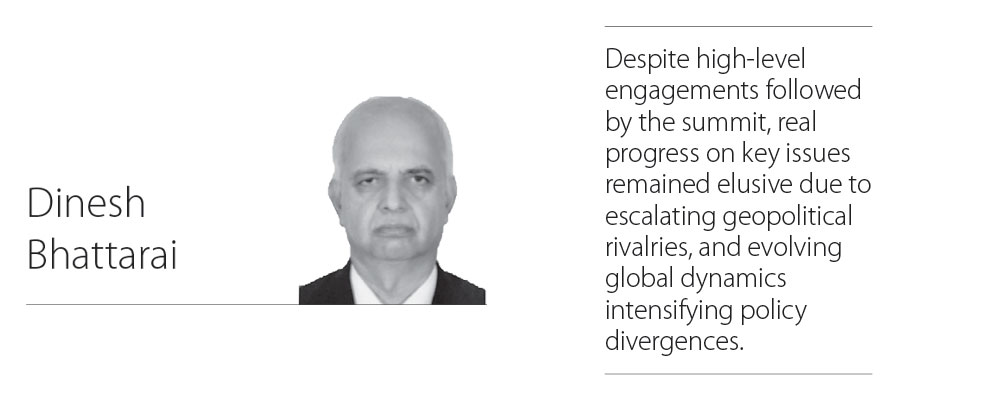
Despite high-level engagements followed by the summit, real progress on key issues remained elusive due to escalating geopolitical rivalries, and evolving global dynamics intensifying policy divergences. However, meeting between the two powerful countries and economies itself was an achievement. The Xi-Biden meeting could serve as a catalyst for regular discussions and talks, shaping the future of the world's pivotal relationship. Decisions made in San Francisco reverberate globally, impacting world peace, security and prosperity.
Trade, aid, investment, finance, services, data and technology are in driver seats of foreign policy, shaping economic dynamics and fostering interdependence for development. APEC summit shows how regional forums provide platform for rapprochement. This demonstrates the South Asian Association for Regional Cooperation in suspicion, tension and distrust, hampering the regional block to mitigate the risk of conflict.
Geopolitical tensions are escalating as global powers compete for power, influence and resources in the Indo-Pacific, now a focal point of American security. Beijing considers it a China containment strategy. Chinese President in 2014 said, “Let the people of Asia run the affairs of Asia, solve the problems of Asia and uphold the security of Asia.” China’s Global Security Initiative is the culmination of this thinking. Global Security Initiative (GSI) opposes efforts to contain China. Beijing has invited regional nations to sign the GSI. It is no secret that China wants to replace the US as global superpower. China, for now, wants Asia under its influence as the US has over the Western hemisphere. Nepal opposes being twisted between two powerful neighbours and squabbling superpowers, unequivocally affirming its commitment to non-alignment.
(Bhattarai, Ph. D., is a faculty member of the Institute of Crisis Management Studies (ICMS), Tribhuvan University. dineshbhattarai@tuicms.edu.np)