- Sunday, 31 May 2026

Power plant endangers Modi Khola
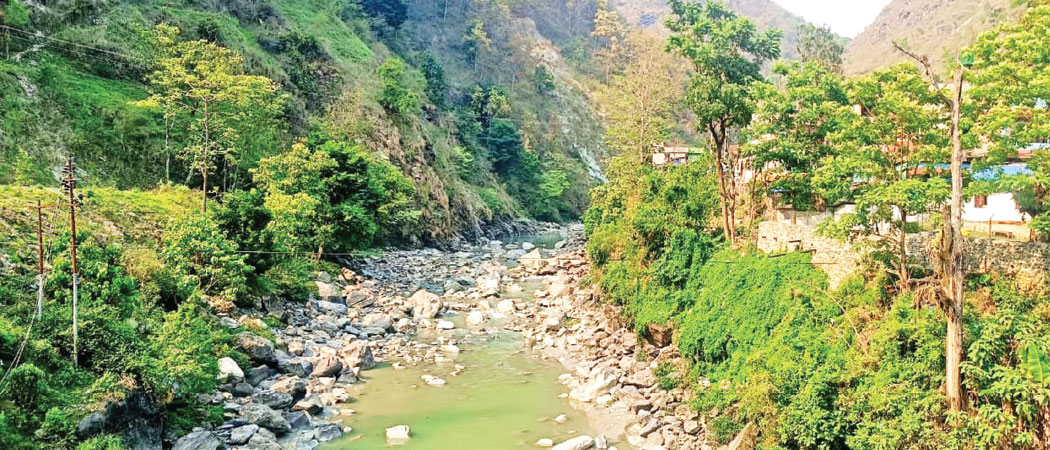
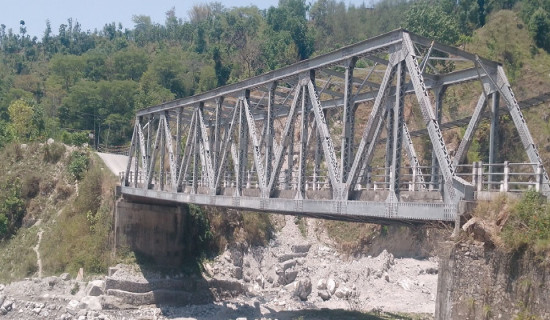
Photo: Sajan Pariyar/TRN Modi Khola in a dry state.

By Sajan Pariwar, Parbat, Apr. 23: Flowing from the foothills of the Annapurna range through Kaski to Parbat, the Modi Khola was once seen as a symbol of life, livelihoods and biodiversity. Known as an “energy river”, it now appears to be struggling to survive.
As hydropower projects expand rapidly, the river’s natural flow has declined, affecting both local lifestyles and the environment.
Until a few years ago, the Modi Khola flowed steadily in its natural rhythm. It was well known for its asala fish. Areas such as Birethanti, Nayapul and Ambot were famous for fish from the river.
Local people earned a living by fishing, while travellers and domestic tourists would stop there to enjoy the local catch. Vehicles travelling to Pokhara and Baglung often halted at Ambot for fish.
Today, however, these places are becoming quiet. As water levels drop, fish are disappearing, and the fishing business is in decline.
Locals said that hydropower projects have diverted water into dams, disrupting the river’s natural flow. Although there is a legal requirement to release a minimum amount of water, they complain that it is not properly enforced.
Local rights activist Madhav Paudel said, “All the projects on the Modi Khola have diverted almost the entire river for use, leaving it nearly dry. According to the rules, at least 10 per cent of the water should be released, but monitoring is weak.”
He added that this is affecting not only aquatic life but the entire ecosystem. “The river itself is under threat. Fish and other aquatic species are close to disappearing. Water sources are drying up, forests are being affected, and there is a growing shortage of irrigation for farming,” he said.
The history of hydropower on the Modi Khola is long. The first project, the Modi Khola Hydropower Centre with a capacity of 14 megawatts, was completed by the Nepal Electricity Authority in 2000. It was followed by the Lower Modi-1 Hydropower Project, which has been operating for over a decade. More recently, the 20-megawatt Lower Modi project has come into operation.
In addition, the private sector-operated Middle Modi Hydropower Project, with a capacity of 15.1 megawatts and backed by the Chaudhary Group, is already running.
The Nepal Electricity Authority is also constructing the Upper Modi project (40 megawatts) and Upper Modi ‘A’ project (18 megawatts) in the Birethanti area. Altogether, completed and ongoing projects along the relatively short river now total around 117.1 megawatts.
Ironically, despite so many projects, electricity generation itself is now being affected due to water shortages. According to Upendra Gautam, director of Lower Modi-1, additional upstream projects have reduced water flow downstream.
“When we designed the project, we estimated a certain level of water, but that is no longer available. Now it is difficult to generate even more than three megawatts,” he said.
While he claimed that their project releases more water than required, he acknowledged that the overall flow of the river has declined. This suggests that hydropower projects themselves could face long-term impacts.
Local businesses are also suffering. Gaurav Kshetri, who runs a hotel in Nayapul, said, “When we were young, we used to go fishing in the river with our brothers. The fish would be sold in our hotel. People travelled from far away to eat Modi Khola fish. Now, as the river is drying up, fish have disappeared and our business is declining.”
Environmentalists warned that a reduction in a river’s natural flow can cause serious long-term damage. A river is not just a channel of flowing water but the foundation of an entire ecosystem. While water use for hydropower is necessary, maintaining a minimum flow is essential.
Stakeholders have called for stricter enforcement of regulations, mandatory release of minimum water by every project, and regular monitoring. They warn that if timely action is not taken, the Modi Khola -- once known as an “energy river” -- could become part of history.