- Thursday, 23 April 2026

Tarai residents make meticulous preparations for Chhath festival
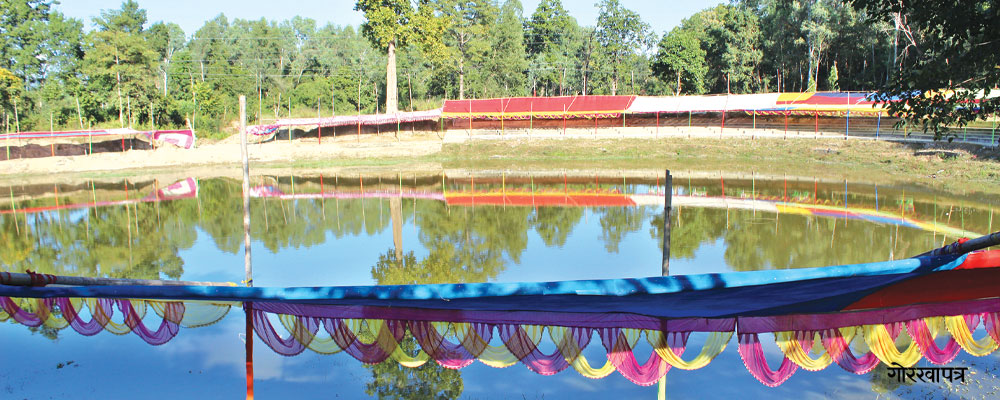
A pond prepared for Chhath Puja in Sarlahi district.Photo: Janarjan Khatri/TRN
By A Staff Reporter, Kathmandu, Nov. 19: After wrapping up the Tihar festival, Hindus in Nepal are now celebrating another famous festival – Chhath – on Sunday by praying and making offerings to the setting Sun in the evening.
Sunday has also been declared a national holiday. But it is not the only day the festival is observed. Chhath is celebrated for four days, with the first day being Nahaya Khaya, second day Kharna, the third day being the day to pray to the setting sun and the fourth day the day to pray to the rising sun.
On the first day, devotees take a dip in holy rivers and ponds, and clean their houses and surroundings. They also take food laced with ghee, and rice and milk, but refrain from consuming salt, onion, ginger and garlic.
On the second day, worshippers fast for the whole day and offer rice porridge or Kheer, Puris and fruits to the Sun god. They break their fast after the sun sets with one evening meal but then begin fasting again. For around the next 36 hours, they will not even drink water.
The devotees spend the third day preparing the Prasad. As mentioned, they pray to the setting sun on this day and make various offerings while standing knee-deep in water.
Revellers gather on the banks of rivers and ponds, decorated with flowers and colourful lights, in the evening and sing folk songs. On the fourth and final day, pilgrims make offerings to the rising Sun and break their nearly 40-hour fast. This is also done at the water bodies.
After the fasters return home, they give the prepared Prasad to their family members and relatives. This year, Chhath began on Friday and shall conclude on Monday. The dates for the festival are determined by lunar phases (Tithis). It starts on the fourth day of the bright fortnight of the Nepali month of Kartik (Kartik Shukla Chaturthi) and ends on the seventh day of the same fortnight (Kartik Shukla Saptami). These dates usually fall in the month of October or November in the Gregorian calendar.
Although people in the hills have also started celebrating the festival with great enthusiasm in recent years, Chhath is marked most grandly in the Tarai region of the country. Nonetheless, various spots along the Bagmati and Bishnumati Rivers, including Gaurighat, Kupondole and Kalimati, as well as ponds including Kamalpokhari, have been fixed in the capital Kathmandu for devotees to come and pray to the Sun God and Chhathi Maiya.
In Gaurighat, for instance, space has been managed to allow 550 families to pray, informed Anil Singh, president of the Chhath Puja Committee there. He also informed that the main rituals for praying to the Chhathi Maiya and making offerings to the setting sun would occur on Sunday after President Ramchandra Paudel formally initiates the puja ceremony. People observe Chhath and its abstentions for their families prosperity, progress and good health. They worship the sun to recognise it as the god of energy and life-force.
-square-thumb.jpg)



-original-thumb.jpg)