- Monday, 11 May 2026

Resolution Eludes Palestine

As if by design, Washington and Beijing have called for Israel’s restraint regarding its reaction to the recent events in the wake of Hamas’ raids in the Jewish state on October 7. President Joe Biden of the United States promised help but not invasion of Gaza and Wang Yi, China’s foreign minister, called for restraint. Predictably, the United Nations appealed for normalcy in the region affected by the aggravated level of conflict.
The Hamas raid took the Israeli and the rest of the world by a complete surprise both by the planning detail and the violence inflicted. More than 1,300 people, including those of ten Nepali agriculture students and at least 29 Americans, were killed in the Hamas raid. The militants have held 150 hostages, some of whom were reported killed in subsequent retaliatory raids by Israeli forces. In all, over 7000 Gaza people, many of them children, lost their lives and over 10,000 suffered injuries in the Israeli response to the October 7 attacks.
Before meeting Israeli Prime Minister Benjamin Netanyahu, the US president cautioned that it would be a “big mistake” if Israel occupied Gaza. China’s Foreign minister was more forthright when he said Israel had “gone beyond self-defence”. Israel’s most rightist coalition, led by Netanyahu, might face turmoil more than what might be initially speculated. With long-standing corruption charges and leading a coalition cabinet described as the country’s most rightist combination, the prime minister faces a survival game.
Call for caution
Given the messages from different corners of the world, including some traditional allies, Netanyahu must realise that his country treads a very complex ground and risks long-term complexities and uncertainties if a full-fledged attack was launched on Gaza for occupying the territory. Under the situation, it will lose much of the sympathy it had, and pave way for sowing seeds of running tensions at a time when a new world order is clearly in the making.
The manner in which Netanyahu had a law passed in parliament to constrict the supreme court would have invited howls of condemnation elsewhere by the very countries that have supported Israel so solidly since its modern identity as an independent state. Israeli settlements in Palestine have become a permanent cause of grievances for the Palestinians who see the settlers as foreign occupiers. Were more territories to be occupied, world patience would run very thin — something the extremist forces in the occupied lands anticipate would erode international sympathy for the Jewish state.
It would also generate renewed activism in the Arab world for a more proactive support for Palestinians. Israel has been receiving annual support of more than $4 billion from the US, most of it in military programmes. The Hamas’s October raid has embarrassed the Netanyahu government, many of whose people take the violent onslaught as a source of humiliation. Impressions of Israeli invincibility got hit hard, and Palestinian psychology. The Israeli state machinery was caught completely unaware, which attracted public anger against the Netanyahu government.
John Paul, an experienced official quit his job as the director of congressional and public affairs for the State Department to register protest over Biden’s “destructive” decision to supply more lethal weapons destined against Gaza. A week after the flare-up, Israel issued a directive to 1.2 million people in parts of the Gaza to evacuate their homes. A storm of protests and some of Israel’s allies stalled the order from being carried out. There were warnings that the “collective punishment of countless civilians” would tantamount to gross violation of human rights equivalent to “genocide” at the level of a war crime.
In the name of containing Hamas and removing its militant presence, any act of evicting large number of people from their place of work and residence would automatically bring into sharp focus the International Criminal Court’s controversial warrant against Russia’s President Vladimir Putin earlier this year. Israeli occupation of Gaza since the 1967 war and organising the settlements of Jews in the occupied swathes of land has attracted harsh criticisms internationally. Bombardment of a Gaza hospital killing at least 500 people drew quick and strong reactions from many governments. It will give a fresh lease of life to anti-Israel condemnations, the consensus being that the Palestinian people should not suffer for the horrific act that the Hamas perpetrated against innocent people in Israeli.
Israel’s far-rightist coalition might face turmoil more than what might be initially speculated. It was already in the midst of public anger following a law it forced through parliament to constrict the Supreme Court’s role and jurisdiction, which many believe was prompted by investigations related to corruption charges against Netanyahu. Had the law been introduced in countries not in accord with the major powers in Europe, it was bound to invite howls of condemnations from the very countries that have so solidly stood in support of Israel’s modern identity as an independent state.
Attack condemned
The African Union accused Israel of a deadly strike on Al-Ahli Arabi hospital of committing a "war crime". Many others have denounced the act that the Israeli government denies. The European Union said such attack against a civilian infrastructure went against international law. French President Emmanuel Macron declared "nothing can justify” the targeting of civilians.
Turkey’s President Recep Tayyip Erdogan issued a condemnation just as Jordan, Qatar and United Arab Emirates were among those in West Asia that issued strong reactions against the “brutal massacre" and "a heinous crime against defenceless civilians". At the popular level in Tunisia, thousands of angry men and women gathered to register their protest. Russia and the United Arab Emirates called for an emergency. The World Health Organisation condemned the deadly strike on the Gaza hospital.
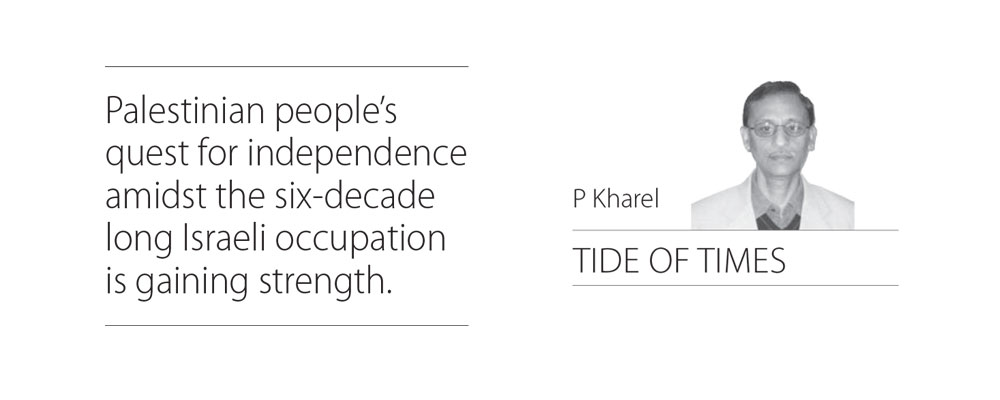
Fresh debates on the Palestinian issue are on. Palestinian people’s quest for independence amidst the six-decade long Israeli occupation is gaining strength. The US faces a tight situation in that it bears the lion’s share of aid and other support to Israel. The Gaza-Israel conflict in its latest spark brings to the fore the role Washington could play, i.e., if it chose to do so, in finally finding a resolution to the Palestine question that is both durable and workable. Guaranteed Israel’s independence and security by the US and other NATO powers should produce the long-awaited outcome.
(Professor Kharel specialises in political communication.)