- Monday, 11 May 2026

Ensure Justice To Conflict Victims

Despite months-long efforts made by a parliamentary subcommittee to build political consensus on the bill to revise the Enforced Disappearances Enquiry, Truth and Reconciliation Commission Act, no remarkable headway has been made as of now. About three weeks ago, the 11-member subcommittee under the Law, Justice and Human Rights Committee of the House of Representatives presented its inadequate report. The victims of the decade-long civil war, some political parties, civil society members and international community had felt it necessary for the parliament to amend some of the provisions incorporated in the bill in order to advance the prolonged transitional justice process.
The subcommittee was formed in the third week of May, entrusting it with the responsibility of finding consensus among the political parties representing in the parliament on the bill within 21 days. The team held a series of discussions in its bid to build consensus on the same. But the parties were not in unanimity when it comes to categorising killings as a serious violation of human rights and addressing cases of rape and other forms of sexual violence. The families who have lost their dear ones or got them disappeared during the conflict and international community have strongly raised their voices against giving amnesty to the perpetrators of gross violation of human rights. They have called for a victim-friendly transitional justice so as to get their traumas healed.
Flawed provisions
The bill that has been under consideration in the House of Representatives for about six months takes only ruthless murder as a serious violation of human rights. Different sections of the society have considered this provision as flawed one as it hampers the process of delivering justice to the victims. As the bill is critical in concluding the lingering transitional justice process, more than two dozen amendments to it have so far been filed. However, the report includes the provision for the victims to appeal in a special court to be formed provided they become discontented with reparations offered. The document proposes constituting various sub-units within the Truth and Reconciliation Commission (TRC) for different purposes such as truth-seeking and investigation, fixing reparations, probing into cases of rape, sexual violence, and other serious violations of human rights. There will also be another sub-unit dedicated to coordinating with the victims.
But the report remains silent about landmines that were planted haphazardly in different parts of the country. Another issue is that the report has not clearly defined disappearances. It has also not mentioned anything about former child combatants as well as the protection of witness. The Maoist insurgency in Nepal came to an end with the inking of the Comprehensive Peace Accord (CPA) between the seven-party alliance and the Communist Party of Nepal (Maoist) in November 2006. Undoubtedly, the CPA was a landmark event in the country’s peace process as it contributed towards bringing the then CPN-Maoist into the mainstream politics. With the engagement of the United Nations, the vital tasks of managing the weapons being used by the Maoist rebels and integrating the former Maoist combatants into the Nepali Army were carried out successfully.
Being a mediator of the peace process in the initial phase, the UN played a crucial role in conflict resolution. The Constituent Assembly elections were held twice under the supervision of the world body. In line with the CPA, the transitional justice process should also have been completed earlier. But it has remained disrupted for almost 17 years due to a lack of strong political determination. Attempts were made to grant amnesty even to all the perpetrators involved in killings and other grave violations of human rights. But those conspiracies were foiled by the Supreme Court (SC) verdict. Some years ago, the SC ordered the government to formulate laws that help bring the culprits of murder and violence to justice. Even the international community called on the government, political parties and other stakeholders to move the transitional justice process ahead only in line with international norms.
Despite the commitments expressed by the political parties to concluding the peace process soon, it could not advance accordingly. It was mainly because the political parties were unable to keep their promises. Instead, they were involved in power plays. Several years after the signing of the CPA, the country got the Act on the Commission on Investigation of Disappeared Persons, Truth and Reconciliation. Two transitional justice mechanisms --Truth and Reconciliation Commission (TRC) and the Commission for Investigation on Enforced Disappeared Persons (CIEDP) -- were put in place only in 2015. The Act had mandated those agencies to speed up the process of delivering transitional justice to the conflict victims and their kith and kin. The TRC got more than 60,000 complaints and about 3,200 cases were filed with the CIEDP. The conflict was so excruciating that more than 17,000 people had been killed. Thousands of people had been mutilated while many more rural people had been displaced.
Valuable opportunity
At a time when the UN has been showing its concern over the stalled transitional justice in Nepal, UN Secretary General Antonio Guterres is now here in the country on a four-day official visit at an invitation of Prime Minister Pushpa Kamal Dahal Prachanda. The UN chief is scheduled to address a joint session of the federal parliament tomorrow (Tuesday). He is expected to dwell on the nation’s peace process, among other issues, in his address to the parliament. He will also hold talks with top Nepali politicians on various issues, including the transitional justice process. His visit is anticipated to offer a valuable opportunity for the country to move towards concluding the delayed peace process.
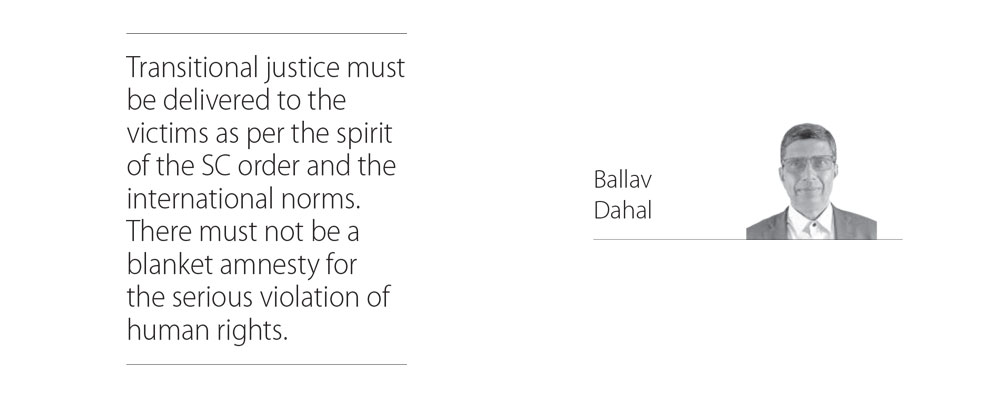
Prime Minister Prachanda seems to be committed to ending the peace process as soon as possible. Addressing the United Nations General Assembly (UNGA) on September 21, he had said that completing the remaining task of transitional justice was high on his political agenda. He had also sought goodwill and support from the international community for that. Transitional justice must be delivered to the victims as per the spirit of the SC order and the international norms. There must not be a blanket amnesty for the serious violation of human rights. The top leaders of various political parties need to come together for settling this contentious matter without further delay.
(The author is a freelancer.)