- Wednesday, 3 June 2026

Central committee meet of Unified Socialist starts

By A Staff Reporter,Kathmandu, Aug. 23: The central committee meeting of the ruling coalition party CPN (Unified Socialist) kicked off in Kathmandu on Tuesday.
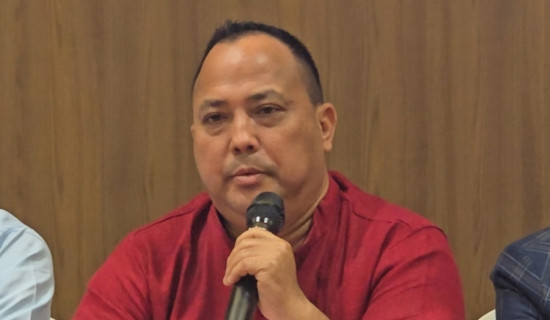
On the first day of the meeting, former Prime Minister and party chairman Madhav Kumar Nepal presented his 39-page political report.
The report included a comprehensive analysis of both national and international affairs, outlining the party’s position and political perspective.
In his political report, Nepal admitted the presence of shortcomings such as laziness, disappointment and passivity within the party ranks and files.
Stating that the emergence of such weaknesses can be attributed to several factors, he mentioned that there were individuals within the party who are undisciplined and engaged in efforts to tarnish the party's reputation.
Though these misconducts were not effectively managed in the past, they could not be overlooked or excused at present, his report added.
Nepal also highlighted the need for addressing these shortcomings, overcoming disappointment, instilling hope and enthusiasm among party ranks and performing the assigned responsibilities of the party with efficiency.
In another context, Chairman Nepal said the current ruling alliance is not on the brink of immediate dissolution and his party has no intention to quit the alliance.
He added, "The present ruling coalition has instilled hope for stable government for five years, ensuring good governance, and eradicating corruption."
"This coalition has been established to facilitate the functioning of the government in accordance with the structure of the existing parliament. While it may not be a permanent arrangement, there will be no immediate change either,” he clarified.
In another context, Chairman Nepal concluded that immediate unity with any other communist party is not possible.
“Considering this fact, Socialist Front has been formed to move forward with the parties sharing similar principles,” he added.
He also clarified that the idea that the socialist front would weaken the party had been inaccurately propagated and was not accurate.
Likewise, in his report, Nepal said the relevance of a people’s multi-party democracy still remains intact.
He, however, concluded that the attainment of socialism cannot be realised through people’s multi-party democracy.
His report read, “The political demands, slogans, and principles that were raised against feudalism within the framework of the people's multi-party democracy have been enshrined in the constitution. This constitutes a notable achievement,” he said.
“The people's multi-party democracy goes beyond being solely an anti-feudalism initiative; it also includes an anti-bureaucratic capitalism stance. It is not limited to a mere political agenda, but includes economic, social, and cultural transformation programmes,” the report added.
However, the practical implementation of the proposed programmes for economic, social, and cultural transformation is yet to be achieved, the political report stated.
Speaking at the meeting, senior leader of the party Jhalanath Khanal expressed his view that the relevance of people’s multi-party democracy, which the UML regarded as a guiding principle, has ended.