- Wednesday, 3 June 2026

Precious Notes Of Life
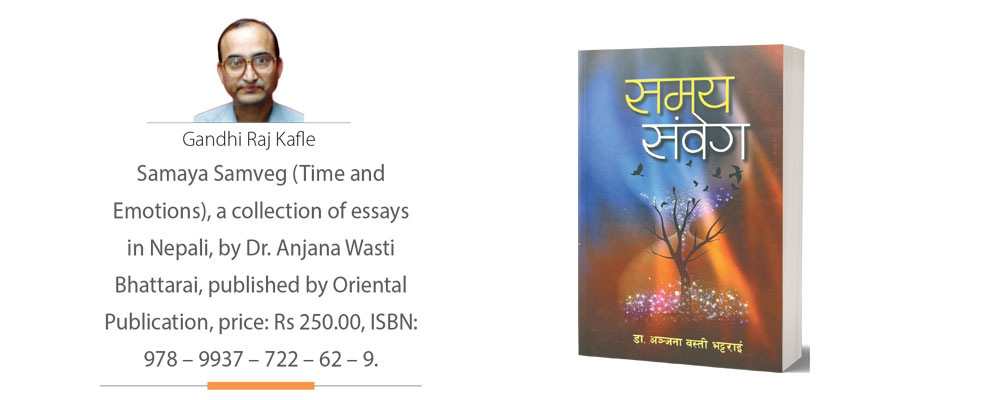

To link life with the canvass of time and interpret it genuinely is a complex literary work. Yet, litterateurs do it because they get extensive space to decorate their feelings in it. And they love to do this work because it is a work of their desire for serving readers.
However, the preference of today’s generations both in speaking and writing is for short. How can this demand for time be met? Naturally, this desire will not be fulfilled if short and sweet writing and speaking are not practiced in expressions.
Talking aforementioned remarks in the context of under review Nepali essay book entitled “Samaya Samveg” (Time and Emotions) by Dr Anjana Wasti Bhattarai; the efforts of the author to explain tough subjects of life in simple language is a shining merit in her expressions. Dr. Anjana’s literary art to put even small day-to-day affairs in the context of talks about globally challenging issues of life, especially of women, is broad. The point she has raised about women in this book is very sensitive, but she does it not to antagonize things in society. The crux point for her is to talk about women delicately and with honor.
Numerically speaking, this collection, which is 141 pages in size, contains twenty-one pieces of essays. The title the author has chosen to talk about is thematically practical. We can pick up a few of them for example here: First essay, “Tapain Pani Lekhnu Hunchha? “Tapain Lekhnu Hunna?” (You also write? Don’t you write? “Apechchha Mahilako” (Expectations of women), “Purushatwo and Pashutwo” (Manhood and Animalhood), “Namma Ke Chha” (What is in the name), and typically the two other important essays in it are – “Darpan” (Mirror) and “Thego” (Catchy Phrase), etc.
Thus, the canvass of the author to decorate feelings in this collection is broad and beautiful. She has the skills to pick up minor issues of family, society, and nation from memories for talking about them in the context of bigger issues at national or international levels.
She talks about her mother respectfully and after marriage, she has mentioned that she found the same emotional attachment with her mother-in-law because the values the mother and the mother-in-law inherited are the same. The other beautiful part about this collection is the author has maintained balance in descriptions of her childhood or youthhood memories of places like Dhankuta (her birthplace), and later Sunsari, Morang, and Jhapa with her lots of experiences during study and on the job period of life. And, remarkably, she is simple and sweet in her literary expressions in the pieces of this collection.
Even the title “Samaya Samveg” (Time and Emotions) is representatively thematic because time carries heterogeneous emotions of life and continuity is the hallmark feature of it. The sentiments flow the same way in this book.
The book, especially in its last pieces, is vocal about the issues of the Coronavirus. The protest of the author against the bid to commit bribery and corruption in the country is specific. Talking about state affairs, she compares even Kings of the nation in the past time because they naturally needed to follow protocol and formalities which were obstacles to interacting with people directly. But why this situation is unchanged even today? She questions people’s leaders, who rise from the ground, for becoming stoic and ego-centric in delivering public works once they reach power. This is her dissatisfaction during the time of the Coronavirus outbreak.
One similar piece from the book which is mentionable in this regard happens to be “Birendra Shahko Nepal Bhraman” (King Birendra Shah’s visit to Nepal). Birendra Shah was a soft-spoken, open-minded, and democratic king in the Shah dynasty of Nepal. Author Anjana Wasti Bhattarai has beautifully used the then King’s this credential to the chaos of our times imaginatively from the symbolic visit of late King Birendra. Here the readers will also know how pure sentiments she has for prosperity and good governance and criticism on the part of the author originated with hopes to correct the system under the republic set up of Nepal.
The other aspect, which is noticeable in this anthology, is the author has been skillful to describe serious issues in beautiful language. A few such examples in the book are the description of the local method of producing oil from mustard (Tel Pelne Kol) and about the way of talking with Thego (catchy phrases) and about similarities/dissimilarities of words making in the Nepali and English languages (page 89, 93 in the book).
In recent times Anjana Wasti has been active in writing for Nepali literature. The publication of “Samay Samveg” is a testimony to it.
(Kafle is a former Deputy Executive Editor of this daily.)