- Tuesday, 2 June 2026

A scientist's 4-decade quest to save the biggest monkey in the Americas
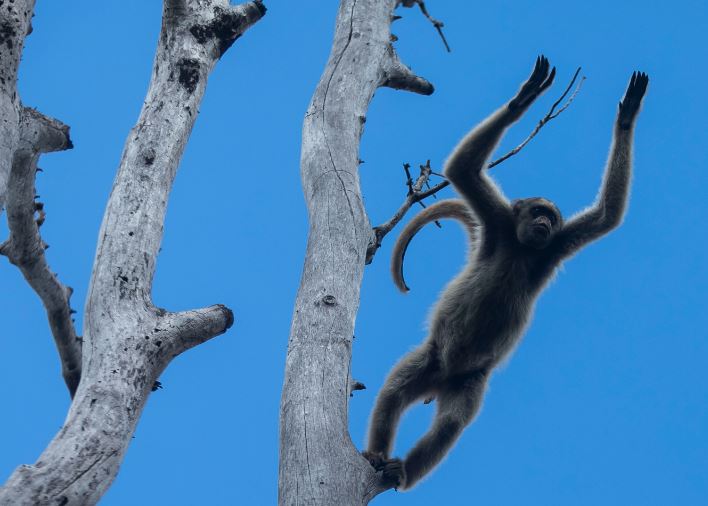

Caratinga, Brasil, June 28: The emerald-green canopy shifts and rustles as a troop of willowy, golden-gray monkeys slides through a tropical ecosystem more threatened than the Amazon.
Karen Strier started studying the biggest monkey in the Americas four decades ago, when there were just 50 of the animals left in this swath of the Atlantic forest, in southeastern Brazil's Minas Gerais state.
Strier immediately fell in love with the northern muriqui, dedicating her life to saving it and launching one of the world's longest-running primate studies.
“I love everything about them; they’re beautiful animals, they’re graceful, they even smell good, like cinnamon,” the American primatologist told The Associated Press on a recent field trip. “It was a complete and total sensory experience that appealed to my mind as a scientist, and to my mind as a person.”
Scientists then knew almost nothing of the species, except that it was on the verge of extinction. Rampant deforestation had dramatically reduced and fragmented its habitat, creating isolated pockets of muriquis.
To Strier's surprise, the northern muriqui turned out to be radically different from large primates studied by Jane Goodall and Dian Fossey, the primatologists who made chimpanzees and mountain gorillas, respectively, globally famous emblems of conservation.
Research was focusing on primates from Africa and Asia, where dominant males frequently fought one another to impose or maintain their power in highly hierarchical societies. Strier herself had spent six months studying baboons in Kenya.
“Muriquis are at the far other extreme of peacefulness,” she said.
In 1983, her first year of research, the biologist spent 14 months in the rainforest observing muriquis. This slender vegetarian can measure up to 5 feet (1.5 meters) from head to tail, and weigh up to 33 pounds (15 kilograms). While muriquis can live as long as 45 years, females can only give birth every three years, slowing down efforts to repopulate the species.
She noticed that males spent a lot of time in peaceful proximity — often within arm’s reach. And when there’s a contest for food, water or a female, males don’t fight like most other primates, but wait, avoid one another, or hug.
This unusually friendly behaviour has earned them the nickname “hippie monkey" among both ordinary people in the area, and scientists.
Some also refer to them as “forest gardeners,” for their role as seed dispersers. They eat fruits from high trees that many other animals cannot reach, and defecate the seeds on the forest floor.
Gender roles among muriquis also were unusual among large primates, Strier's initial research found. Much like bonobos, muriqui females are the same size as males, meaning they have a lot of autonomy, and in muriqui societies, females break off from the group to seek partners.
“We now see a lot more variations among primates, and I think the muriquis helped open that door to understanding better some of this diversity,” Strier said.
Inside the 2,300-acre (950-hectare) Feliciano Miguel Abdala reserve, a privately protected area where Strier has based her research program, the northern muriqui population has grown nearly fivefold, to 232. That’s about one-fifth of the critically endangered species’ overall population.
“There are very few (primate projects) that have run that long, continuously, and of that kind of quality in the world,” said American primatologist Russell Mittermeier, chief conservation officer at Re:wild, who introduced Strier to the muriquis. (AP)