- Tuesday, 26 May 2026

Nutrition Vital For Healthy Life
 Dr. Shyam P Lohani
Dr. Shyam P Lohani
Dr. Shyam P Lohani
Food is one of the major necessities for a human being to survive and thrive. The nutrients from consuming food give us the energy and nourishment for sustaining our daily activities and thus remain healthy. It has a great role in society, and our culture, and gives a certain identity to a community. The sensations and flavours it provides, consumption of food brings different experiences. Food security can only exist when all people, at all times, have physical and economic access to sufficient, safe, and nutritious food to meet their daily dietary needs and their preferences for an active and healthy life. However, efforts to end hunger, food insecurity, and malnutrition in all its forms are yet to be satisfactory.
Impacts
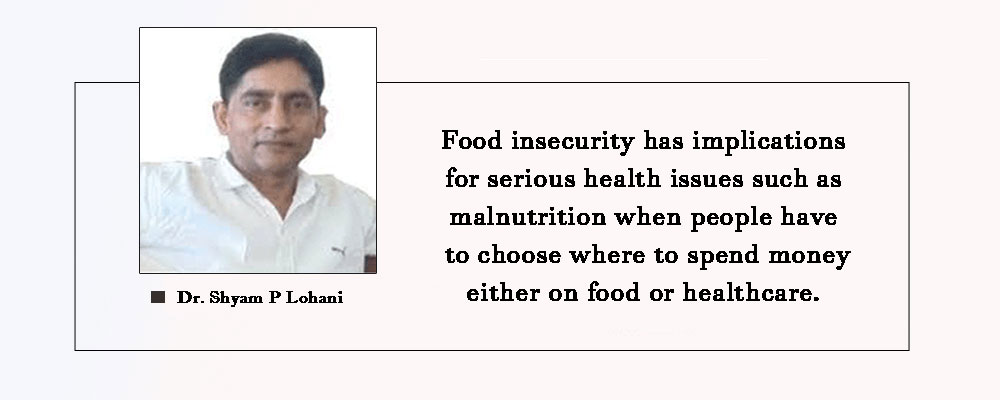
The causes of food insecurity are complex. There are several causes of food insecurity that include poverty, unemployment, low income, chronic health conditions, and lack of access to healthcare. Although it depends on circumstances, food insecurity can have a wide variety of impacts more specifically on health and welfare. Food insecurity has implications for serious health issues such as malnutrition when people have to choose where to spend money either on food or healthcare.
The goal to achieve many of the Sustainable Development Goal (SDG) 2 targets is growing broader with every passing year as we are just seven years away from 2030. Most governments are indeed placing tremendous efforts to make progress towards SDG 2. Yet they are not sufficient and truer in the face of a challenging and uncertain context. The present trends of war and conflict, climate change, and economic shocks are the major drivers behind recent food insecurity and malnutrition trends. At the same time, the increased cost of healthy foods and growing inequalities among people will continue to challenge issues such as food security and nutrition.
The recent trends of population growth worldwide show that additional 25,000 more people need to be fed every day. To meet the growing demand, over the next 50 years, the world needs to produce as much food as in the previous 10,000 years. The demand for food is projected to be increased by 60 per cent by 2050. According to the Asian Development Bank (ADB), a 10 per cent rise in domestic food prices could push an additional 64 million people into poverty. Rising food prices will also further reduce the quality of life of families who were already in poverty.
Malnutrition crisis
The current global hunger and malnutrition crisis is massive with more than 345 million people facing high level of food insecurity in 2023 which is more than double the number in 2020. An estimated 900,000 people worldwide are fighting to survive catastrophic hunger. This number is ten times more than five years ago, a worryingly speedy increase. The global community must not fail in its promise to end hunger and malnutrition by 2030 for which an immediate and concrete response is warranted.
At present, 820 million people go to bed hungry every day but at the same time, 670 million people are obese. Other statistics show, 1 billion people are vitamin D deficient and over half of the world population i.e. 4 billion are iron deficient. Over the past century, more than 90 per cent of crop varieties have disappeared and today, just nine plant species account for 66 per cent of total crop production which is thought to be responsible for ubiquitous health risks such as diabetes, obesity, and malnutrition. Food production, distribution, and consumption worldwide have also changed dramatically. Thus, we now focus on new ways of thinking about hunger and food insecurity and its close link to health.
There are places where severe food insecurity exists, but even moderate food insecurity is worrying. In the case of those who are moderately food insecure, access to food remains uncertain. In order to access food, those people might have to sacrifice other basic needs such as medicines. Such a case results in consuming food that is most readily available or cheapest, which in turn may not be nutritious. The dangerous rise in obesity and other forms of malnutrition is partly due to this trend. Easily available highly processed foods that are energy-dense, high in saturated fats, sugars, and salt are often cheaper and readily available than fresh fruits and vegetables.
Food security
Eating junk/fast foods may mean that the daily requirement of calories is met, albeit we are missing essential nutrients to keep our bodies healthy and functioning well. In addition, the stress of living with uncertain access to food and going through periods without food can lead to physiological changes that can contribute to overweight and obesity. Children facing hunger, food insecurity, and undernutrition today may have a higher risk of being overweight and obese, and suffer from chronic diseases like diabetes later in life. In many parts of the world, undernutrition and obesity coexist and both are the result of food insecurity.
The demand for food is projected to increase by 60 per cent by 2050. Therefore, the decisions we make today will have an enormous impact on food security and, by extension, on the environment, economy, health, education, peace, and human rights. The primary responsibility lies on the government. However, everyone should feel responsible for their share of food. The lack of an efficient supply chain has resulted in the wastage of food in many parts of the world nowadays. Thus, it is urged all stakeholders come together for brainstorming on achieving food security, ending hunger, and healthy life.
(Dr. Lohani is the clinical director at the Nepal Drug and Poison Information Centre. lohanis@gmail.com)