- Tuesday, 2 June 2026

Anthology Of Senior Citizens

The wrong notion that senior citizens are compelled to be at the mercy and remain mere liabilities rather than assets particularly applies in Nepal, where there is a misplaced feeling that only those in power or attached to its strings can exercise better judgment. Retired people are treated with disdain, despite lip service being paid here and there, including the ritual appendage of senior citizens in the composite nomenclature of a ministry at the federal level.
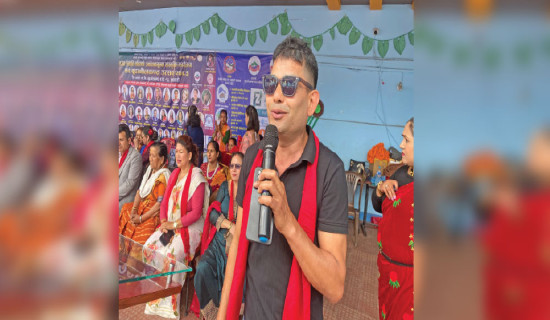
Possibly as a stern signal of rebuttal and even rebuke to perceived trends in society, a group of 25 senior citizens under the sponsorship of Jestha Naagarik Milan Kendra (the center for the union of senior citizens) and Paakaako Chautaari (the forum of senior people) has taken the lead to publish a collective autobiography, making the exercise quite worthwhile and interestingly readable.
It amply shows that retirement from a profession or undertaking doesn't necessarily mean that they are tired people but continue to have versatile brains and active approaches to issues, individuals, and events.
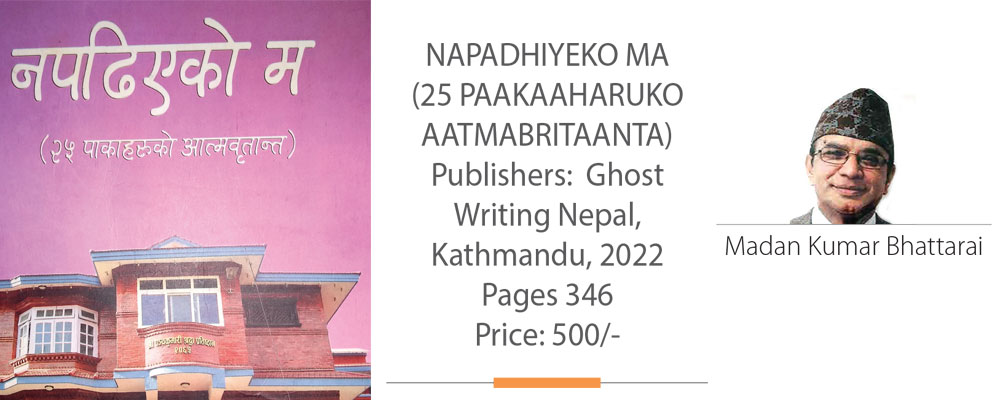
Ghost Writing Nepal has taken the initiative to publish the book entitled NAPADHIYEKO MA (25 PAAKAAHARUKO AATMABRITAANTA) roughly meaning I Am Unread (Memoirs of 25 Senior People) that succinctly portrays expertise, experience, and thought process of enlightened senior citizens. The book starts with the message of an active nonagenarian who has made a name and fame as a writer, activist, and senior journalist, Bhairab Risal.
Risal's words are more prescriptive for senior citizens in the sense that they become a three-point advisory. This includes a suggestion for reading books as a judiciously constructive method of utilizing pensionary or other benefits, taking weal and woe as revolving parts of the same coin, and consuming enough water to keep the body system functioning.
The book also pays tributes to Kuber Sharma who made a significant mark as one of Nepal's leading chartered accountants and even politicians. He passed away in 2021. Bidur Mainali, Chairman of Panchakumari Shraddhaa Pratisthaan provides a venue for a meeting of senior citizens and is the moving spirit behind the new publication, has given a background of how the book was conceived despite delays in publication on account of the COVID-19 pandemic.
At the outset, let me first pay tributes to one of the contributors Bholanath Kandel who is, unfortunately, no more. Kandel who combined the unique attributes of a civil servant attached to the Employees' Provident Fund, a government entity, and participation in cultural activities, especially Nepali drama, has given a wonderful description of his rather philosophical bent of mind, his family and its origin with migration from Gorkha to the core urban area of Kathmandu before shifting to Baneshwar.
Among the rest of the two dozen contributors, civil servants occupy the major chunk. They include Achyut Prasad Koirala, Ishwar Chandra Sharma, Rishi Ram Sharma (Sigdel), Dr. Keshav Chandra Sharma, Dr. Jagadish Chandra Baral, Padma Lal Paudel, Punya Prasad Luitel, Ramananda Mishra, Shiva Prasad Sharma Pudasaini, Devi Das Koirala, Dwarika Prasad Sharma, Shiva Raj Mainali, Bishwa Nath Upreti, and Dr. Dwarika Nath Dhungel.
Achyut Prasad Koirala depicts the poor status of decision-making in Nepal as he and his batchmates were forced to seek the good office of Prince Gyanendra to get formal appointment letters even after being cleared by Public Service Commission. He also credits our ace diplomat Professor Yadunath Khanal for saving his job when he was subjected to problems from the senior authority of the Royal Palace.
Dwarika Prasad Sharma gives his perspective of the eye-witness experience of the inauguration of Koshi Barrage by King Mahendra and Prime Minister Lal Bahadur Shastri when he was yet to join the service.
While all others acquired senior positions in government bureaucracy or organs owned by the government, Dr. Dhungel, also a prolific writer, reached the status of Secretary in various ministries and also served as Executive Director of the Institute of Integrated Development Studies (IIDS). Devi Das Koirala gives a good account of the National Development Service which was a compulsory part of the master’s level curriculum in those days.
Despite different perspectives, backgrounds, and perceptions, at least in one subject, that is, summary dismissals of thousands of government servants in 1992 through arbitrary amendments of civil service rules made by the first post-1990 elected government in the wake of its success in getting a massive majority, taken as Nepal's biggest administrative massacre, there seems to be a substantially same conclusion on the part of senior government officials.
Academic-minded Dr. Keshav Chandra Sharma, himself the victim, calls it a Tsunami of dismissals. Dr. Jagdish Chandra Baral terms the decision a great earthquake even comparing it to Rana-style Pajani (outright dismissal). Dr. Dwarika Nath Dhungel calls it Kot Parva (massacre carried out in the court) in civil administration comparing it with Jang Bahadur's forceful seizure of political authority in September 1846 in a violent coup heralding the beginning of 104 years of Rana autocracy.
Krishna Prasad Bhandari being seniormost in the group and about to strike a century, has written a very useful episode of his eventful life with sarcastic comments about what he calls the rise of unworthy and undeserving at the cost of honesty and merit in Nepal. Likewise, Krishna Prasad Devkota has given a personal perspective of long involvements in the United Mission to Nepal and Agricultural Projects Services Center.
Others who have contributed articles are Uddhab Dhungana, Khadga Raj Mainali, Jaya Prakash Bhushal, Dal Bahadur Thapa, Narayan Hari Upadhyaya, Prabha Mainali (Lamsal), Yadunath Guragain and Bidur Mainali. Dal Bahadur Thapa gives a good account of Yoga and other healthy exercises being rendered at the Panchakumari Shraddhaa Pratisthaan and also talks about the historical aspects of Godar Thapas.
Khadga Raj Mainali depicts among other things, his experience with Chirika Bhai Raman Tamrakar and his spouse Krishna Tamrakar who made a name by her powerful voice over Radio Nepal and sadly passed away only recently. Chirika Bhai popularly called CV, was a youth leader to visit Europe as early as 1953.
There is a combination among contributors of brothers in Ishwar Chandra Sharma and Dr. Keshav Chandra Sharma, Shiva Prasad Sharma Pudasaini (incidentally once our boss) and Dwarika Prasad Sharma, and the lone case of a couple, Bidur Mainali and Prabha Mainali (Lamsal), the only instance of a female contributor in the anthology. We applaud the senior citizens for their exemplary and thoughtful initiative.
(Dr. Bhattarai is a former foreign secretary, ambassador and author.)