- Tuesday, 2 June 2026

Gorkhapatra: The Pride Of The Nation

It is needless to say that the Gorkhapatra has played a key role in the development of print journalism in Nepal for more than a century. This is probably among very few publications in the entire South Asia to serve the readers unceasingly for such a long time. When this newspaper came into being, the literacy rate in the nation and the people’s level of understanding were quite low. A conservative mindset was dominant in society. Amidst that scenario, the Gorkhapatra made a significant contribution to bringing about social change by disseminating news and views to the public.
The Gorkhapatra is the oldest broadsheet daily run by the state. However, this publication is regarded as the second Nepali-language newspaper after Sudha Sagar, a monthly literary magazine, to have been published in Nepal. The credit for launching the Gorkhapatra goes to the then-prime minister, Dev Shumsher Rana. Bringing out a newspaper during the dictatorial Rana rule was a very challenging task. The newspaper started being published every week since Baisakh 24, 1958 BS (May 6, 1901 AD). The nation’s pioneer newspaper turned out to be bi-weekly from Asoj 29, 2000 BS. It began being printed thrice a week from Poush 8, 2003 BS, while the publication became daily from Falgun 7, 2017 BS.
Landmark phenomenon
The launching of a newspaper during the Rana oligarchy rule was a landmark phenomenon. It was possible only because of Dev Shumsher, who was one of the most liberal Rana rulers. He had wanted to increase the level of awareness among the people and advance the nation to the path of development. Historical documents show that the newspaper, at the outset, was managed by Pandit Nara Dev Pandey. Denoted as Talukdar, Pandey was provided with a 14-point list of do's and don'ts in regard to the matters to be printed. Dev Shumsher, however, was able to remain in power only for a short period. The generous and reformist ruler was succeeded by his own brother, Chandra Shumsher.
Dev Shumsher planned to step up a lot of reform measures to achieve socio-economic progress, but the rivals within the Rana family were unhappy with his benevolent ideas. In fact, Dev Shumsher had a great vision for the nation’s overall development. He came up with a plan to promote universal education through the opening of many primary schools across the country. He was also in favour of putting an end to the slavery system and introduce numerous social welfare schemes. He is also said to have made attempts to make sweeping social reforms. As he envisaged a free and open society, he used to listen even to the representatives of the suppressed sections.
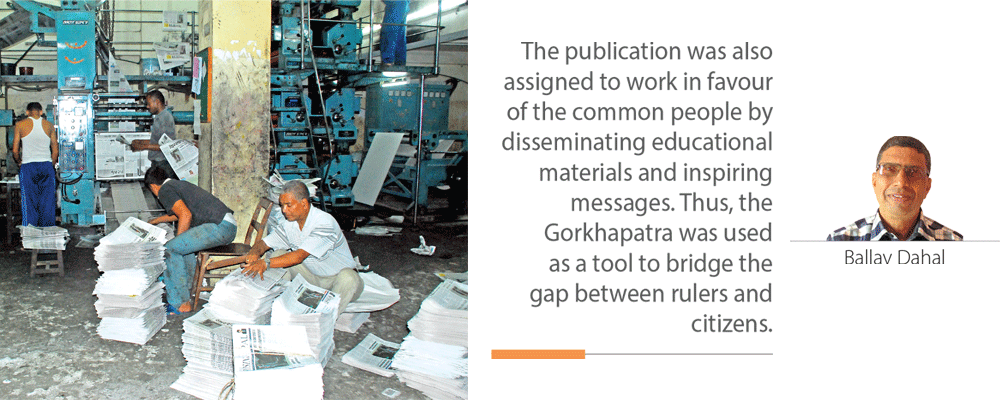
The Gorkhapatra had to carry out its responsibility of publishing news and information regarding vital sectors like agriculture, education and health for the people. The publication was also assigned to work in favour of the common people by disseminating educational materials and inspiring messages. Thus, the Gorkhapatra was used as a tool to bridge the gap between rulers and citizens. The newspaper also had to create public awareness against various social problems like corruption, witchcraft and other difficulties prevailing in society. In addition, the newspaper was used as an instrument for the rulers to receive feedback from the people living across the country.
It may be worthwhile to recall one of the decrees issued by Dev Shumsher. He wanted the Gorkhapatra to bring any unwarranted decisions made in courtrooms to light. That shows that he intended to establish the rule of law and accountability. Besides, he had entrusted the publication with the responsibility of highlighting delays and carelessness on the part of government officials and their absence in their offices during duty hours. In addition, he had not been in favour of using the publication to misinform the public. He had clearly instructed the newspaper not to publish any materials to praise him.
Distinct position
Gorkhapatra remained synonymous with the newspaper for many decades in the country. With the advent of multiparty democracy in 1990, the nation has witnessed an unprecedented growth in both print and electronic media. The main reason behind such an advancement of the media industry is the liberal economic policy adopted by the successive governments. Over the years, the country also experienced a rapid rise in the number of online media or new media, thanks to the revolution brought about in the information and communication technology (ICT).
Even in this changed context, the Gorkhapatra occupies a distinct position in the nation’s media industry. The Gorkhapatra Corporation has two dailies— the Gorkhapatra and The Rising Nepal—and three monthlies (Madhupark, Yuva Manch and Muna). These publications have been scrambling to adapt themselves to the new environment. All these publications are now available in print as well as digital versions.
This publication house has definitely served as the country’s important journalism school, providing practical knowledge and skills to a lot of aspiring Nepali journalists. The Gorkhapatra marks its 123rd anniversary today. In view of its great legacy, the Gorkhapatra is a major national treasure. As the nation’s pride, the Gorkhapatra should be safeguarded to serve the nation and the people. On this important occasion, the government, the political parties and other stakeholders need to reiterate their commitments to developing the Gorkhapatra and its sister publications as more dynamic, responsible and credible state media. The Gorkhapatra Corporation’s management should also come up with concrete plans and programmes to make the publications more competitive in terms of content, design and circulation.
(The author is a Deputy Executive Editor of this daily.)
-square-thumb.jpg)
-original-thumb.jpg)