- Tuesday, 2 June 2026

Appeal And Resilience Of Gorkhapatra
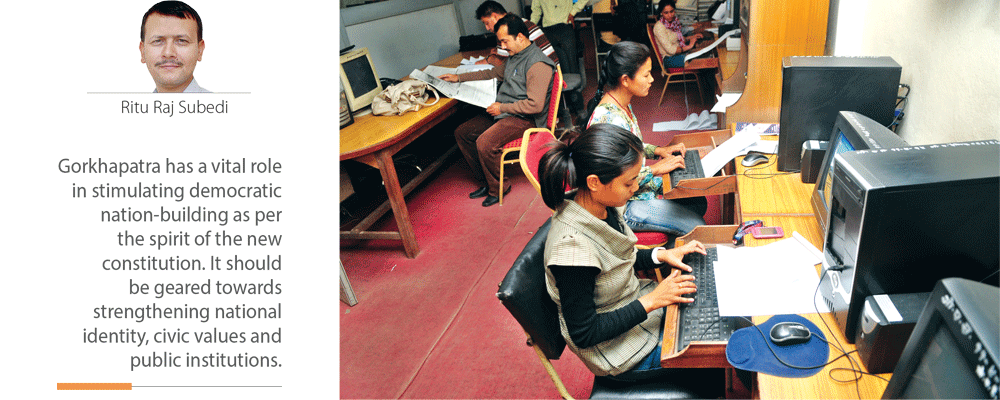

As Gorkhapatra marks its 123rd anniversary today, it is natural for us to ponder over its history as well as contribution in the evolution of Nepali journalism. Gorkhapatra was the brainchild of reformist Rana prime minister Dev Shumsher. It was born when Nepali society was in the dark ages. Nepalis were enduring the hereditary rule of the Rana oligarchy. Right to speak or open a political organisation was beyond their imagination. The people were treated as raiti (subjects), not citizens. They had hardly heard of modern concepts such as democracy, free speech and press freedom. So, the birth of Gorkhapatra was in itself a revolutionary step. It was like a firefly taking wing through the pitch-dark. It marks the germination of a new consciousness, heralding an era of hope and emancipation for Nepalis.
The country has witnessed many ups and downs since the establishment of Gorkhapatra. It was first published as a weekly on Baisakh 24, 1958 B.S. (May 6, 1901) to inform the people about the government’s activities, interesting things, places and events. However, prime minister Dev Shumsher had issued a directive not to publish the content that praised him and those in power. Dev Shumsher’s premiership was very short and his vision to develop Gorkhapatra as a robust public media was nipped in the bud after his brother Chandra Shumsher unceremoniously removed him from power.
Survival in adversity
The idea of spreading awareness of people’s rights and freedom was an anathema for autocratic and cunning rulers like Chandra Shumsher. So Gorkhapatra was not expected to flourish and expand under him. The oldest newspaper enjoyed greater autonomy only after the country saw its first glimpse of democracy in 1951. Nonetheless, it was quite surprising that Gorkhapatra survived the ouster of its founder within a short span of his rule. This amply indicates the charm and resilience of Gorkhapatra even during the feudal autocratic regime that often-abhorred press freedom and civil liberties.
Prime minister Juddha Shumsher was considered illiterate, while Padma Shumsher was timid, but they took steps for the expansion of Gorkhapatra. During their regimes, the pioneer paper became bi-weekly and tri-weekly respectively. King Mahendra converted it into a daily newspaper from February 18, 1961, on the occasion of Democracy Day.
During the time of these rulers, there was no democracy in the true sense of the word, but Gorkhapatra did exist, showing the significance of the newspaper in the lives of the general public. It gave them news about unusual events, places and people.
Any write-up on the Gorkhapatra daily will be incomplete without discussing the Sanad (decree) that prime minister Dev Shumsher issued regarding what should and should not be published in it. "It should not publish our (the Prime Minister’s) praise and plaudits," states the Sanad. It says that the paper should publish unjust decisions of courts, negligence of government employees and any reports of injustice or violence in the hills or Terai without any indictment of the reporter. That the reporter should not be charged just for publishing the news report in the spirit of press freedom enshrined in modern constitutions. The edict carries the vision of Dev Shumsher that news should be objective, balanced and impartial while adhering to professional values and ethics. It was astounding because it preceded a similar code of conduct unveiled in Western nations, where modern journalism evolved.
It is true that Gorkhapatra as the mouthpiece of the government could not speak up against the whims and atrocities of the autocratic rulers, but it served as the intellectual platform to enhance literary, linguistic, social and cultural awareness, thereby educating the people on democracy, citizens’ rights, justice and equality. For all its limitations, Gorkhapatra and its sister daily – The Rising Nepal - and the monthlies published by the Gorkhapatra Corporation have contributed to creating and strengthening the national unity and collective consciousness of Nepali society through value transmission and public opinion formation. It has been the carrier of the nation’s history, heritage, knowledge and wisdom.
Free flow of information
At a time when the media has been instrumentalised to meet the interests of businesses, political parties and foreign agencies, Gorkhapatra has become a medium for the free flow of right information and genuine public concerns. In a digital era when social media outlets influence and sway the public, Gorkhapatra stands as an impartial media capable of avoiding all pitfalls, biases and illusions. The internet-driven social sites lack social decency and democratic coherence. False information, rumours and hate speech that swirl through diverse digital platforms have posed a threat to democracy, free speech and public morality.
These anomalies can be overcome only with a robust and autonomous public media that rises above commercial interests, political indoctrination and geopolitical manoeuvres. "A number of private newspapers, filled with self-reference and projectised by external funding, lack the sanity of national wisdom and tradition and turn to postmodernism and subsidiary identity politics, a caricature of external media narrative, regardless of their contribution to the national affinity, utility and unity of the Nepali nation," writes political scientist Dev Raj Dahal. This further accentuates the importance of public media in the country struggling to achieve economic and political stability.
Gorkhapatra has a vital role in stimulating democratic nation-building as per the spirit of the new constitution. It should be geared towards strengthening national identity, civic values and public institutions. But this calls for a policy shift and structural overhaul.
The government, political parties and policy makers should attach priority to the institutional development of Gorkhapatra Corporation. The inclination to use it as an organ mouthpiece of the government and ruling parties must come to an end. Then only can it evolve into a truly vibrant and inclusive public media house.
(The author is Deputy Executive editor of this daily.)
-square-thumb.jpg)
-original-thumb.jpg)