- Tuesday, 2 June 2026

Poor hand hygiene facilities putting many at health risk

By Nayak Paudel,Kathmandu, May 6: After touring the Kathmandu Durbar Square in Basantapur on the occasion of a public holiday for Buddha Jayanti on Friday, Sabin Karki and his friends entered an eatery near the Juddha Barun Yantra, the oldest fire brigade of Kathmandu.
Before ordering food, the group of friends asked the eatery’s owner for a place to wash their hands. But to their surprise, there was no such facility there.
“Our hands were already dirty as we clicked a lot of pictures, touched different things and sat on different places when touring the Durbar Square. We searched for a place to wash our hands but could not find any. Looking at my dirty hands, I could not order food before washing it,” said Sabin.
Since the eatery neither had a tap nor enough water to allow Sabin and his friends to wash their hands, the eatery owner suggested them to visit a public toilet nearby. “I am well aware of the scarcity of water in the Kathmandu Valley, so I carry a hand sanitiser. However, washing the hands with soap and water is better when the hands are extremely dirty,” Sabin added.
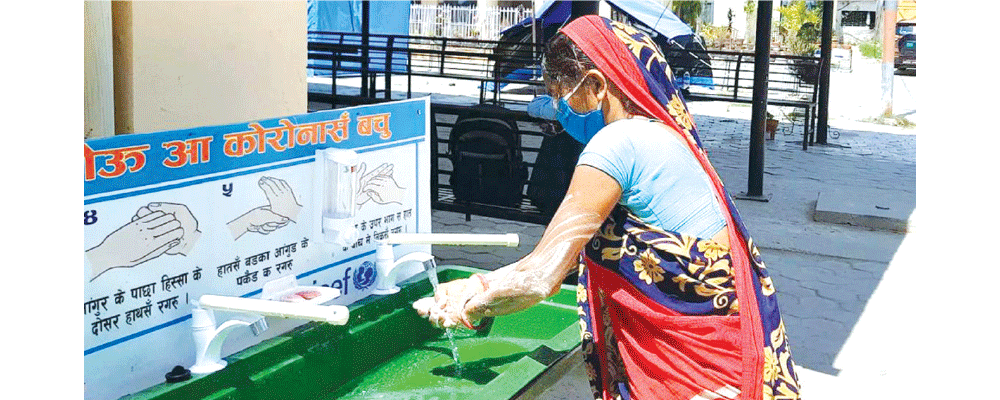
On May 5, Nepal government was together with the governments and international and national organisations across the world urging people to maintain hand hygiene to mark World Hand Hygiene Day. However, for lack of water and hand washing facilities in public spaces across the country, many Nepalis continue falling ill from infections caused by poor hygiene.
“Hands are used in everything. We work and eat with hands. While working, our hands get dirty and are filled with harmful bacteria, increasing the risk of several water-borne and food-borne diseases,” said Dr. Sher Bahadur Pun, an infectious disease expert at the Shukraraj Tropical and Infectious Disease Hospital.
Talking to The Rising Nepal, Dr. Pun informed that poor hand hygiene causes diseases such as diarrhoea, viral hepatitis and intestinal parasitic infections among others.
“Importance of washing hands is known to almost everyone. People wash their hands after using toilet; however, they do not wash hands before meal. Consuming food with dirty hands can cause different illnesses,” said Dr. Pun.
Hand washing facilities were set up in different parts of the Kathmandu Valley and outside when the COVID-19 pandemic was at its peak and when people washed their hands frequently as a preventive measure.
During the COVID-19 pandemic, WaterAid, an international organisation working in the sectors of clean water, improved sanitation and proper hygiene, reported that 52 per cent of people in Nepal had no handwashing facilities at home. “Children often play with dirt, eat food with the dirty hands due to the lack of supervision and get sick. Children need supervision, but adults ignoring the importance of hand hygiene shows the lack of awareness. People fall ill due to bad hygiene but blame the food they ate in ignorance,” said Dr. Pun.
Now, with the decrease in COVID-19 cases, health experts warn that people have stopped washing their hands.
According to the World Health Organisation (WHO), hand hygiene can save millions of lives every year when performed at the right moments during health care delivery. A national Infection Prevention Control (IPC) programme or operational plan and water, sanitation and hygiene (WASH) and environmental health standards existed in Nepal, but were not fully implemented, reported the WHO in its Global report on infection prevention and control.
The WHO also suggests that hospitals and health care facilities should raise hand hygiene awareness to move action to the point of care, and to reduce health care-associated infection (HAI).
The organisation also highlighted that people can be made aware of the importance of hand hygiene with active participation of civil society organisations.


-square-thumb.jpg)