- Tuesday, 2 June 2026

Post-quake reconstruction and lessons unlearnt
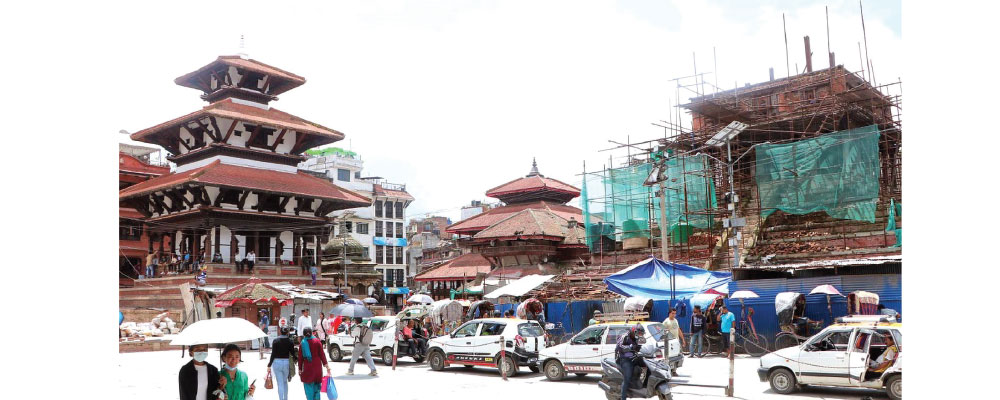

By Binu Shrestha & Aashish Mishra,Kathmandu, Apr. 23: At 11.56 am on April 25, 2015, Nepal was struck by a catastrophic 7.6-magnitude earthquake that killed nearly 9,000 people and destroyed countless homes, government offices, hospitals, schools, religious structures and monuments. Eight years on, the scars of that tragedy remain visible in the buildings that remain to be reconstructed, health and educational institutions that are propped up by scaffolding and the centuries-old structures at Kathmandu Valley’s three Durbar Squares that are still undergoing renovation.
Nevertheless, figures show that Nepal has made much progress in reconstruction over the past eight years, especially in private residences. According to the data provided by the Central Level Project Implementation Unit (Building), 733,214 of the total 832,585 beneficiaries found eligible for the government’s Rs. 300,000 private house reconstruction grants have received the full amount. “This means that our progress in the reconstruction of private homes is 88.06 per cent,” informed the Unit’s Director Kosh Nath Adhikari.
Similarly, of the 415 government buildings damaged by the quake, only a couple are yet to be reconstructed. “But we are working to finish rebuilding them within this fiscal year,” Adhikari said.
Likewise, of the 1,137 health institutions that needed to be rebuilt, 330 are under construction while 807 have been completed.
The progress on the construction, development and improvement of integrated settlements stood at 63.70 per cent at the end of the last fiscal year 2021/22, as per the 60th annual report of the Office of the Auditor General submitted to the president on April 13.
Meanwhile, as per the data provided by the Central Level Project Implementation Unit (Education), 7,581 schools needed rebuilding after the devastating tremor, out of which, 7,190 have been completely rebuilt while 391 are under construction.
The Central Level Units took over the reconstruction works from the National Reconstruction Authority after the latter’s term came to an end in December 2021.
The 2015 earthquake, which had its epicentre at Barpak, Gorkha, also damaged or destroyed 920 heritage sites and monuments across the country. Of them, the Department of Archaeology (DoA) has reported the reconstruction of 703 structures, shrines and temples.
While talking about the much-hyped Dharahara project, progress stands at around 85 per cent, according to the construction company.
Even though the then Prime Minister KP Sharma Oli inaugurated the new Dharahara at Sundhara, Kathmandu on April 24, 2021, work has not finished yet on the triple basement parking, recreational area, four-storeyed earthquake museum, rooftop garden and other components of the project. And, as called out by the Auditor General’s annual report, the pace of work is not satisfactory.
Work has also not begun on preserving the remains of the old Dharahara that came down in 2015 and restoring the golden Sundhara water spout.
Raman Construction Company had been awarded the contract to build the new Dharahara in 2018. The contract was initially for two years and work was supposed to be concluded by 2020. But the deadline has been extended multiple times.
Regarding Singha Durbar, the administrative headquarters of the Government of Nepal, Director Adhikari said that work on retrofitting the west wing was in its last stage while other parts of the historic building, including the Prime Minister’s Office, had already been rebuilt and brought into operation.
Lessons forgotten
The Barpak quake and the destruction it caused and could have caused schooled us on the need to rethink our construction practices and build earthquake-resistant structures in line with the country’s building code. Unfortunately, less than a decade later, we seem to be starting to forget those lessons, worried Dr. Gokarna Bahadur Motra, a professor at Tribhuvan University’s Institute of Engineering and an expert in earthquake-resistant design and vibration control and energy dissipation of structures.
“Our construction pattern is not what it should have been,” he said, adding that we appeared to be reverting to our pre-earthquake building habits.
However, this is more out of compulsion than choice, said Shiva Bhakta Karki. Karki built a house in Shankhamul, Kathmandu two years ago but is unsure whether it will withstand an earthquake as strong as the one in 2015. “We would like to build safe homes but it is expensive,” he said. “Also, we face a lack of space in Kathmandu.”
This lack of space, most apparent in the core settlements of the valley, pushes people to build up, said building contractor Lalit Thapa. “A family needs five to six rooms, plus a kitchen and two bathrooms, to live. And when your land only allows you to build one room in one storey, you have to build six or seven storeys,” he said.
The local levels could monitor and prevent unsafe constructions but oftentimes, they lack the resources and manpower, Professor Dr. Motra noted. “Rural municipalities, in particular, do not have the required number of sufficiently trained personnel to enforce the building code,” he believed.
Heritage reconstruction without preservation
Bhim Prasad Nepal, heritage conservationist and former chief of the National Archives of Nepal, said that the work being done to renovate and reconstruct the country’s monuments was not up to scratch.
“They are not consistent with the general principles of conservation,” he remarked. “The focus seems to be on re-erecting the toppled structures as quickly as possible without proper study and examination.”
Nepal felt that the Kasthamandap was the only historical building in Kathmandu that was properly rebuilt. Similarly, he found Bhaktapur’s reconstruction efforts comparatively better than other areas.
While cultural monuments and heritages in other parts of the country are being handled by contractors selected for their lowest bid or are being reconstructed through foreign aid, Bhaktapur Municipality worked with local support and through consumer committees.
“Locals volunteered time and labour which bred a sense of ownership and helped them develop fondness towards their heritage,” he said.
-square-thumb.jpg)